Wondershare Filmora AI video editor (2026) review
A feature-packed AI video editor with advanced editing capabilities and excellent value for money.

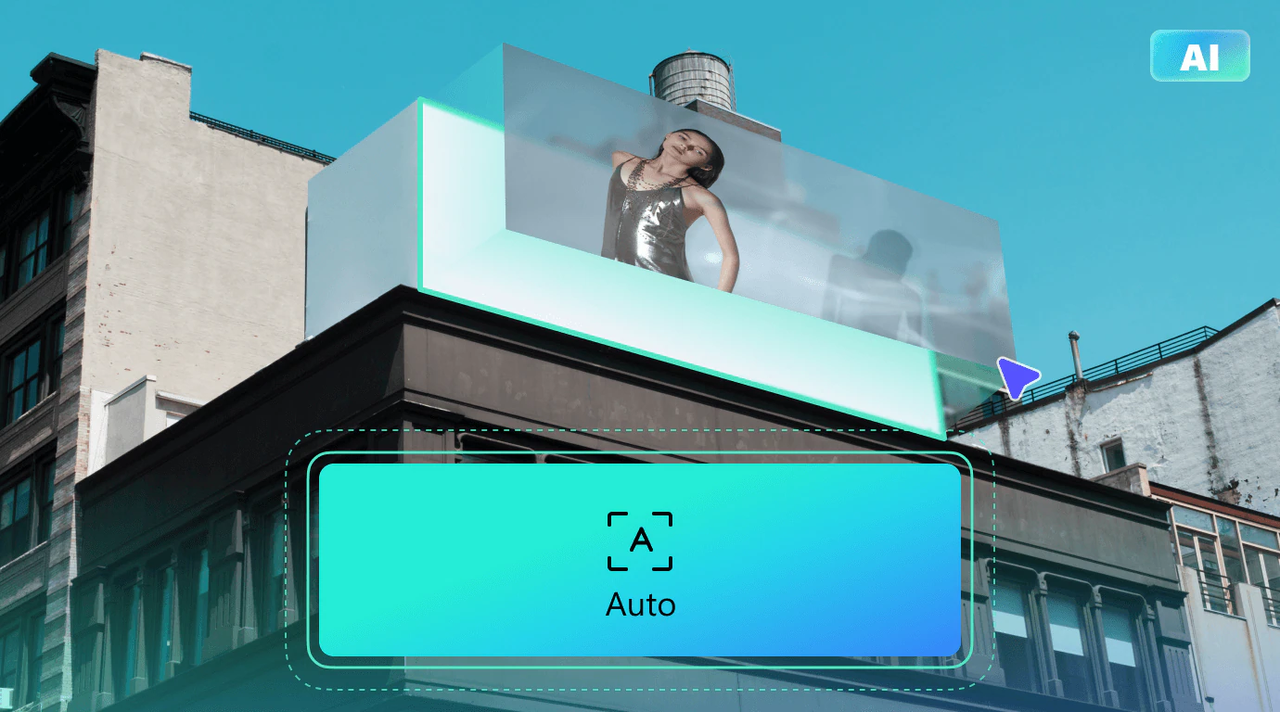
Filmora is one of the most well-known video editing software in the industry. The company has also done well to embrace AI, adding a whole new range of advanced AI functions that have only made the platform better and more capable over time.
In this review, we've put Filmora to the test, trying out its top features hands-on to see if they live up to expectations. We also dive deeper into its other offerings, value for money, and in-use experience, as well as compare it to the best AI video editors to help you find out if it's the right choice for you.
Filmora: Plans and pricing
Much like other AI editing and content generation tools, Filmora also offers a free-forever plan, allowing you to edit videos along with access to a limited amount of creative assets such as effects, filters, transitions, music, and sound effects.
However, unlike Kapwing, Adobe Firefly, or Fliki, Filmora's free plan does not include any AI credits. This means you won't be able to generate AI videos or images for free with Filmora, which is a bit of a letdown considering the competitive landscape.
Filmora's paid plans start at $4.17 per month. The Basic plan is not much different from the free plan, except that you get 500 uses of its proprietary AI Mate, along with 1GB of cloud storage. Besides this, everything else remains pretty similar to the free plan.
You also have the option to add the Filmora Creative Assets add-on to the Basic plan for $19.99 per month. However, you do get a 14-day trial of the Creative Assets package.
There's also an option to purchase the Basic plan with a one-time perpetual license for $79.99. However, you will not receive future updates and will need to pay an additional upgrade fee to access newer versions.
You can check out Filmora by clicking here.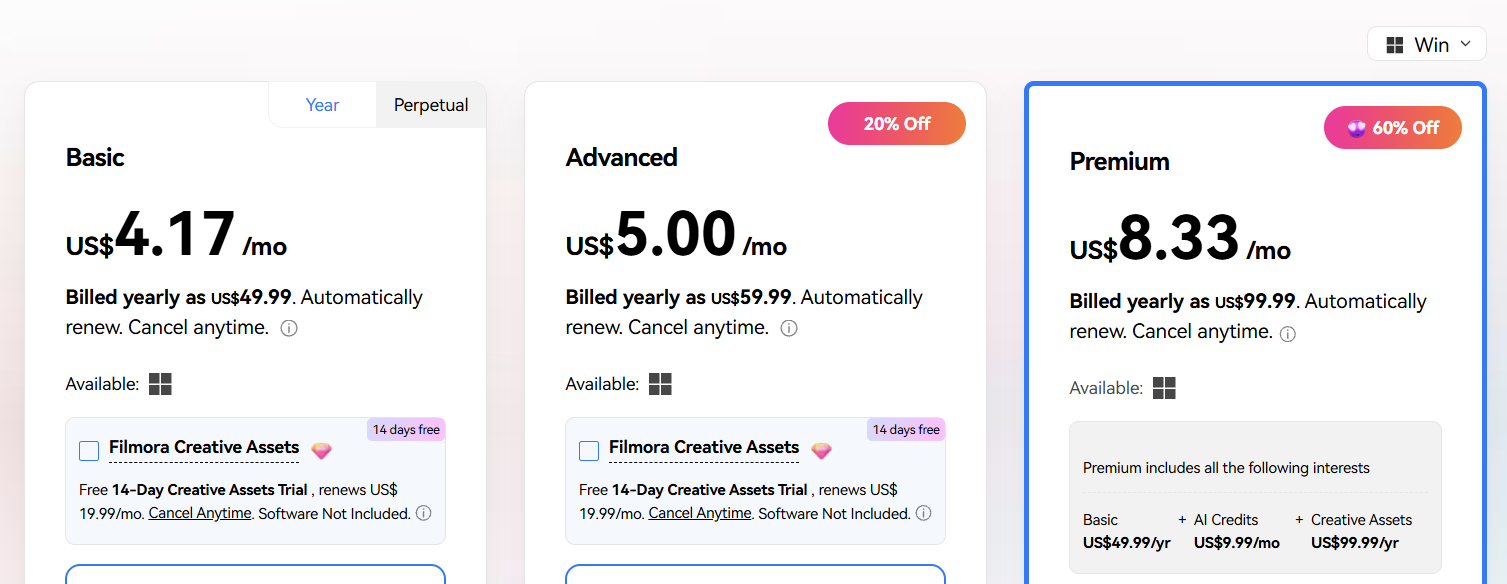
Next up is the Advanced plan at $5 per month, which comes with 1,000 AI credits. This is the first plan where you can create AI videos and short clips, and use AI tools like Text to Object, Text to Speech, AI Music, AI Images, AI Copywriting, and more. You also get 10GB of cloud storage, along with limited access to Creative Assets.
Compared to the likes of Veed, which costs $12 per user per month, or Kapwing, which costs $16 per user per month, Filmora's Advanced plan is one of the most affordable options available for AI content generation. Just like the Basic plan, you can also add the Filmora Creative Assets pack for $19.99 per month.
However, the Premium plan, which costs $8.33 per month, already includes the Creative Assets package and is, in our opinion, one of the best value-for-money plans you can get. You receive 2,000 AI credits per month, along with 100GB of cloud storage. The Creative Assets package also includes over 12,000 effects and filters, more than 7,000 transitions, and access to 1.5 million stock media assets.
Also, all the prices mentioned above are for the Windows version, with Mac pricing being slightly higher. For instance, the Basic plan on Mac costs $5.83 per month, with a perpetual license priced at $99.99, whereas the Advanced plan costs $6.67 per month and the Premium plan costs $10 per month.
Even though they are a tad pricier than the Windows version, they're still pretty affordable compared to other similar video editing and AI generation tools.
Filmora: Features
The best thing about Filmora is that it keeps adding new features. With the release of version 15, the platform has added a new repertoire of both AI and video editing features. For instance, there's the new AI Video Extender, which helps you expand your footage forward or backward with the help of a prompt.
This may come in handy when your footage is too short and you need a bit more footage for smooth intros and outros. Using it is also pretty simple. You just need to drag its Smart Pen onto the editing dashboard and add a prompt describing how the video should continue.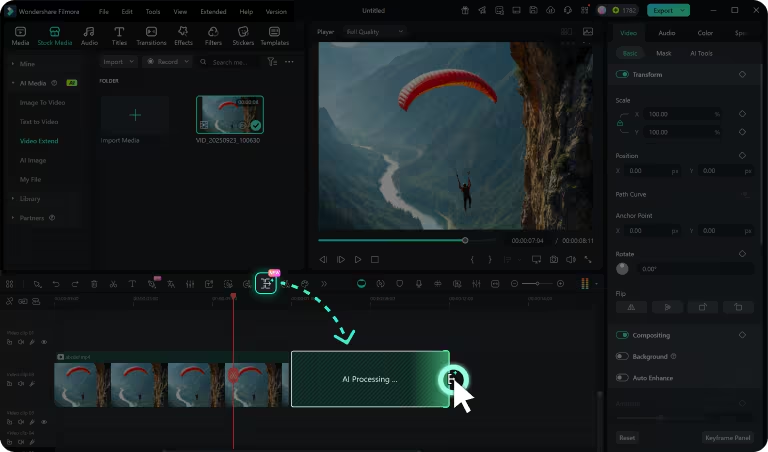
In the same vein, Filmora has also introduced Prompt Video Editing, which allows you to add, replace, or remove objects in your videos using simple text prompts instead of having to do it manually on the editing dashboard.
Another impressive new feature is Animated Charts, which lets you import CSV or Excel files and generate chart and graph animations to build dynamic line, area, and pie charts. This comes in handy for commercial teams that want to prepare engaging presentations with animated visualizations.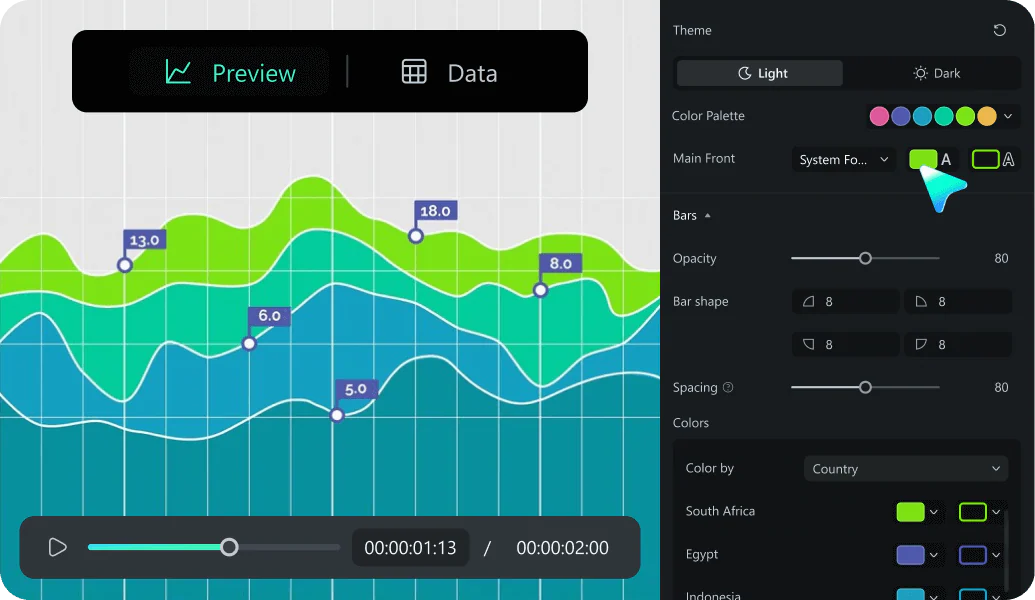
The platform has also recently introduced advanced pixel tracking and motion compensation algorithms for its built-in video stabilization. This helps repair shaky video footage, making it more stable.
Similarly, there's also a Lens Correction option, which helps you remove optical distortions caused by camera lenses. This includes barrel or fisheye distortion, pincushion distortion, vignetting, and perspective or keystone distortion.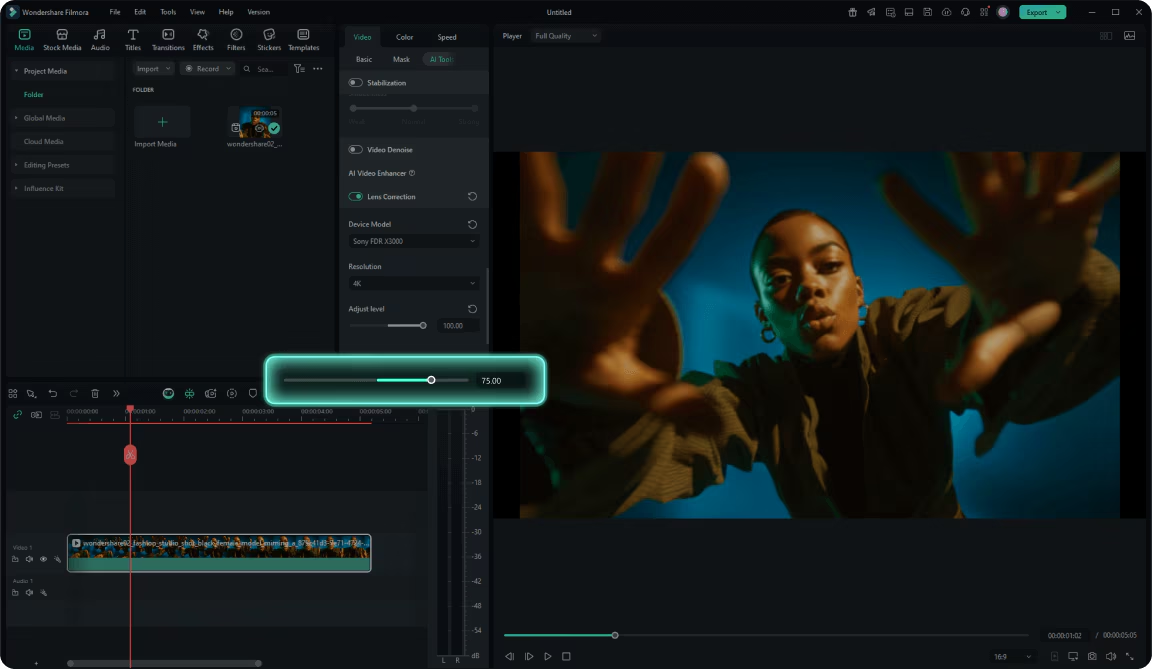
This comes in handy while editing wide-angle or action camera footage, where the fisheye bulge is distracting, or architecture and interior shots, where you want walls and buildings to look straight instead of curved.
Furthermore, Filmora now has advanced planar tracking, which can follow an entire flat surface across a moving video and lets you add images, videos, text, logos, mosaics, or anything else you want to that flat surface, much like inserting an image into a video. For instance, you can attach a logo to a moving truck, billboard, or storefront sign.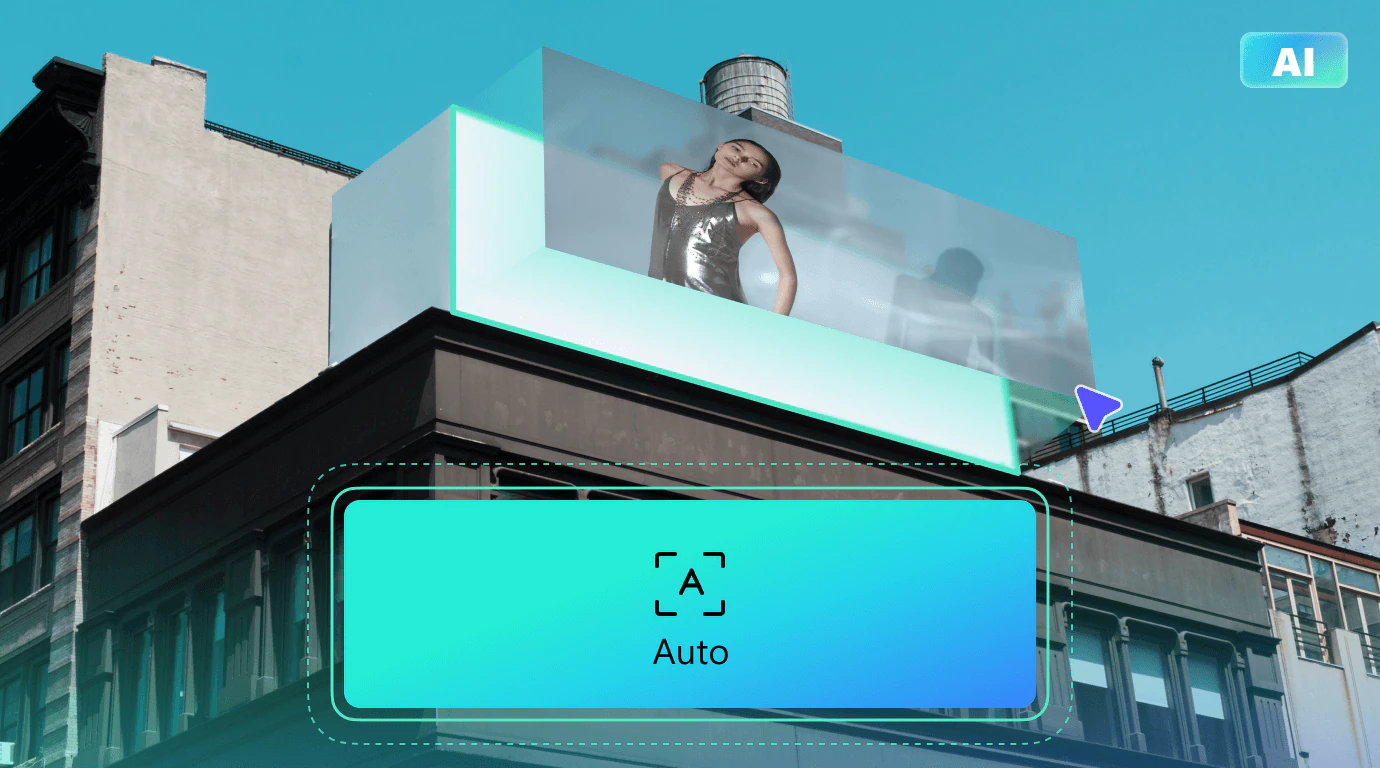
Filmora also has one of the largest libraries of creative assets we have seen across similar applications. Although it's a paid add-on, the Creative Assets package unlocks a large pool of premium effects and media.
This includes stock media and original video effects, over 100,000 royalty-free audio tracks, professionally designed title templates, a wide range of basic and professional transitions, aesthetic and cinematic effects and filters, stickers, more than 10,000 ready-made templates, and over 500 AI-powered effects.
Here are some other features you get with Filmora:
- AI text-to-video, audio-to-video, and image-to-video.
- AI Storyboard Generator, allowing you to generate ready-to-use storyboards with editable characters, scenes, and styles.
- An all-new Pen Tool, which lets you draw custom vector paths and shapes directly onto the video frame.
- AI Color Palette for cinematic color editing.
- Text animation with immersive and dynamic effects.
- An automated AI-powered subtitle generator, along with more than 100 animated subtitle templates.
- AI voice cloning in 16 languages.
Filmora: Interface and in use
The Filmora dashboard can seem a bit overwhelming at first, especially if you are a beginner. The editing panel is divided into three panes: one for adding edits and elements such as audio, titles, transitions, and effects; one for viewing your image or video as you edit it; and a horizontal editing bar at the bottom, which lets you drag and drop various editing elements into your project.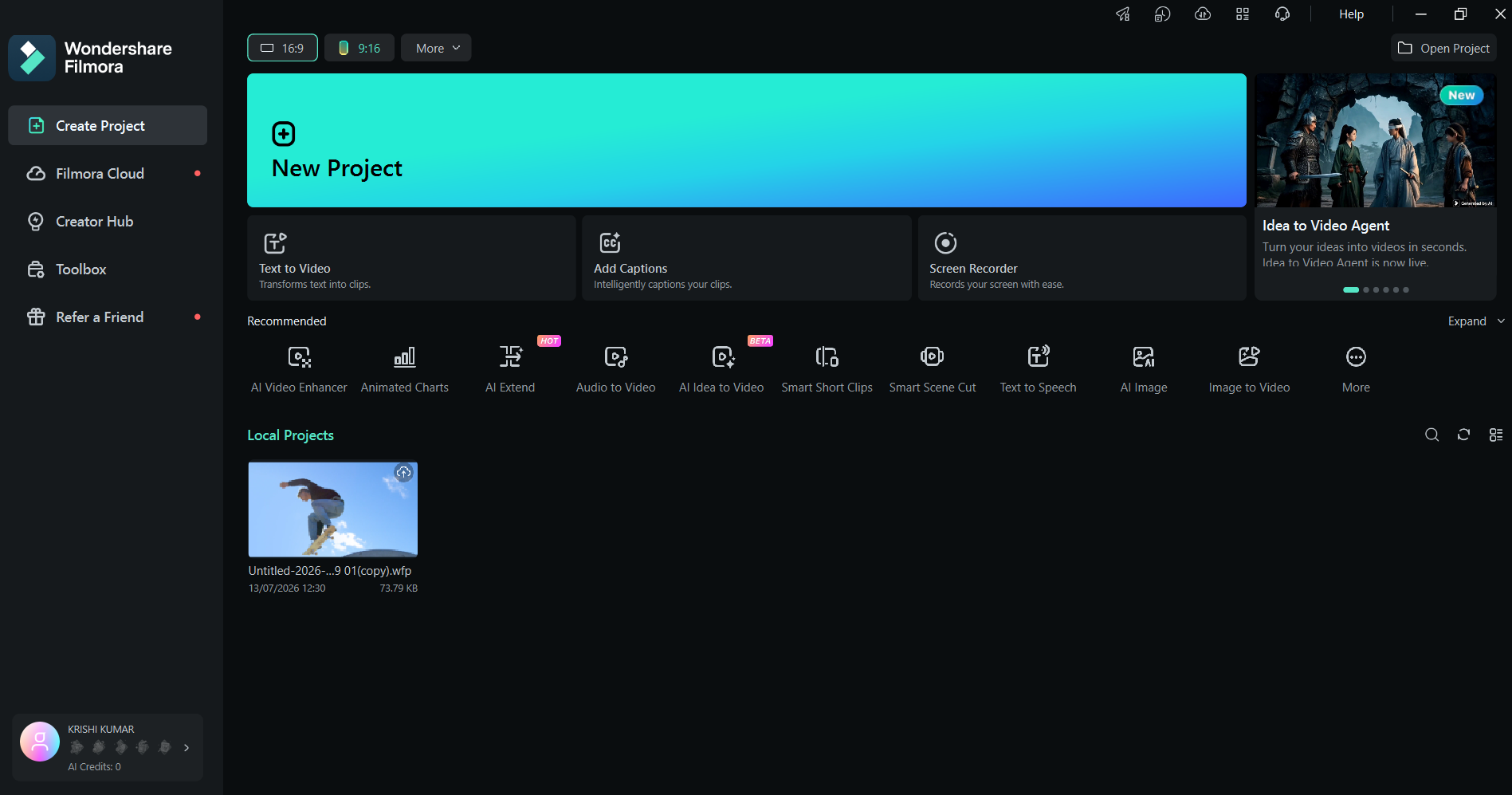
At the top of your dashboard, you'll see various options such as Media, Filters, Transitions, Effects, and Templates. Simply click on any of them to open all the available options and drag and drop the ones you want onto the horizontal bar at the bottom.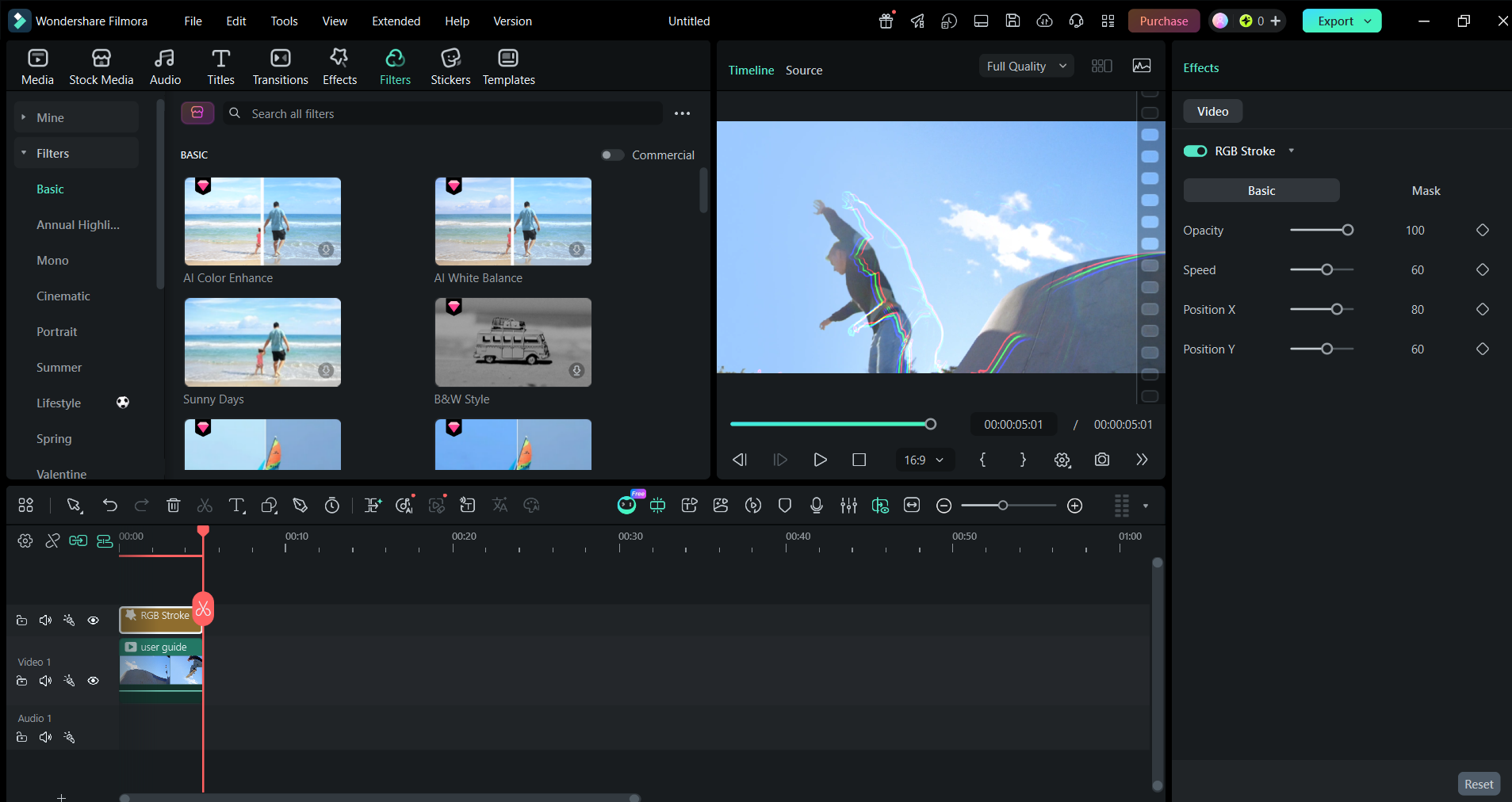
Once you click on the panel where your video is being previewed, a host of other options opens on the right-hand toolbar, where you can adjust various video settings such as width, height, rotation, and flip.
As you scroll down, you'll find various AI functions such as motion tracking, planar tracking, motion blur, and stabilization. What we liked most is that you simply have to toggle the buttons to activate the features and drag elements onto your video to apply the edits. There are no complex steps involved.
In addition to video, you'll also find other advanced editing options such as speed, animation, color grading, and AI palettes on the same right-hand panel.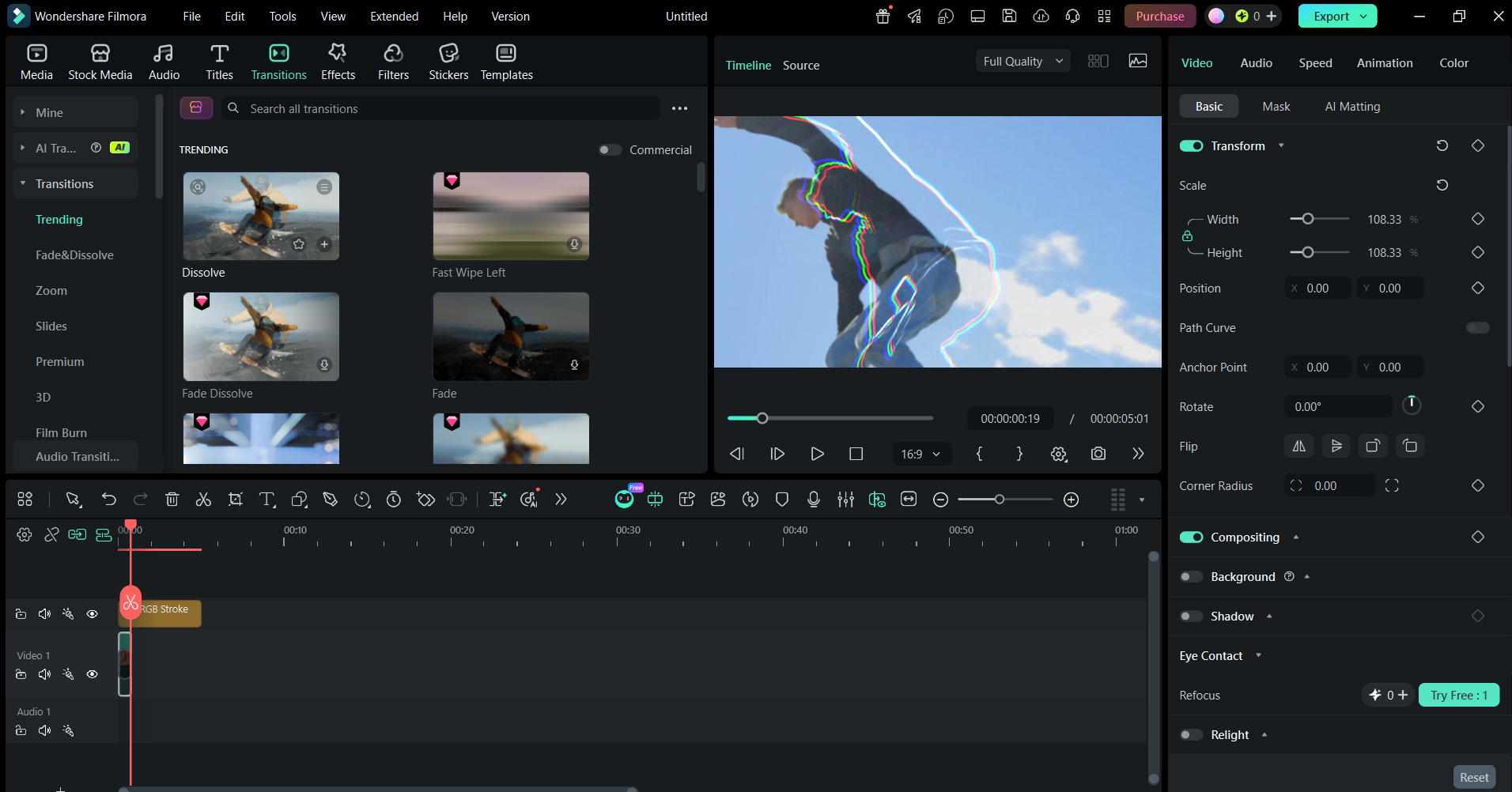
To be fair, it can take a bit of time for new users to get the hang of the platform. That said, Filmora is one of the most rewarding platforms once you get past that learning curve thanks to the sheer number of editing options available.
Filmora: How we tested
Since Filmora doesn't allow you to create AI content on its free plan, we couldn't test the platform's AI capabilities. However, we did put Filmora's editing functions through a thorough test.
We first downloaded the application on our Windows 11 PC, which took around a minute or two. Once set up, we imported stock media to edit. We clicked on Effects and added an RGB Stroke effect to our video of a man skateboarding. Filmora was able to identify and track the person in the video and apply the RGB Stroke effect pretty accurately.
Adding the effect was also pretty easy. We only had to select and drag the effect onto the horizontal bar. We then added a dissolving transition to the beginning of our video. Again, a simple drag-and-drop did the trick.
We then played around with various video and audio editing settings, and all of them were applied to our video almost instantaneously. There was no lag or buffering while editing even the most complex or longest videos.
Filmora: Alternatives
Filmora focuses heavily on video editing features, offering several advanced options for professional editors. But there are a few alternatives you can consider.
If you're looking for free AI video and image generation, you can consider tools like Kapwing or Fliki. Both allow you to create AI videos and images for free.
Kapwing does a good job when it comes to generating AI characters, from simple everyday characters like a baby or a cheerleader to fantasy characters like a dragon or a cyborg. There are plenty of options.
Fliki, meanwhile, gives you many pre-video generation options to choose from. For instance, you can customize your video format, template, AI avatar, voiceover, and captions before generating a video, which saves a lot of editing work afterward.
However, Kapwing's highest-tier plan can be pretty expensive, costing $50 per user per month, whereas Fliki can go up to $44 per month. Even Filmora's most advanced plan costs only $8.33 per month, making it far more affordable. Plus, both platforms lack advanced editing options such as planar tracking and video stabilization.
Filmora: Final verdict
Filmora is one of the most feature-packed AI content generation and editing tools on the market. Apart from basic features like image-to-video, script-to-video, and audio generation, you get advanced editing options such as planar tracking, storyboard generators, video stabilization, AI video and audio extenders, dual-monitor editing, animated charts, and lens correction.
Additionally, Filmora houses one of the most extensive libraries of stock assets, including licensed music, effects, transitions, stickers, and more than 10,000 templates.
That said, its interface is not among the simplest we have seen and requires a bit of a learning curve. Also, its free plan does not allow you to create any AI content, which was a bit of a disappointment. If this is a deal-breaker for you, you can consider other options like Adobe Firefly or Kapwing.
We've tested a range of video makers and editors, including the best video editing software, the best video editing apps and the best free video editing software.
Share
What's Your Reaction?
 Like
0
Like
0
 Dislike
0
Dislike
0
 Love
0
Love
0
 Funny
0
Funny
0
 Angry
0
Angry
0
 Sad
0
Sad
0
 Wow
0
Wow
0