Microsoft 2.5: A new series on the people shaping the company’s future
Mary Jo Foley is launching a GeekWire series profiling the people and priorities behind Microsoft's evolution. It's a look at what she calls the "Microsoft 2.5" era, where cloud and AI dominate but the company still can't walk away from Windows, Office, and enterprise customers whose products weren't built around AI. Read More

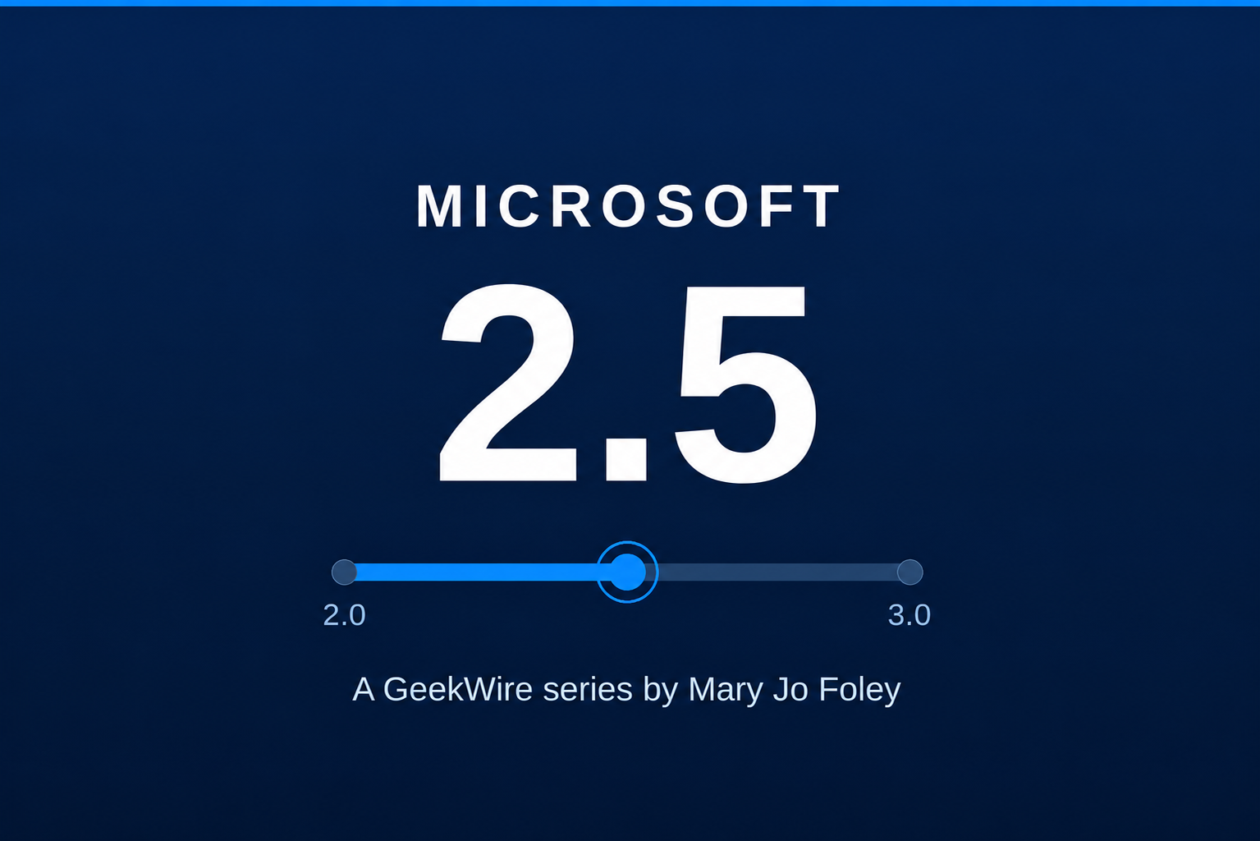
Nearly 20 years ago (!), in 2007, I published my first and only book: Microsoft 2.0. It focused on changes I expected at the company in the “Post-Gates” era. What would remain the same and what likely would be different once co-founder and CEO Bill Gates had left the building?
CEO Satya Nadella has not exited the company (yet). But there’s no question that Microsoft and its mission have morphed considerably in the past year or two. I’m not quite ready to christen this the Microsoft 3.0 era, even though Nadella handed the reins of Microsoft’s dominant commercial business to Judson Althoff nearly a year ago.
That decision resulted in Nadella moving into more of a “founder mode” role, allowing him to focus less on the day-to-day work of running the business. (Microsoft historians may recall that Gates made a somewhat similar move back in 2000 when he became Microsoft’s chief software architect.)
While it might not yet be time for Microsoft 3.0, we arguably could be in the “Microsoft 2.5” era. Windows and Office are still around and still play a big role. Microsoft still builds and sells developer tools and databases. But there’s no question that the cloud and all things AI are at the top of the pecking order now.
I’m embarking on a series here at GeekWire that will focus on what matters to Microsoft and, by extension, to its customers, partners, investors, and employees these days. Who are some of the people shaping and leading the company? What are their opportunities and challenges right now?
Over the next few weeks, I will be profiling various Microsoft execs working on plans for Microsoft’s ongoing evolution. Some are company veterans; some are newcomers. I’ll be talking with top execs from Microsoft’s Security, Copilot, Windows + Devices, Xbox, GitHub, and more.
I’m interested in their strategies for Microsoft’s key products and technologies and how they plan to try to turn Microsoft’s ambitious vision into reality. What are their teams building? What do they see as their biggest challenges and opportunities? And where do they see the technologies in their respective areas heading?
I feel like many of us who’ve been keeping track of the biggest tech companies (myself included) have fallen into the trap of blaming or attributing everything a company does to AI. Layoffs? AI is the culprit. Price increases? It’s all thanks to AI. Changing sales strategies? Chalk it up to AI …
But upon further reflection, I believe Microsoft’s strategy is more nuanced than “AI or bust.” There’s no question that Microsoft’s AI ambitions are shaping its goals and tactics. But Microsoft, as a heavily enterprise-focused entity, can’t simply stop supporting products that aren’t built from the ground up with AI (as much as it might like to do so). Nor can it just leave behind customers who aren’t 100% onboard with its AI moves.
Couple those enterprise hurdles with some not-so-popular consumer decisions, like axing 3,200 people in the gaming unit, and Microsoft’s approach to turning the ship looks a lot trickier.
Our Microsoft 2.5 series kicks off Thursday. Stay tuned.
Share
What's Your Reaction?
 Like
0
Like
0
 Dislike
0
Dislike
0
 Love
0
Love
0
 Funny
0
Funny
0
 Angry
0
Angry
0
 Sad
0
Sad
0
 Wow
0
Wow
0