Context Engineering for AI Coding Assistants: The Missing Discipline Behind High-Volume Search Interest
Your engineers are copy-pasting fragments of code, half a Slack thread, and a rushed one-line prompt into Copilot, Cursor, or Claude Code, and expecting production-grade...Read More The post Context Engineering for AI Coding Assistants: The Missing Discipline Behind High-Volume Search Interest appeared first on ISHIR | Custom AI Software Development Dallas Fort-Worth Texas.


Your engineers are copy-pasting fragments of code, half a Slack thread, and a rushed one-line prompt into Copilot, Cursor, or Claude Code, and expecting production-grade output. Then they are surprised when the same assistant that wrote clean code on Monday writes something inconsistent, off-convention, or flat wrong on Friday.
This is not a model problem. It is a context problem.
“Context engineering” now pulls close to 2,900 searches a month, and the interest is not academic curiosity. It is thousands of engineering leaders and senior developers searching for an answer to a very specific, very expensive pain point: why does the same AI coding assistant produce brilliant output in one session and unusable garbage in the next, using the same model, the same team, the same codebase.
The answer is that most teams are still treating context as something you type into a chat box. It is not. Context is infrastructure. It has to be engineered, versioned, retrieved, and maintained with the same discipline you apply to your CI/CD pipeline. Teams that treat it as a one-off prompting trick get one-off results. Teams that treat it as an engineering discipline get compounding returns.
This piece breaks down what context engineering actually means at the technical level, why copy-paste context is structurally incapable of scaling, and what a real ContextOps stack looks like for engineering organizations that are serious about AI-assisted development.
Fragmented Context Is an Engineering Failure, Not a Prompting Failure
By end of 2026, AI-generated code accounts for roughly 41% of all code being written globally across tools like GitHub Copilot, Cursor, and Claude Code. AI coding assistant adoption has reached high levels among developers in 2026, with 41% of global code now AI-generated across tools like GitHub Copilot, Cursor, and Claude Code. Adoption is not the issue. Trust is.
Despite that adoption, 96% of developers do not fully trust AI-generated code, and only 48% always check it before committing. That gap between “we use this constantly” and “we don’t trust what it gives us” is the entire problem in two numbers. Developers are not rejecting the tools. They are compensating, manually, for a discipline the tools were never given.
Zoom out further and the trust erosion is trending the wrong direction. As of 2026, 84% of developers use or plan to use AI coding tools, yet only 29% trust the output, a drop from 40% just two years earlier. Adoption is climbing. Confidence is falling. That is not a maturity curve. That is a warning sign that most teams are scaling a workflow they have not actually engineered.
Repeated explanation
Developers repeatedly explain repository conventions, test commands, architecture patterns, and business rules across sessions.
Inconsistent implementation
Two developers may give the same coding assistant different context, producing incompatible solutions to similar problems.
Hidden knowledge dependency
The output quality depends on whether the individual developer remembers which constraints need to be mentioned.
Context loss
Important details can disappear when a conversation becomes long, is summarized, reaches its context limit, or moves into a new session.
Review overload
Pull requests may contain code that is syntactically correct but architecturally inconsistent, forcing senior engineers to identify problems the AI assistant should have known about earlier.
False confidence
Because the generated code looks polished, developers may underestimate how much the model inferred rather than verified.
The underlying issue is not necessarily the model. It is the absence of a disciplined context architecture.
Why Context Engineering Is Replacing Prompt Tricks
Prompt engineering focuses primarily on the wording of an instruction.
For example:
Refactor this authentication service using clean architecture and follow security best practices.
The prompt appears reasonable, but it leaves critical questions unanswered:
- Which clean architecture pattern does the repository already use?
- Where are authentication interfaces defined?
- What identity provider is approved?
- Which security controls are mandatory?
- Can the public API contract change?
- Which error format must be preserved?
- What tests must pass?
- Is backward compatibility required?
- Which modules are allowed to depend on the authentication service?
- Are there known production incidents related to this code?
Without these answers, the assistant has to infer the implementation environment.
Prompt wording cannot compensate for missing system knowledge.
A better prompt may improve the presentation of the answer. Better context improves the probability that the implementation is technically correct.
This is the key difference:
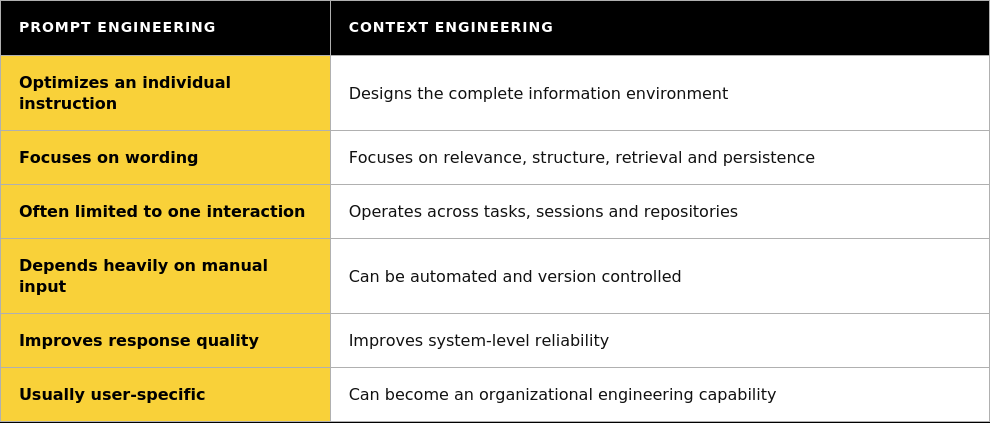
Prompt engineering asks, “How should we ask?”
Context engineering asks, “What must the model know before it acts?”
Why Copy-Paste Context Structurally Cannot Work
When a developer manually pastes a snippet of code, a partial requirements doc, and a two-sentence instruction into a chat window, three things go wrong at once, and all three are architectural, not behavioral.
First, it is inconsistent by construction. Every developer decides, in the moment, what counts as relevant context. One person includes the error handling convention. Another does not think to. The AI assistant has no persistent, shared understanding of your team’s standards, so every session starts from a different baseline. This is precisely why organizations report the review burden rising instead of falling as AI usage scales.
Second, it collides with a real architectural limit in how language models process long input. Research from Stanford and the University of Washington, replicated across six major model families including GPT-4 and Claude, found that LLM performance on multi-document question answering and retrieval follows a U-shaped curve, with accuracy highest when relevant information sits at the beginning or end of the input and degrading by more than 30% when that information is positioned in the middle. This is known in the research community as the “lost in the middle” problem, and the architectural root cause has been traced to how positional encoding decays attention weight over distance, an effect that softmax normalization then amplifies. The effect has been confirmed across additional architectures beyond the original six models tested.
What that means in practice: dumping a massive, unstructured wall of context at an AI coding assistant does not make it smarter. It makes the most important instruction, wherever it happens to land in that wall of text, statistically more likely to be ignored. A larger context window does not fix this. It just gives you more room to bury the instruction that mattered.
Third, copy-paste context has no memory. Every session is a cold start. The assistant does not know what convention you corrected it on yesterday, what architectural decision your team made last sprint, or which pattern was explicitly banned after a production incident. Without a persistent context layer, your team pays the same correction cost, in every session, indefinitely.
The Three Pillars of Real Context Engineering
1. Context Window Management
Every AI coding assistant has a finite context window, and how you fill it matters more than how big it is. Effective context window management means being deliberate about ordering: place your highest-priority instructions, your non-negotiable conventions, and your critical constraints at the start or end of the context, where the lost-in-the-middle research shows retrieval accuracy is highest. Mid-context space should be reserved for supporting material the model can afford to weight less heavily.
It also means pruning aggressively. Feeding an assistant your entire codebase history “just in case” does not improve output. It dilutes attention across irrelevant tokens and increases the odds that the instruction you actually care about gets lost in the noise.
2. Retrieval
Static context files solve part of the problem, but they cannot capture everything relevant to every task. A retrieval layer, typically built on top of your existing documentation, architecture decision records, and codebase, pulls in the specific, relevant context for the task at hand rather than relying on a developer to remember and manually attach it.
Chunking strategy matters here more than most teams realize. Retrieval systems that pull document fragments in ranges of roughly 100 to 600 tokens tend to balance context sufficiency against retrieval precision. Chunks too large reintroduce the lost-in-the-middle problem inside the retrieved content itself. Chunks too small strip away the surrounding context that made the fragment meaningful in the first place.
3. Memory
This is the layer most copy-paste workflows lack entirely. Persistent memory means the correction your senior engineer made to the AI’s output last Tuesday is captured, stored, and automatically applied the next time a similar task comes up, across the whole team, not just in that one developer’s chat history.
Without this layer, you are not using an AI coding assistant. You are re-training an amnesiac every single morning.
What Should Go Into an AI Coding Instruction File?
A repository instruction file should contain stable, high-value information that the assistant needs frequently.
A strong structure may look like this:
# Repository Purpose
This repository contains the customer billing platform.
# Architecture
– Domain logic lives in `src/domain/`.
– External integrations live in `src/integrations/`.
– API handlers must not access the database directly.
– Domain packages cannot import infrastructure packages.
# Build and Test
– Install dependencies with `pnpm install`.
– Run unit tests with `pnpm test`.
– Run billing integration tests with `pnpm test:billing`.
– Run linting with `pnpm lint`.
# Coding Standards
– Use existing domain error classes.
– Do not throw raw strings.
– Do not add a dependency without approval.
– Preserve public API compatibility.
# Security
– Never log payment tokens.
– Validate webhook signatures before parsing payloads.
– Use the approved secrets provider.
– Do not place credentials in local configuration files.
# Workflow
– Inspect relevant tests before modifying implementation.
– Explain any database schema change.
– Run affected tests before declaring completion.
What should not go into the file:
- Entire architecture documents
- Full API schemas
- Long incident reports
- Temporary task notes
- Large code examples
- Raw logs
- Personal preferences
- Rules for unrelated modules
- Repeated or contradictory instructions
The instruction file should point to detailed sources rather than duplicating all their content.
A Practical Context Budget for AI Coding
Teams should treat context tokens as a limited engineering resource.
A simple context budget can be divided into the following categories:
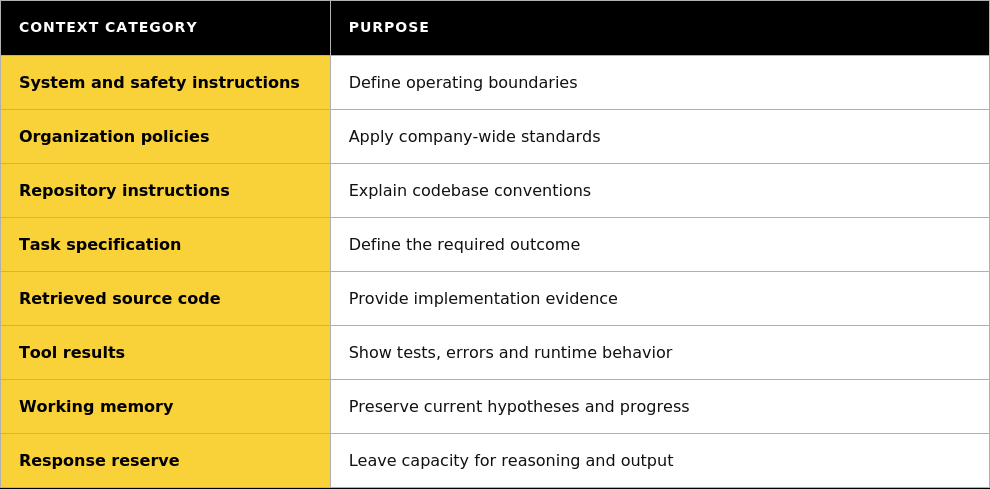
The exact percentages will vary by model and task. The important point is that every category competes for finite attention.
Teams should monitor:
- Tokens loaded at session start
- Tokens added by repository rules
- Tokens added by retrieved files
- Tokens consumed by command output
- Frequency of context compaction
- Number of repeated corrections
- Instruction conflicts
- Retrieval precision
- Cost per successful change
Without this visibility, teams may optimize for model size while ignoring context waste.
A Disciplined AI Coding Workflow
Context engineering should be embedded into the development workflow.
Step 1: Define the Task Boundary
Before generating code, specify:
- Desired outcome
- Business reason
- Files or services in scope
- Explicit non-goals
- Compatibility requirements
- Security constraints
- Expected tests
- Definition of done
Large tasks should be decomposed into smaller units.
“Modernize authentication” is too broad.
“Replace the legacy password hash verifier while preserving the login API contract and migration behavior” is actionable.
Step 2: Load Stable Instructions
Load only the organization, repository, and path-specific instructions relevant to the task.
Verify that:
- Instructions are current.
- There are no contradictions.
- The assistant can identify which rules are authoritative.
- Behavioral guidance is not being confused with enforced policy.
Step 3: Retrieve Evidence Before Planning
The assistant should inspect:
- Current implementation
- Interfaces and types
- Call sites
- Tests
- Configuration
- Related documentation
- Recent changes
- Known incidents, where relevant
The assistant should state what it knows and what remains uncertain.
Step 4: Produce a Change Plan
Before editing, require a concise plan containing:
- Files to change
- Expected behavior
- Risks
- Compatibility impact
- Tests to add or update
- Open questions
This creates an early review point before code volume increases.
Step 5: Execute in Bounded Increments
Make one coherent change at a time.
After each increment:
- Compile or type-check
- Run focused tests
- Inspect errors
- Update working memory
- Reassess the plan
Avoid asking one agent to plan, implement, debug, refactor, document, and deploy a large feature in a single uninterrupted session.
Step 6: Refresh Context After Failures
When a test fails, do not immediately ask the model to “fix it.”
First determine what new evidence is needed:
- Test source
- Stack trace
- Related implementation
- Runtime configuration
- Recent change
- Dependency behavior
Then retrieve that evidence and update the task state.
Repeatedly prompting an assistant to fix its own output without improving context creates correction loops.
Step 7: Validate Against Requirements
Validation should cover:
- Acceptance criteria
- Public API compatibility
- Architecture boundaries
- Security requirements
- Error handling
- Performance implications
- Unit tests
- Integration tests
- Regression risk
- Operational observability
Passing generated tests is not enough if the tests were based on the same incorrect assumptions as the implementation.
Step 8: Capture Durable Learning
After completion, determine whether the session uncovered knowledge worth preserving.
Examples:
- A missing build command
- A recurring debugging issue
- An undocumented architectural boundary
- A coding rule repeatedly violated
- A hidden deployment dependency
Store durable knowledge in the appropriate context layer.
Do not save every conversation detail.
Why Context Engineering Matters to CTOs
Context engineering is not merely a developer productivity technique.
It affects:
- Software quality
- Delivery predictability
- Security
- Technical debt
- Onboarding
- Knowledge retention
- Architecture consistency
- Regulatory compliance
- Engineering cost
- AI return on investment
Without context discipline, AI coding assistants amplify local developer behavior. Strong developers may get faster. Inexperienced developers may generate larger amounts of code they cannot fully evaluate. Different teams may encode conflicting patterns. Senior engineers may inherit more review work.
With context discipline, organizational knowledge becomes reusable.
Architecture decisions no longer live only in the heads of senior engineers. Coding standards do not need to be retyped into every conversation. Known failure modes can be surfaced before implementation. Security rules can be routed to sensitive code paths. Retrieval can expose existing patterns instead of letting the model invent new ones.
That is how AI coding moves from individual acceleration to enterprise capability.
How ISHIR Helps Build Context-Aware AI Software Development Workflows
ISHIR helps engineering organizations move beyond ad hoc AI coding adoption by designing controlled, context-aware development workflows.
We assess how developers currently use tools such as GitHub Copilot, Cursor, Claude Code, Codex, and internal coding agents. We identify repeated corrections, missing repository knowledge, weak task specifications, retrieval gaps, security risks, and review bottlenecks.
We then help design the context architecture around the coding workflow. This can include repository instruction standards, architecture knowledge structures, path-specific rule systems, retrieval pipelines, coding-agent permissions, test automation, context observability, and memory governance.
The objective is not to generate the most code. It is to reduce the distance between generated code and production-ready software.
For CTOs, that means faster delivery without sacrificing architecture, security, maintainability, or engineering control.
Is Your AI Coding Assistant Generating More Code but Creating More Review and Rework?
ISHIR helps engineering teams design context-aware AI coding workflows that improve code quality, architecture consistency, security, and production readiness.
FAQs
Q. What is context engineering in AI coding?
Context engineering is the systematic practice of designing, structuring, storing, and delivering the right information to an AI coding assistant at the right time, across every developer and every session, rather than relying on individuals to manually type relevant context into a prompt each time.
Q. How is context engineering different from prompt engineering?
Prompt engineering focuses on wording a single instruction well to get a good response in one interaction. Context engineering focuses on building the persistent system, including memory, retrieval, and structured context files, that feeds every interaction across an entire team and codebase.
Q. Why does my AI coding assistant give inconsistent results?
Inconsistent output is almost always a context problem, not a model problem. If context is assembled ad hoc by whichever developer is prompting the assistant that day, every session starts from a different baseline, and the model has no persistent memory of team conventions, prior corrections, or architectural decisions.
Q. Does a bigger context window solve this problem?
No. Research on long-context language models consistently shows a “lost in the middle” effect, where information placed in the middle of a large context is retrieved far less reliably than information at the start or end. A larger window without deliberate structure just gives you more space to bury the instruction that mattered.
Q. What does a context engineering stack actually include?
At minimum: version-controlled, repo-level context files documenting conventions and architecture; a retrieval layer that surfaces relevant documentation and code per task; a persistent memory layer that captures and reapplies corrections across the team; and a monitoring process that tracks AI-assisted code quality separately from human-authored code.
How ISHIR Can Help
ISHIR works with engineering organizations that have already adopted AI coding assistants and are now dealing with the second-order problem: inconsistent output, rising review burden, and no systematic way to feed context across a growing team of developers and a growing set of repositories.
As an AI-native software development partner, ISHIR helps engineering leaders build the ContextOps layer that turns ad hoc prompting into a governed engineering discipline. That includes structuring repo-level context files that encode your actual architectural standards, designing retrieval systems that surface the right context per task instead of relying on developer memory, and setting up review and monitoring processes that catch AI-generated inconsistency before it reaches production rather than after.
If your team has the tools but not the discipline, the fix is not a better prompt. It is a better system. That is the gap ISHIR closes.
The post Context Engineering for AI Coding Assistants: The Missing Discipline Behind High-Volume Search Interest appeared first on ISHIR | Custom AI Software Development Dallas Fort-Worth Texas.
Share
What's Your Reaction?
 Like
0
Like
0
 Dislike
0
Dislike
0
 Love
0
Love
0
 Funny
0
Funny
0
 Angry
0
Angry
0
 Sad
0
Sad
0
 Wow
0
Wow
0