‘Dolby Atmos has a curious ability to reveal not just the details within a recording, but also the memories embedded within it’: Dire Straits’ producer says that mixing spatial audio rescues lost elements that were ‘sacrificed’ for stereo
Dire Straits' Guy Fletcher says that Atmos can deliver more emotion from the music you love

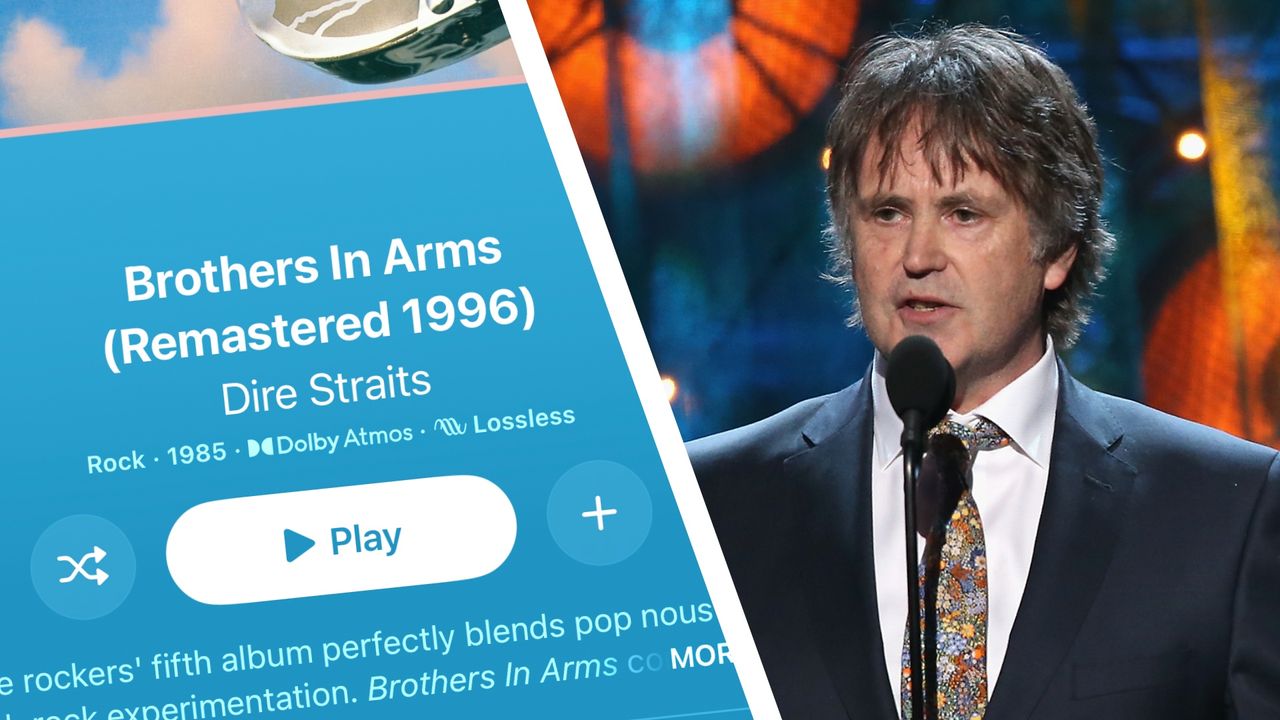
- Dire Straits' keyboardist/producer Guy Fletcher post about mixing their albums in Dolby Atmos
- He says immersive mixing of the original recording sessions is "quite addictive" and often very emotional
- 3D audio can reveal details that were previously buried when engineering for stereo
One of the things I love most about audio technology is how it can reveal things you've never heard before either because they were buried in the mix or because your setup, speakers or headphones weren't delivering all the detail.
And according to Dire Straits' keyboardist and producer Guy Fletcher, Dolby Atmos is delivering revelation after revelation not just to music fans, but to the musicians and producers who made the records in the first place.
The majority of records are made with stereo in mind, and according to Fletcher "stereo remains an extraordinary format". But as he explains on LinkedIn, redoing a stereo record for Atmos enables you to rediscover "the little things that get sacrificed along the way when you're making a stereo record. The tiny details. The decisions nobody notices because they're buried beneath more important decisions."
Fletcher makes an intriguing claim. Taking a stereo record and making it three-dimensional isn't about making it sound the same; "it's more to do with matching the emotional impact" as he says. It's not what you hear. It's what you feel.
What immersive audio delivers – and doesn't quite deliver
I think Fletcher is correct, and I'm going to compare audio to another art form: video games. I've been replaying some very old favorites recently and I'm amused by how terrible the graphics are; in my memories, those games were photorealistic as well as utterly compelling. When those games are remastered to higher visual quality they're effectively enabling me to play what I remember, not what I actually saw.
As Fletcher describes it, taking recordings into spatial audio does much the same. "The moment you begin placing objects or building beds around the listener, the music seems to breathe and expand. Mix or bus compression suddenly seems rather pointless. Sounds are no longer confined to a flat line between two speakers. Instead, they occupy a living, sculptural environment with depth, height and dimension."
It's not perfect by any means, because people listen to Atmos and other spatial audio on all kinds of different hardware that may be suboptimal: headphones, soundbars, and a range of speaker systems that don't deliver the full experience.
"Creating extraordinary Atmos mixes is no longer the obstacle," Fletcher says. "The real challenge is ensuring that the sense of space, scale and emotional impact that makes immersive mixing so exhilarating, can be faithfully experienced by the vast majority of listeners who do not own a dedicated Atmos speaker system.
Fletcher describes spatializing Dire Straits' biggest hit album, Brothers in Arms, whose original multi-tracks took him straight back to the recording studio in 1984. Although the album had previously been remastered for 5.1 audio, the Atmos edition still required extensive detective work as well as painstaking restoration.
"The real challenge lay in respecting an album that has become woven into the lives of millions of listeners," Fletcher recalls. "While 5.1 and Atmos share some similarities, Atmos offers a very different creative canvas. The challenge was never technical — the challenge was emotional."
For Fletcher, "Atmos has a curious ability to reveal not just the details within a recording, but also the memories embedded within it. In that respect, at its best, the spatial audio experience is as much about rediscovery as it is about technology."
Of course Atmos doesn't guarantee a mix is good: the record industry is very good at remastering records as a quick cash grab, and there are plenty of famous records by big artists whose remasters caused howls of outrage. But when an album is approached with care, patience and above all else, a love of the original material, the move to 3D can make songs sing even more beautifully.
Share
What's Your Reaction?
 Like
0
Like
0
 Dislike
0
Dislike
0
 Love
0
Love
0
 Funny
0
Funny
0
 Angry
0
Angry
0
 Sad
0
Sad
0
 Wow
0
Wow
0