Anthropic launches "AI workbench" for scientists using Claude
Anthropic says Claude Science will let scientists consolidate tools and data within a single secure environment.

- Claude Science is a new “workbench” to consolidate fragmented research workflows
- Everything from literature review to publication is handled on private infrastructure
- Anthropic continues to roll out industry-specific AI tools for real-world use cases
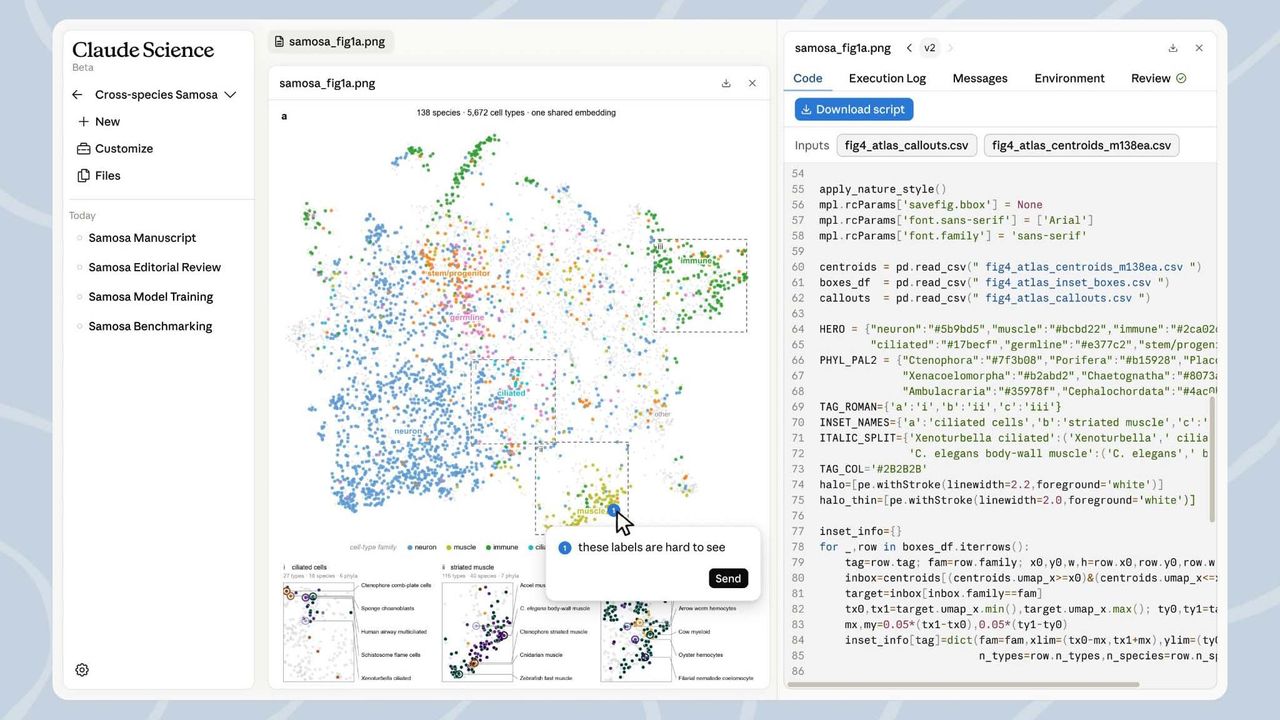
Anthropic has introduced Claude Science – a new, beta AI workbench it says will let scientists consolidate fragmented research workflows into one unified environment.
With model capabilities no longer holding back AI adoption, the Claude-maker’s solution is to respond to today’s challenges, including limited use cases, struggles deploying AI in real-world environments and difficulties integrating multiple tools.
Claude Science represents this response, packaging existing capabilities into a purpose-built application for life sciences and scientific computing, following earlier work on MCPs, skills and other partnerships. An FAQ on Claude Science’s web page reiterates this: “Claude Science is a public beta app, not a model.”
Scientific ‘workbench’
Anthropic’s clearest message in the announcement is that scientific research is largely held back by workflow fragmentation, not model intelligence, with scientists already juggling tools like PubMed, Jupyter, R, a cluster terminal and more.
“Claude Science brings these fragmented tools into a single research environment where scientists can conduct all stages of their work,” the company summarized.
The platform should help scientists handle everything, from literature review and hypothesis exploration to analysis, figure generation, manuscript drafting and publication.
“Scientific research is inherently visual,” Anthropic wrote, acknowledging that many researchers are being held back in quickly and accurately producing visuals, which could need multiple revisions and finetunes before reaching production.
For full auditability, Claude Science also includes underlying source code, message history and plain-language explanations within AI-generated outputs for scientists to review and audit progress.
“It runs on your lab’s own infrastructure,” Anthropic added, referencing enterprise-grade laptops, Linux boxes or HPC login nodes, “so large or sensitive datasets never have to leave the systems they’re already on, and only the context needed for each step of the analysis is sent to Claude
Science is a growing focus for AI developers
Anthropic says early testers have already used Claude Science for single-cell RNA sequencing analysis, CRISPR screen design, protein structure prediction and cheminformatics, by the likes of Manifold Bio, Allen Institute neuroscientist Jérôme Lecoq, and UCSF Brain Tumor Center associate professor and epidemiologist Stephen Francis.
The new tool represents a growing area of interest for AI developers, who are now targeting sectors with industry-specific tools rather than continually upgrading model capabilities without offering clear use cases. Until now, finance and legal have been a major focus for the likes of Anthropic and OpenAI, and this new science-focused initiative could mark the next stage.
It follows rival company OpenAI’s introduction of Prism earlier this year, described as an “AI-native workspace for scientists to write and collaborate on research” that launched with GPT-5.2 – the then-current model.
Claude Science is a separate app that’s available in beta for macOS and Linux installations to Pro, Max, Team and Enterprise subscribers.
The company has also committed up to $30,000 in credits for 50 lucky projects.
Share
What's Your Reaction?
 Like
0
Like
0
 Dislike
0
Dislike
0
 Love
0
Love
0
 Funny
0
Funny
0
 Angry
0
Angry
0
 Sad
0
Sad
0
 Wow
0
Wow
0