Agentic AI for Field Operations: How Business Leaders Can Eliminate the Costly Disconnect Between Field and Office Teams
Field operations do not usually fail because technicians, supervisors, dispatchers, or back-office employees are not working hard enough. They fail because the people doing the...Read More The post Agentic AI for Field Operations: How Business Leaders Can Eliminate the Costly Disconnect Between Field and Office Teams appeared first on ISHIR | Custom AI Software Development Dallas Fort-Worth Texas.


Field operations do not usually fail because technicians, supervisors, dispatchers, or back-office employees are not working hard enough.
They fail because the people doing the work, the systems recording the work, and the leaders making decisions about the work are operating with different versions of reality.
A technician discovers an equipment issue at a customer site, but procurement does not hear about the required replacement part until the end of the day. A construction supervisor records a safety concern in a paper report, but the compliance team reviews it after the risk has already escalated. A utility worker completes an inspection, but incomplete documentation delays billing. A dispatcher changes a schedule, but the customer service team continues communicating the original appointment window.
These are not isolated communication problems. They are operational design failures.
For years, businesses have attempted to fix the field-to-office disconnect with mobile applications, field service management software, dashboards, workflow automation, and collaboration platforms. These tools have improved visibility, but they still depend heavily on people manually entering information, interpreting events, updating systems, and deciding what should happen next.
Agentic AI changes that model.
Instead of simply displaying information or generating a summary, an AI agent can observe operational events, interpret their business meaning, coordinate multiple systems, initiate actions, request approvals, and continue monitoring the workflow until the intended outcome is achieved.
For CEOs, COOs, CIOs, CTOs, and field operations leaders, the opportunity is not to add another AI assistant to the technology stack. The real opportunity is to redesign field operations around faster decisions, cleaner data, lower administrative overhead, and continuous coordination between physical work and digital systems.
Why the Field-to-Office Disconnect Remains a Serious Business Problem
Most executives see the symptoms of disconnected field operations in financial reports, customer complaints, operational KPIs, or compliance escalations.
They do not always see the thousands of small handoff failures creating those outcomes.
The field-to-office gap typically appears in six areas.
1. Critical Operational Information Arrives Too Late
Field employees often discover problems before anyone else in the business.
They see failing equipment, changing customer requirements, unsafe conditions, incorrect inventory, property damage, quality issues, access restrictions, and unexpected job complexity.
However, these observations may remain trapped in:
- Handwritten notes
- Text messages
- Photographs
- Voice messages
- Unstructured work-order comments
- Personal spreadsheets
- End-of-shift reports
- Conversations with supervisors
By the time the information reaches the office, the organization has lost valuable decision-making time.
The issue is not simply slow communication. The organization cannot reliably determine which event requires immediate intervention and which can wait.
2. Field Employees Carry Too Much Administrative Work
Many field workers spend a significant part of their day completing reports, locating information, documenting customer interactions, entering inspection results, updating work orders, and correcting incomplete forms.
Salesforce research reported that information gathering and administrative responsibilities consume approximately 30% of an average technician’s working time, compared with 28% spent performing actual service work. The same research found that 81% of workers handled administrative work outside regular hours at least monthly, while 66% reported frequent burnout.
When skilled technicians become data-entry operators, the business pays twice.
It pays for expensive labor to complete low-value administrative tasks, and it loses the revenue-generating capacity those employees could have used to complete additional work.
3. Back-Office Systems Do Not Reflect Field Reality
Enterprise resource planning, customer relationship management, asset management, billing, inventory, and scheduling systems are often updated after the physical work has already changed.
This creates a lag between operational reality and the system of record.
During that gap:
- Dispatchers may assign unavailable technicians.
- Sales teams may promise unrealistic timelines.
- Procurement may order the wrong quantities.
- Finance may invoice incomplete work.
- Customers may receive inaccurate updates.
- Managers may make decisions using stale dashboards.
A digital system is not a reliable source of truth when employees do not trust that it reflects what is happening in the field.
4. Operational Knowledge Is Locked Inside Experienced Employees
Field organizations rely heavily on technicians, supervisors, site managers, inspectors, and coordinators who have accumulated years of practical knowledge.
They know which equipment fails under specific conditions. They know which customer sites require special access. They know which error codes indicate a serious issue and which can be resolved quickly. They know which workaround is safe and which creates downstream risk.
Much of this knowledge never enters a formal system.
When experienced employees retire, leave, or become unavailable, the business loses more than labor capacity. It loses operational intelligence.
AI can help surface relevant information and step-by-step guidance to frontline employees, reducing the time required to locate knowledge and complete complex tasks.
5. Small Exceptions Create Large Coordination Costs
Most field operations software handles standard processes reasonably well.
The difficulty begins when reality deviates from the planned workflow.
A customer is not available. A component is damaged. A required permit is missing. Weather changes the schedule. A technician identifies additional work. A site has an unexpected safety restriction. A repair needs an expert who is not present.
Each exception can trigger emails, phone calls, system updates, approval requests, schedule changes, customer communications, and inventory checks.
The actual cost of the exception is not limited to the physical problem. It includes the coordination required to resolve it.
6. Leaders Receive Reports, Not Operational Understanding
Executives often receive weekly or monthly summaries containing:
- First-time fix rate
- Mean time to repair
- Technician utilization
- Travel time
- Jobs completed
- Service-level agreement compliance
- Customer satisfaction
- Revenue per technician
- Repeat visits
These metrics are necessary, but they are retrospective.
They explain what happened. They do not always explain why it happened, which operational patterns are emerging, or which interventions could prevent the same problem next week.
Agentic AI can move field operations from delayed reporting toward continuous operational reasoning.
What Agentic AI Actually Changes for the C-Suite
Agentic AI is not a chatbot that answers questions when asked. It is software that can pursue a goal with limited human oversight: monitoring conditions, making decisions within defined guardrails, taking action, and escalating only what genuinely requires a human judgment call. That distinction matters enormously to a business owner evaluating where to invest next.
A traditional dashboard tells an executive that inventory is low. An agentic system notices inventory is trending toward a stockout three days before it happens, checks supplier lead times, reorders automatically within an approved budget threshold, and only pings a decision maker if the reorder would exceed policy. That is the functional shift enterprise leaders need to understand: agents do not just report state, they close the loop.
For the C-suite specifically, this shows up in four places.
1. Real-Time Operational Visibility Without the Reporting Lag
Instead of waiting for a weekly rollup, agentic AI systems continuously monitor operational data streams from field teams, plants, warehouses, call centers, or remote sites and surface only what changed and why it matters. Executives get a live signal instead of a retrospective summary. This is the single highest-leverage use case for enterprise AI adoption in 2026 because it attacks the root cause of slow decisions: latency between event and awareness.
2. Autonomous Escalation Instead of Manual Reporting Chains
Agentic systems are built with escalation logic. Routine variances get handled automatically. Anything outside defined thresholds gets escalated immediately, with full context attached, to the right person. This removes the multiple layers of middle-management filtering that used to sit between the frontline and the executive suite, and it means the issues that do reach leadership arrive with more context, not less.
3. Faster, More Confident Capital and Resourcing Decisions
When leadership can trust that the number in front of them reflects what is actually happening right now, capital allocation decisions move faster. Salesforce’s State of Service research on AI agent deployments found that customer satisfaction, not cost reduction, is now the top-ranked KPI companies track after deploying AI agents, a reversal from the cost-cutting narrative that dominated earlier AI cycles. That shift signals something important for the C-suite: agentic AI is being evaluated on business outcomes, not just efficiency.
4. A Measurable Reduction in the Cost of Coordination
Coordination between departments, between frontline teams and management, and between business units and leadership has always carried a hidden tax: meetings, reports, follow-up calls, and the executive hours spent chasing status. McKinsey’s 2026 customer service research found that AI-driven resolutions average $0.62 per interaction compared to $7.40 for a fully human-handled resolution. The same logic applies across internal operations. Every layer of manual coordination agentic AI removes is executive time returned to strategic work.
Why This Matters More in 2026 Than It Did a Year Ago
Three things converged recently that make this the year agentic AI stops being a pilot project and starts becoming standard enterprise infrastructure.
First, models can now reliably use tools and carry multi-step tasks through to completion without constant human supervision. Earlier generations of AI could draft a response or flag an anomaly, but they could not be trusted to execute the follow-through. That reliability threshold has now been crossed, which is why McKinsey’s 2025 State of AI survey found 62 percent of organizations already experimenting with AI agents and 23 percent actively scaling them into production, and both figures have climbed through 2026.
Second, there is now a common protocol, the Model Context Protocol, that lets agents connect consistently to enterprise tools, CRMs, ERPs, and data sources instead of requiring custom integration work for every system. That turned agentic AI from a collection of one-off experiments into something that can actually be deployed across an organization.
Third, the market has caught up on cost. MarketsandMarkets projects the AI agents market will grow from roughly 5.3 billion dollars in 2024 to 52.6 billion dollars by 2030, a compound annual growth rate above 46 percent. That kind of investment velocity means the tooling, the integration partners, and the implementation playbooks are maturing fast, which lowers the risk for enterprise leaders who were previously right to be cautious.
The honest caveat that every C-suite leader should hold onto: most organizations are still experimenting, not scaling. The gap between “we bought the tool” and “we changed how work happens” is where most agentic AI initiatives currently stall. That gap is not a technology problem. It is a change management and governance problem, and it is exactly where the right implementation partner earns their value.
Agentic AI Versus Traditional Field Service Automation
The distinction matters because many vendors are attaching the word “agentic” to existing automation features.
Traditional automation follows predetermined rules:
- When a work order closes, send an email.
- When inventory reaches a threshold, create an alert.
- When a technician changes status, update the dispatcher.
- When a form is incomplete, reject it.
Agentic AI can handle workflows where the correct next step depends on context.
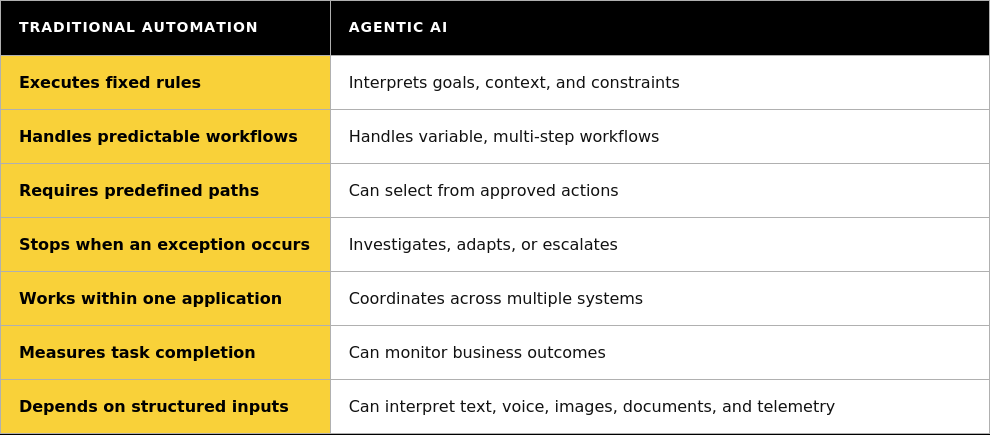
Agentic AI should not replace deterministic automation where simple rules are sufficient.
Businesses should use conventional automation for predictable, low-risk processes and reserve AI agents for workflows requiring interpretation, coordination, and contextual decisions.
Where Agentic AI Produces Measurable Field Operations ROI
C-suite leaders should evaluate agentic AI through operational and financial outcomes, not through the number of agents deployed.
The strongest business cases usually fall into the following categories.
Higher Technician Utilization
Reducing paperwork, information searches, status updates, and manual coordination allows technicians to spend more time on service work.
Salesforce reports that more than 75% of mobile workers say AI saves them time by improving scheduling, routing, access to information, problem resolution, and work summarization.
Improved First-Time Fix Rate
Agents can improve preparation by identifying probable parts, surfacing asset history, providing diagnostic guidance, and connecting technicians with expert knowledge.
A higher first-time fix rate reduces repeat visits and increases available service capacity.
Lower Mean Time to Repair
The agent can reduce delays between diagnosis, approval, inventory coordination, expert support, documentation, and customer communication.
Faster Billing and Revenue Recognition
Completed work often waits for documentation review, coding, signatures, or system updates before finance can issue an invoice.
An agent that validates and processes completion records can shorten the field-to-cash cycle.
Reduced Operational Leakage
Agentic AI can identify unbilled work, missed contract entitlements, unused warranties, unnecessary repeat visits, incorrect parts consumption, and avoidable overtime.
Better Service-Level Agreement Compliance
By continuously monitoring schedule risk, technician capacity, part availability, and job progress, agents can intervene before an SLA breach occurs.
Reduced Customer Support Volume
Proactive and accurate status communication decreases customer calls asking for appointment, technician, repair, or delivery updates.
Lower Employee Burnout
Reducing repetitive administrative work can improve the technician experience, particularly when employees can use voice, photographs, and natural-language interfaces instead of navigating complicated forms.
Where to Start: High-Leverage Agentic AI Use Cases for Business Leaders
Executives evaluating where to deploy agentic AI first should look for the intersection of high transaction volume, high coordination cost, and low decision complexity. That is where agents deliver value fastest with the least risk.
Operational monitoring and exception reporting. Instead of a human reviewing every report, an agent monitors continuously and only surfaces genuine exceptions, with context, to the right person.
Customer service resolution. Move past agents that only answer FAQs. Look for agents that can complete a transaction, resolve an actual technical issue, or make a recommendation grounded in real usage data.
Vendor and supply chain coordination. Agents that can track lead times, flag risk, and initiate routine reorders remove an entire layer of manual coordination between procurement and operations.
Internal reporting and executive briefings. Agents that continuously synthesize operational data into a live executive summary reduce the multi-day lag between something happening and leadership knowing about it.
Compliance and safety monitoring. In regulated industries, agents that continuously check operational activity against compliance requirements and escalate violations immediately close a gap that manual audits, by design, can only catch after the fact.
The common thread across every one of these use cases is the same: agentic AI does not replace executive judgment. It removes the delay and the noise that used to sit between an event happening and a decision maker knowing enough to act on it.
How ISHIR Can Help
ISHIR works with enterprise leadership teams to design and deploy agentic AI systems that are grounded in real operational data, governed with clear authority boundaries, and built to integrate with the systems you already run, not replace them wholesale. As an AI-native software development and IT services partner, ISHIR helps C-suite teams move past the pilot stage that most agentic AI initiatives get stuck in, with a focus on measurable business outcomes: faster executive visibility, reduced coordination overhead, and decisions made on current information instead of last week’s report.
If your leadership team is evaluating where agentic AI fits into your operating model, or if you already have pilots running but cannot get them to scale, ISHIR can help you build the governance framework, the technical integration, and the rollout plan that turns agentic AI from an experiment into infrastructure.
The disconnect between the frontline and the boardroom is not permanent. It is a structural problem, and structural problems can be engineered away. In 2026, the enterprises that close this gap first will make faster, better decisions than the ones still waiting for next week’s report.
Are disconnected field and office workflows increasing service costs, delaying billing, and frustrating customers?
ISHIR can help you design and build secure agentic AI workflows that connect field activity with your CRM, ERP, and customer operations systems.
FAQs
Q. What is agentic AI, and how is it different from generative AI?
Generative AI produces content, text, images, or analysis in response to a prompt. Agentic AI goes further: it can pursue a goal with limited oversight, make decisions within defined boundaries, use tools, take action, and escalate only what genuinely needs human judgment. For business leaders, the practical difference is that agentic AI can close a loop end to end, not just produce a recommendation someone else has to act on.
Q. Is agentic AI actually delivering ROI for enterprises in 2026, or is this still hype?
Both experimentation and hesitation are real right now. McKinsey’s 2026 research shows measurable revenue gains between three and fifteen percent for companies with agentic AI in production, and Gartner projects 40 percent of enterprise applications will integrate task-specific agents by year end. At the same time, most organizations remain in the pilot phase rather than full-scale deployment, so the honest answer is that ROI is real for the enterprises that have moved past pilots, and unproven for the ones that have not.
Q. What is the biggest risk of deploying agentic AI at the enterprise level?
The biggest risk is not the technology itself. It is deploying agents with undefined authority boundaries, ungoverned data access, and no clear accountability structure. Enterprises that treat agent governance with the same rigor as employee access management see far fewer incidents than those that treat deployment as a plug-and-play exercise.
Q. How should a C-suite leader prioritize which business function gets agentic AI first?
Start with functions that combine high transaction volume, high coordination cost between teams, and relatively low decision complexity, such as operational monitoring, exception reporting, and routine vendor coordination. These deliver measurable value quickly and build organizational trust in the technology before moving into higher-stakes, higher-complexity use cases.
Q. Does agentic AI eliminate the need for middle management or human oversight?
No. It shifts where human judgment is applied. Routine, repeatable decisions move to the agent. Human attention moves toward the exceptions, the judgment calls, and the strategic decisions that agents are explicitly designed to escalate rather than resolve on their own.
The post Agentic AI for Field Operations: How Business Leaders Can Eliminate the Costly Disconnect Between Field and Office Teams appeared first on ISHIR | Custom AI Software Development Dallas Fort-Worth Texas.
Share
What's Your Reaction?
 Like
0
Like
0
 Dislike
0
Dislike
0
 Love
0
Love
0
 Funny
0
Funny
0
 Angry
0
Angry
0
 Sad
0
Sad
0
 Wow
0
Wow
0