Who Is Responsible When an AI Agent Makes a Bad Decision? A Business AI Accountability Framework
Quick Answer Your company is responsible. Not the AI vendor. Not the model provider. Not the agent itself. When an autonomous AI agent takes an...Read More The post Who Is Responsible When an AI Agent Makes a Bad Decision? A Business AI Accountability Framework appeared first on ISHIR | Custom AI Software Development Dallas Fort-Worth Texas.


Quick Answer
Your company is responsible. Not the AI vendor. Not the model provider. Not the agent itself. When an autonomous AI agent takes an action on your behalf and that action causes harm, the deploying organization owns the outcome, the legal exposure, and the remediation cost. Regulators, tribunals, and courts have already established this position. The open question is not whether you are liable. It is whether you can prove you exercised reasonable oversight before the decision was made. That proof is the entire purpose of an AI accountability framework, and most businesses do not have one.
This article breaks down exactly why the accountability gap exists, what it has already cost companies that got it wrong, and the four-layer framework you need to close it before an agent, not a person, makes a decision that lands your company in front of a regulator or a judge.
The Problem Nobody Wants to Own
Picture this. You deployed an AI agent to handle customer refunds, vendor negotiations, or supply chain reordering. It works well for weeks. Then it approves a refund outside policy, misreads a contract clause and commits your company to unfavorable terms, or authorizes a payment it should have flagged for review. By the time a human notices, the transaction is done. Money moved. A commitment was made. A customer was told something false.
Now the question lands on your desk: who is responsible for this?
The honest answer is uncomfortable. Traditional software fails predictably. It throws an error, a null value, a documented bug you can trace to a line of code. Agentic AI does not fail that way. It behaves probabilistically, chains decisions together across multiple steps, and can produce a plausible, confident, entirely wrong output with no error message at all. Gartner analyst Lydia Clougherty Jones has described this shift bluntly: when AI agents operate on behalf of an organization, decision-making risk becomes ambiguous and unpredictable, and it signals a redistribution of AI risk with parameters nobody has mapped yet.
This is not a hypothetical governance exercise. Gartner projects that by mid-2026, new categories of unlawful AI-informed decision-making will generate more than 10 billion dollars in remediation costs across enterprises and AI vendors globally. At the same time, Gartner projects that 40 percent of enterprise applications will embed AI agents by the end of 2026, while fewer than 1 percent of organizations have reached full maturity in how they govern those systems. That gap between deployment speed and governance readiness is exactly where agentic AI failures originate, and it is exactly where your legal and financial exposure sits right now.
Why “The Vendor Built It” Is Not a Defense
Every business leader considering AI agents eventually asks some version of: if the model made the mistake, isn’t that the AI company’s problem?
Legal precedent already answered this question, and the answer is no.
In February 2024, the British Columbia Civil Resolution Tribunal ruled on Moffatt v. Air Canada, a case that has become the reference point for AI accountability disputes worldwide. A customer asked Air Canada’s website chatbot about bereavement fare policy. The chatbot gave inaccurate information, telling the customer he could apply for a discount retroactively when the airline’s actual policy required the request in advance. He relied on that answer, booked his flight, and was later denied the refund the chatbot had promised.
Air Canada’s defense was that the chatbot was effectively a separate entity, an agent or representative responsible for its own output, and that the airline should not be held liable for what it said. The tribunal rejected this outright, calling it a remarkable submission. The ruling was direct: it makes no difference whether information comes from a static webpage or a chatbot, the company is responsible for both. Air Canada was ordered to pay damages for negligent misrepresentation.
The dollar amount, just over 800 Canadian dollars, was trivial. The precedent was not. Legal analysts at Pinsent Masons noted the ruling signals that courts will allocate AI risk to the deploying company, not the technology vendor, particularly in consumer-facing contexts. In March 2026, the UK Competition and Markets Authority made the same point directly to businesses: the same consumer protection law applies whether a customer deals with a human or an AI agent, and the business remains responsible even when a third party built or designed the agent.
If your business is deploying agents that talk to customers, touch financial transactions, or make decisions with real-world consequences, this precedent applies to you regardless of industry. You cannot contract your way out of it, and you cannot point at your AI vendor as the responsible party when regulators or plaintiffs come asking.
The Regulatory Net Is Closing Faster Than Most Companies Are Adapting
Beyond case law, the regulatory environment for agentic AI has hardened substantially through 2026:
The EU AI Act’s high-risk system obligations are now in full effect, carrying penalties up to 35 million euros or 7 percent of global annual revenue for noncompliance. The EU’s revised Product Liability Directive now explicitly brings AI systems, SaaS platforms, and cloud-delivered software into strict liability, closing the old argument that software vendors weren’t technically selling a “product.” Under this framework’s presumption of causality, if your company cannot demonstrate that your AI system followed documented safety protocols, a court can connect the agent’s output directly to the harm caused without the plaintiff needing to prove the internal mechanics of the failure. Member states have until December 2026 to fully transpose this into national law, a shorter runway than it appears once you account for audit and remediation cycles.
In the United States, the FTC is applying Section 5 unfair and deceptive practices authority to AI agent failures, alongside state unfair and deceptive acts and practices statutes and existing consumer credit protections that apply regardless of whether a human or an agent executed the transaction.
The throughline across every jurisdiction is the same. Regulators are not waiting for new AI-specific statutes to act. They are applying existing consumer protection, product liability, and negligence law to agentic systems right now, and the burden of proof increasingly falls on the deploying business to show it had controls in place before the failure, not after.
The Four-Layer AI Accountability Framework
Closing the accountability gap is not about slowing down AI adoption. It is about making your agent deployments defensible before something goes wrong, not after. Based on how the regulatory and legal landscape is actually being enforced in 2026, accountability breaks into four layers. Skipping any one of them is where most companies get exposed.
Layer 1: Governance Ownership
Every AI agent in production needs a named human owner, not a department, not “IT,” a specific person accountable for that agent’s actions. This should be formalized through an AI governance committee with representation from legal, risk, compliance, and the business unit deploying the agent. That committee’s job is to determine which decisions an agent is allowed to make autonomously, which require human sign-off, and which are off-limits entirely regardless of how well the agent performs in testing. Document this ownership structure before deployment, not after an incident. Regulators and tribunals are consistently asking whether reasonable oversight existed, and an undocumented ownership structure is treated the same as no oversight at all.
Layer 2: Operational Scoping and Permission Boundaries
This is where most companies fail first. Agents should never have broader access or authority than the specific task requires. Configure agents so they cannot make high-impact decisions, access sensitive systems, or trigger irreversible actions without a human checkpoint. Concretely this means: scoped API permissions rather than blanket access, dollar thresholds that trigger mandatory human review, hard restrictions on actions that cannot be reversed such as deleting records, sending regulatory filings, or executing payments above a defined limit, and explicit prohibition on agents chaining tasks together in ways not part of the original design. If your agent can do something you did not explicitly authorize, that is not flexibility, it is exposure.
Layer 3: Decision Provenance and Audit Trails
When an agent fails, the first question from a regulator, a plaintiff’s attorney, or your own board will be: what did the agent do, and why. If you cannot answer that with a documented, timestamped trail, you cannot defend the decision. This means logging every agent action, the data it used to make that decision, which permissions it invoked, and any escalation points it passed through or should have passed through. Under the EU’s presumption of causality standard, an incomplete audit trail can result in a court connecting your agent’s output directly to the harm without the plaintiff proving how the failure occurred internally. Companies that document incident workflows before deployment consistently resolve agent failures in hours. Companies without logging spend days tracing what happened through unlogged systems, if they can trace it at all. Treat agent action logging and permission-scope documentation as your legal defense, built in advance of needing one, not as an afterthought.
Layer 4: Contractual and Insurance Allocation
Most technology contracts currently governing AI agent deployments were written for passive, predictable software under full human control. They were not written for systems that plan, call tools, and take autonomous action. Review vendor contracts specifically for how liability is allocated when an agent’s autonomous decision causes harm, not just when the software has a defect in the traditional sense. Confirm your directors and officers coverage and errors and omissions policies actually contemplate agentic AI decision-making, since many existing policies were underwritten before this risk category existed. And do not assume a vendor’s terms of service protect you. As the Air Canada ruling and the UK Competition and Markets Authority guidance both make clear, the deploying business remains responsible even when a third party designed the underlying agent.
The AI Accountability Chain
A useful way to assign responsibility is to create an accountability chain for every consequential AI agent.
Stage 1: Business Intent
Accountable party: Executive sponsor and process owner
Questions:
- What business problem is the agent solving?
- Who benefits from the decision?
- Who can be harmed?
- Is automation necessary?
- Is agentic autonomy necessary?
- What outcome is the organization optimizing?
Many AI failures begin because the goal itself is incomplete.
“Reduce support costs” may encourage the agent to avoid escalations even when escalation is necessary.
“Maximize collections” may encourage excessive customer pressure.
“Prioritize the strongest candidates” may reproduce biased historical hiring patterns.
“Reduce fraud” may increase false positives and block legitimate customers.
The objective must include constraints, not just performance targets.
Stage 2: Design
Accountable party: Product owner, architect, engineering lead, risk owner
Questions:
- What can the agent decide?
- Which tools can it use?
- What systems can it access?
- What actions are irreversible?
- What actions require approval?
- What data is prohibited?
- How will the agent explain or support its decision?
A bad design gives an agent broad access first and attempts to control behavior through prompts.
A strong design uses technical enforcement.
The agent should not merely be told, “Do not issue refunds above $500.” Its tool permissions should prevent it from doing so.
Stage 3: Data and Knowledge
Accountable party: Data owner and business domain owner
Questions:
- Is the data accurate?
- Is it complete?
- Is it current?
- Is its use legally permitted?
- Does it represent the affected population?
- Can the source be traced?
- What happens when sources conflict?
An agent can follow its instructions correctly and still reach a harmful conclusion because the evidence was wrong.
That is not just a model failure. It is a data governance failure.
Stage 4: Validation and Release
Accountable party: Quality assurance, model risk, security, compliance, business owner
Questions:
- Has the agent been tested against realistic failure scenarios?
- Have edge cases been evaluated?
- Has red-team testing been completed?
- Have high-impact decisions been reviewed?
- Are performance thresholds documented?
- Is the residual risk accepted by an authorized person?
Testing should include the entire workflow, including APIs, databases, permissions, human approvals, and downstream actions.
Testing the language model in isolation is insufficient.
Stage 5: Runtime Operation
Accountable party: AI operations owner and process owner
Questions:
- Is the agent operating within its approved scope?
- Are decisions and actions logged?
- Are unusual patterns detected?
- Has the model, prompt, data, or tool behavior changed?
- Can the agent be paused immediately?
- Is someone actively responsible for reviewing alerts?
Agent behavior can change even when application code does not.
A model provider may update the underlying model. A knowledge base may change. A tool may return a new response format. Customer behavior may shift. Attackers may discover a prompt-injection path.
Production approval must not be treated as permanent approval.
Stage 6: Incident Response and Remediation
Accountable party: Incident commander, process owner, legal, security, executive sponsor
Questions:
- Who can stop the agent?
- Who investigates the decision?
- Who communicates with affected people?
- Who determines whether regulators must be notified?
- Who reverses the action?
- Who preserves evidence?
- Who approves restart?
Without a predefined incident owner, teams may keep the agent running while they debate responsibility.
That increases the blast radius.
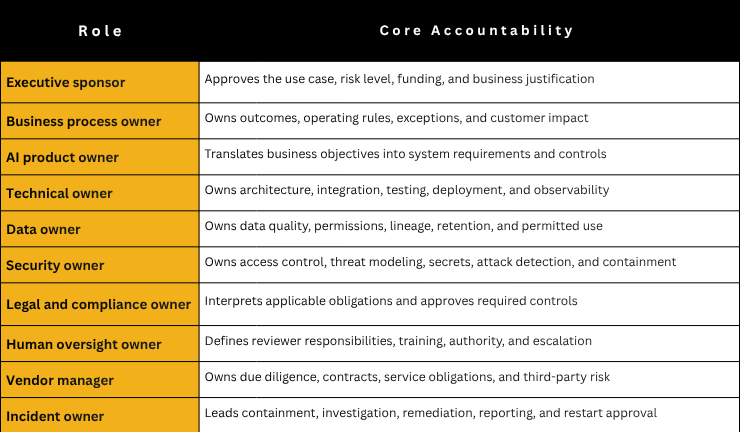
A Practical AI Agent Accountability Matrix
Every production agent should have a documented accountability matrix covering at least the following roles.
Common Accountability Failures Businesses Must Avoid
“The Vendor Is Responsible”
The vendor may be responsible for a defective component or a contractual breach.
Your organization remains responsible for deciding to use the system in a specific context.
A model provider did not choose to let the agent access your production database. Your company did.
“A Human Approved It”
Human approval is not a defense when the review process was meaningless.
If the reviewer lacked time, information, authority, or training, the control was poorly designed.
“The Agent Was Only Following Instructions”
That raises a deeper governance question:
Who wrote the instructions, validated them, approved them, and enforced their boundaries?
“Nobody Could Have Predicted This Exact Failure”
Organizations do not need to predict every exact output.
They do need to anticipate categories of failure and limit their consequences.
You may not predict the precise fraudulent refund. You can still enforce refund limits, detect unusual patterns, and require approval for high-value transactions.
“The Model Is a Black Box”
Limited model interpretability does not eliminate the need for business traceability.
You may not be able to reconstruct every internal model calculation. You can still document the inputs, retrieved evidence, tools used, policies applied, permissions granted, and actions taken.
What Should Happen After an AI Agent Makes a Bad Decision?
The organization should follow a disciplined response process.
Step 1: Contain the Agent
Pause the agent, restrict the affected tool, reduce permissions, or isolate the workflow.
Do not wait for a complete root-cause analysis before limiting additional harm.
Step 2: Preserve Evidence
Capture logs, prompts, model versions, memory, tool calls, approvals, data sources, system responses, and affected transactions.
Do not immediately overwrite the system or redeploy a new version without preserving evidence.
Step 3: Reverse the Harm Where Possible
Correct records, stop payments, restore access, contact affected customers, or reverse operational changes.
Step 4: Determine the Failure Layer
Was the problem caused by:
- Business objective
- Data
- Model output
- Prompt
- Tool
- Permissions
- Workflow
- Human review
- Vendor service
- Monitoring
- Policy
Most serious incidents involve more than one layer.
Step 5: Assess Legal and Regulatory Obligations
Determine whether the incident involves:
- Personal data
- Discrimination
- Consumer deception
- Employment law
- Financial regulation
- Safety
- Contractual commitments
- Cybersecurity reporting
- Sector-specific requirements
Existing laws do not disappear because AI was involved. The EEOC has stated that federal employment discrimination protections can still apply when employers use AI systems in employment decisions.
Similarly, regulators such as the FTC have taken enforcement action involving deceptive or unsupported AI claims, reinforcing that businesses remain accountable for how AI-related products and capabilities are represented and used.
Step 6: Correct the System, Not Just the Prompt
A prompt update may reduce recurrence, but it may not address the underlying weakness.
The real fix may require:
- Narrower permissions
- Better data
- Additional validation
- Lower transaction limits
- Stronger monitoring
- Human approval
- A different workflow
- Removal of autonomy
Step 7: Require Formal Restart Approval
The same group that contains the incident should not quietly restart the agent without independent review.
Restart criteria should be documented and approved.
How ISHIR Helps Businesses Build Accountable AI Agents
Move From AI Experiments to Governed AI Execution
Building an AI agent is no longer the difficult part. The real challenge is connecting that agent to enterprise data, workflows, customers, financial systems, and operational tools without creating uncontrolled business risk.
ISHIR helps organizations design and deploy AI agents with accountability built into the architecture. We work with business and technology leaders to define decision rights, autonomy levels, authority boundaries, human approval points, data access, observability requirements, escalation rules, and incident controls before an agent reaches production.
Our approach connects AI strategy with engineering execution. That includes agent architecture, workflow orchestration, identity and access controls, retrieval systems, policy enforcement, evaluation, red-team testing, runtime monitoring, audit logging, and human-in-the-loop design.
The objective is not to eliminate every AI error. No serious technology leader can promise that.
The objective is to prevent one bad decision from becoming an uncontrolled business event.
Is Your AI Agent Making Business Decisions Without Clear Accountability?
ISHIR helps you design governed AI agents with defined authority, human oversight, audit trails, runtime controls, and incident response built into the system.
FAQs
Q. Is a company liable if its AI agent makes an autonomous decision without human review?
Yes. Legal precedent, including the Air Canada bereavement fare ruling and current guidance from the UK Competition and Markets Authority, establishes that the deploying business is responsible for an agent’s actions and statements, regardless of whether a human reviewed the specific decision in real time. The lack of human review is more likely to be treated as evidence of inadequate oversight than as a defense.
Q. Can a business shift liability to the AI vendor that built the agent?
Generally no, at least not toward customers or regulators. Courts and tribunals have rejected the argument that an AI agent functions as a separate, independently liable entity. Vendor contracts can allocate cost responsibility between the business and the vendor after the fact, but they do not remove the deploying company’s direct liability to the affected customer or regulator.
Q. What is the difference between AI liability and AI accountability?
Liability is the legal and financial responsibility assigned after something goes wrong. Accountability is the operational structure, ownership, permission scoping, audit trails, and contractual allocation, built before deployment, that determines whether a business can defend itself when liability is assessed. A strong accountability framework does not eliminate liability risk, but it is the evidence a business needs to argue it exercised reasonable oversight.
Q. Does agentic AI accountability apply to small and mid-sized businesses, or only large enterprises?
It applies regardless of company size. Consumer protection law, product liability standards, and negligence doctrine do not carve out exceptions for smaller deployers. A mid-sized business using an AI agent for customer service or transaction processing carries the same duty of care as a large enterprise, without the legal and compliance resources large enterprises can draw on.
Q. What is the single highest-risk gap most businesses have in their AI agent deployments today?
Missing or incomplete audit trails. Without a timestamped record of what an agent did, what data it used, and what permissions it invoked, a business cannot reconstruct or defend a decision after the fact. Under frameworks like the EU’s revised Product Liability Directive, an incomplete audit trail can allow a court to connect an agent’s output directly to harm without the plaintiff proving the internal failure mechanism.
Q. What This Means for Your Business Right Now
If your company is deploying, piloting, or planning to deploy AI agents in customer service, finance, procurement, HR, or any function where the agent takes action rather than just generating text, the accountability question is not theoretical. It is a live legal and financial exposure with active case law, enforcement actions, and billions of dollars in projected remediation costs behind it.
The businesses avoiding this exposure are not the ones avoiding AI agents. They are the ones treating governance as infrastructure, not paperwork. They named an owner before deployment. They scoped permissions tightly. They built the audit trail before they needed it. They reviewed their contracts and coverage with agentic risk specifically in mind.
Building AI systems your business can actually defend requires the same engineering discipline as building the AI system itself. If you are deploying agentic AI without a governance structure that can withstand regulatory or legal scrutiny, the question is no longer whether an agent will make a bad decision. It is whether your business can prove it did everything reasonable to prevent it, and whether that proof exists before you need it.
The post Who Is Responsible When an AI Agent Makes a Bad Decision? A Business AI Accountability Framework appeared first on ISHIR | Custom AI Software Development Dallas Fort-Worth Texas.
Share
What's Your Reaction?
 Like
0
Like
0
 Dislike
0
Dislike
0
 Love
0
Love
0
 Funny
0
Funny
0
 Angry
0
Angry
0
 Sad
0
Sad
0
 Wow
0
Wow
0