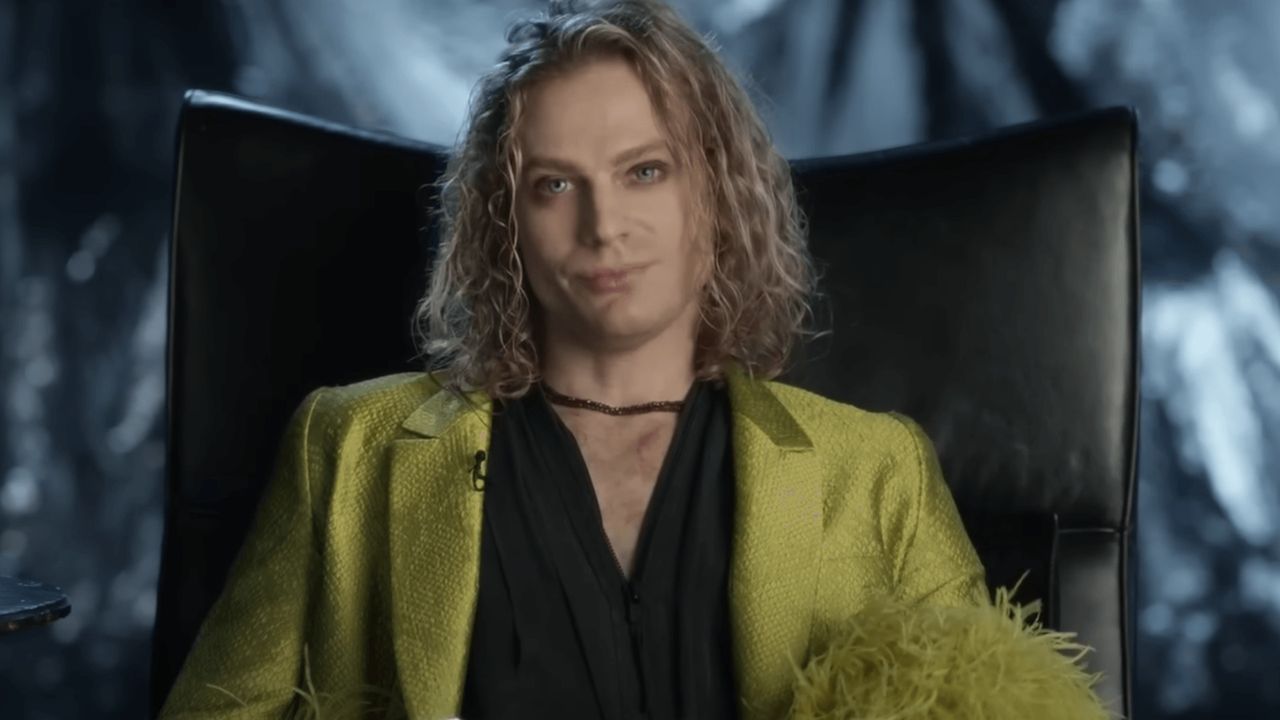
Uncommon Thinkers: Hope for the future from our 2025 honorees
Recorded backstage at the GeekWire Gala, this special episode of the GeekWire Podcast spotlights the 2025 Uncommon Thinkers — innovators working on space, biology, AI, environmental cleanup, and the future of social media. Read More


At the GeekWire Gala this week, we spent time talking backstage with five of this year’s Uncommon Thinkers — the inventors, scientists, and entrepreneurs who were selected in partnership with Greater Seattle Partners for their work transforming industries and the world.
You can hear the full conversations on this week’s episode of the GeekWire Podcast. As I mentioned at the end, I came away with an unexpected sense of optimism.
Jeff Thornburg of Portal Space Systems spent years building rocket engines for Elon Musk at SpaceX and Paul Allen at Stratolaunch. Now he and his team are reviving a NASA concept from decades ago: spacecraft propelled by focused sunlight.

When I asked what the world will look like “if Portal succeeds,” he made a classic entrepreneurial pivot: “When we’re successful,” he said, “we become the backbone of Earth-Moon logistics.”
From there, he said, it’s about protecting orbits for commerce, supporting human presence on the moon, and eventually pushing out to Jupiter’s moons.
Anindya Roy of Lila Biologics is using AI to design proteins from scratch — molecules that have never existed in nature — to fight cancer. He trained in David Baker’s Nobel Prize-winning lab at UW, so he saw the before and after of machine learning’s impact on the field.

Before: success rates below 1%, ordering hundreds of thousands of designs to find one that worked. Now: 5-20% success rates, ordering a few hundred designs to find a drug candidate.
“If you told me a couple of years ago that we can design an antibody from a computer, I would not believe you,” he said.
Jay Graber of Bluesky runs the decentralized social network that has become a leading alternative to X. But while most tech CEOs build moats, she and her team are building a protocol designed to help users leave.

She talks about Bluesky and the underlying AT Protocol as a “collective organism,” and describes her role as guiding and stewarding the ecosystem rather than controlling it.
The industry and the world would be better off, she says, if leaders would think about their role “more as guides and stewards, rather than just dictators or emperors as they like to style themselves.”
Kiana Ehsani of Vercept came to Seattle from Iran for her PhD, spent four years at the Allen Institute for AI, and is now competing with OpenAI and Google in the AI agent space with a fraction of their resources.

The ultimate vision is to help people move beyond mouse, keyboard, and touchscreen, letting them interact with computers the way they’d talk to a coworker.
AI agents are still early, she cautions. “Think of ChatGPT three years ago. Don’t think of it today.” Her advice for getting started with AI agents: “Start small, start with simple tasks that you don’t want to do, and then slowly build on top of it to see the magic.”
Brian Pinkard of Aquagga is tackling forever chemicals, the PFAS compounds that have spread through our water, food chain, and bloodstreams. The industry standard is to filter them out and then landfill or incinerate the waste, approaches that don’t truly solve the problem and can simply move it elsewhere.

Aquagga uses technology originally designed to destroy chemical weapons to break PFAS down into inert salts under extreme heat and pressure. Pinkard didn’t believe it was possible until he saw the data. “I’m a skeptic, I’m cynical, I’m a scientist,” he said. “I wanted to see proof.”
His bigger vision is to transform hazardous waste processing entirely. Today, huge volumes of wastewater are trucked to incinerators and burned — which he calls “thermodynamic insanity.”
We’ll speak on a future episode with our sixth honoree, Chet Kittleson, co-founder and CEO of Tin Can, the startup making WiFi-enabled landline phones to help kids connect without screens.
Uncommon Thinkers is presented in partnership with Greater Seattle Partners.
Subscribe to GeekWire in Apple Podcasts, Spotify, or wherever you listen.
Audio editing by Curt Milton.
Share
What's Your Reaction?
 Like
0
Like
0
 Dislike
0
Dislike
0
 Love
0
Love
0
 Funny
0
Funny
0
 Angry
0
Angry
0
 Sad
0
Sad
0
 Wow
0
Wow
0