The Strangler Fig Pattern: How to Modernize Legacy Systems Without a “Big Bang” Rewrite
Most legacy system modernization projects do not fail because the technology was wrong. They fail because leadership chose the riskiest possible way to deploy it:...Read More The post The Strangler Fig Pattern: How to Modernize Legacy Systems Without a “Big Bang” Rewrite appeared first on ISHIR | Custom AI Software Development Dallas Fort-Worth Texas.


Most legacy system modernization projects do not fail because the technology was wrong. They fail because leadership chose the riskiest possible way to deploy it: replacing an entire system in one cutover event and hoping nothing breaks.
The data on this is not ambiguous. Independent research from NRI Digital Consulting puts the failure or underperformance rate of modernization projects at 68 to 79 percent in 2026. A separate industry review found that over 50 percent of enterprise IT transformation programs run over budget and more than 30 percent are significantly delayed. When TSB Bank attempted a single-event “big bang” migration of 5.2 million customer accounts to a new core banking platform in April 2018, the result was 1.9 million customers locked out of their accounts, widespread fraud exposure, a GBP 330 million loss, a GBP 48.65 million regulatory fine, and the resignation of the CEO. Knight Capital lost 440 million dollars in 45 minutes in 2012 when a single deployment script failed to update one of eight production servers, reactivating dormant legacy code that had been sitting untouched for nearly a decade.
Neither of these failures happened because modernization was the wrong call. They happened because the organizations tried to replace deeply embedded legacy systems in one irreversible move, without a mechanism to isolate risk, test incrementally, or roll back safely.
The strangler fig pattern exists specifically to prevent this outcome. It is the modernization strategy that lets you replace legacy application logic module by module, keep the business running throughout, and avoid betting the company on a single go-live weekend. This article breaks down exactly how it works, when it applies, where it fails, and how to build the business case for using it.
What Is the Strangler Fig Pattern?
The strangler fig pattern is an incremental legacy system modernization strategy in which a new system is built and deployed alongside an existing legacy system, gradually taking over functionality piece by piece until the legacy system can be fully decommissioned.
The term was coined by Martin Fowler in 2004 after observing strangler fig vines in the rainforests of Queensland, Australia. A strangler fig germinates in the canopy of a host tree, grows downward and outward, and slowly envelops the host over years. Eventually the host tree dies and decomposes, leaving the fig standing in a form that echoes the original tree’s shape. Fowler saw the same pattern in software: instead of demolishing a legacy system and rebuilding from scratch, you grow a new system around it until the old one is no longer needed.
Technically, the pattern works through an interception layer, usually a reverse proxy, API gateway, or facade, that sits between users (or client applications) and the underlying systems. Initially, this layer routes 100 percent of traffic to the legacy system, exactly as before. As new components are built, tested, and validated, the routing layer incrementally redirects specific requests to the new system while everything else continues to flow to the legacy application. Over time, more and more functionality shifts to the new system until the legacy system handles nothing at all and can be safely retired.
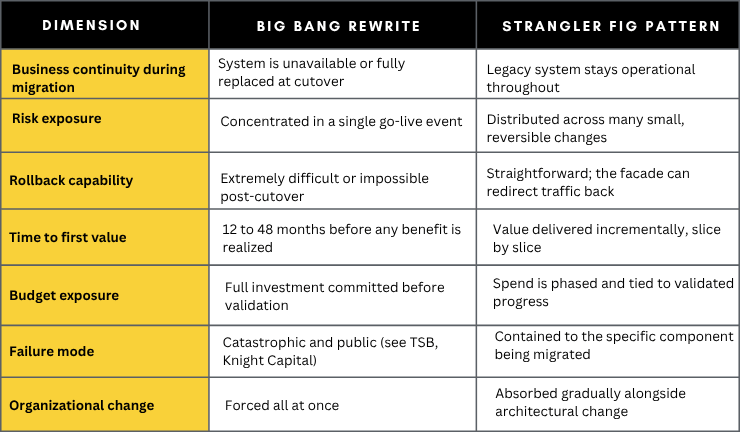
This is fundamentally different from a rewrite. A rewrite treats modernization as a single project with a single delivery date. The strangler fig pattern treats modernization as a continuous, reversible process with dozens of small delivery points instead of one large one.
Why Big Bang Legacy System Replacement Fails So Often
Enterprises keep choosing the big bang approach because it looks faster and cleaner on a project plan. The reality documented across enterprise IT programs tells a different story.
The numbers are consistent across independent studies.
NRI Digital Consulting’s 2026 analysis found that 68 to 79 percent of modernization projects fail or underperform, driven primarily by weak stakeholder alignment, incomplete system assessment, and ineffective project management, not by the underlying technology choice. A separate 2026 industry review found that failed modernization programs typically consume 18 to 36 months of organizational energy before being abandoned or scaled back, and that the business is often left with a legacy system that has now fallen even further behind because no feature development happened during the failed attempt.
Underestimating legacy business logic is the number one root cause.
Legacy systems accumulate decades of undocumented business rules, exceptions, and workarounds that were never written down anywhere except in the code itself. When a team commits to a full rewrite, they are implicitly betting that they can reconstruct all of that embedded logic correctly, in one attempt, before go-live. The TSB Bank post-mortem, conducted by the law firm Slaughter and May at TSB’s own request, found that the bank’s board was told about only 800 of the 2,000 known defects present at the time of go-live, and that the two data centers built to support the new platform were, despite being specified identically, configured inconsistently. These are the kinds of gaps that surface in a big bang cutover with no fallback path.
The federal government provides the starkest illustration of this at scale.
A U.S. Government Accountability Office report found that the federal government spends more than 100 billion dollars annually on IT, with roughly 80 percent of that consumed by operating and maintaining existing systems rather than building new capability. Of 10 critical legacy systems flagged for modernization back in 2019, only three had been fully modernized by 2025. Several of the remaining systems still run on COBOL and Assembly, languages with a shrinking pool of engineers who can safely maintain them.
Discipline in completion is a separate failure mode entirely.
Even organizations that choose an incremental approach can stall out once the highest-visibility features are migrated, leaving the legacy system running indefinitely in a reduced but permanent capacity. This creates a worst-case outcome: double the maintenance burden, because both the old and new systems now require ongoing support, with none of the payoff of full decommissioning.
How the Strangler Fig Pattern Works: The Technical Mechanics
Implementing the strangler fig pattern for application modernization follows a consistent sequence, regardless of whether you are modernizing a monolithic web application, a mainframe COBOL system, or a legacy ERP platform.
Step one: map system boundaries.
Before writing any new code, the legacy system needs to be understood as a set of discrete components rather than a single indivisible block. This discovery phase is where most timeline overruns actually originate. Enterprises that skip detailed dependency mapping consistently see a six-month project expand into a multi-year engagement once testing surfaces functions nobody knew existed. This step alone determines whether the rest of the project succeeds.
Step two: define thin, independently deployable slices.
Break the system into components small enough to migrate individually, but significant enough to deliver real business value on their own. A reporting module, an authentication service, and an invoicing engine are typical starting slices because they tend to have clearer boundaries and lower interdependency than core transaction processing.
Step three: introduce the routing layer (the facade).
This is the software seam that makes the entire pattern possible. For web applications, this is usually a reverse proxy or API gateway. For legacy mainframe or desktop systems, it often requires a custom-built wrapper or adapter layer. At the start, the facade routes all traffic to the legacy system, so nothing changes from the user’s perspective.
Step four: build and validate the new component in isolation.
The team builds the modern replacement for one slice, ideally starting with a component that already has strong test coverage and comparatively low technical debt. AWS’s own prescriptive guidance on the pattern recommends this explicitly: start with the component that gives the team the most confidence, not the one that delivers the flashiest headline.
Step five: incrementally redirect traffic.
Once the new component is validated, the facade begins routing a portion of relevant requests to it while the legacy system continues handling everything else. This can be done gradually, by percentage of traffic, by user segment, or by feature flag, allowing the team to monitor for regressions before committing fully.
Step six: repeat, then decommission.
This cycle of building, redirecting, and validating repeats slice by slice. Once the legacy system has zero live traffic routed to it, it can be decommissioned. Some organizations choose to keep the facade permanently as an adapter layer for older clients while continuing to evolve the core system behind it. Others remove it entirely once migration is complete.
Throughout this entire process, the legacy system remains fully operational. That single fact is what eliminates the highest-risk failure mode in the TSB and Knight Capital cases: an irreversible cutover with no safe path backward.
Strangler Fig Pattern vs. Big Bang Rewrite
When the Strangler Fig Pattern Is the Right Call, and When It Isn’t
The strangler fig pattern is not a universal answer. It fits best when specific conditions are present.
Use it when:
- The legacy system is large, business-critical, and cannot tolerate extended downtime
- The system has identifiable, separable modules (authentication, billing, reporting, and similar functions)
- The organization needs to keep shipping features and cannot absorb a multi-year feature freeze
- Regulatory or compliance requirements (DORA, HIPAA, PCI-DSS) demand continuous auditability rather than a disruptive cutover
- Leadership wants measurable progress and ROI checkpoints rather than a single binary outcome 18 months out
Reconsider it when:
- The legacy system is small enough that a full rewrite carries limited risk
- The architecture is so tightly coupled that no meaningful component boundaries exist, meaning “thin slices” cannot be defined without deep refactoring first
- The organization lacks the operational discipline to maintain a routing layer and dual-system data synchronization for an extended period
- Leadership is unwilling to commit to finishing the migration, since a stalled strangler fig effort leaves both systems running indefinitely at double the maintenance cost
The Business Case: What Modernization Done This Way Actually Delivers
C-suite sponsors do not need a metaphor about rainforest vines. They need numbers.
McKinsey’s 2026 research on enterprise modernization programs completed in 2024 and 2025 shows infrastructure cost reductions of 30 to 50 percent, along with a 20 to 30 percent improvement in development cycle times following legacy-to-cloud migration. A separate synthesis of the same body of work found release cycles accelerating 40 to 60 percent and security breach risk dropping by roughly half after modernization.
The cost of inaction is equally well documented. Enterprises currently spend 60 to 80 percent of total IT budget simply maintaining existing systems, according to Gartner and PwC research, and most organizations undercount their true legacy cost burden by 40 to 60 percent because expenses are scattered across engineering time, end-of-life vendor contracts, integration workarounds, and unbudgeted security remediation. Gartner separately found that organizations still running legacy systems are 40 percent more likely to fail compliance audits under frameworks like GDPR, HIPAA, and DORA.
There is also a talent dimension that boards increasingly need to treat as a risk line item, not an HR footnote. Reuters reporting has documented that a large share of banking systems still run on COBOL, and the population of engineers who can maintain that code is retiring faster than it is being replaced. This is precisely the kind of risk the strangler fig pattern is built to manage: it allows an organization to migrate away from a shrinking-talent-pool language module by module, rather than requiring a single, high-stakes rewrite executed under time pressure by a dwindling number of specialists.
Common Pitfalls to Plan For Before You Start
- Data synchronization complexity: Running two systems in parallel means both often need access to the same underlying data. Without a clear synchronization strategy, data drift between the legacy and new system becomes a silent source of production incidents. Plan this before writing any migration code, not after the first slice is already in production.
- Losing the discipline to finish: The single most cited failure mode specific to this pattern is stopping once the most visible, highest-value components have been migrated. Set a hard decommissioning target for the legacy system at the start of the program, not as an afterthought once momentum slows.
- Treating it as a purely technical exercise: Legacy systems are often rigid because the organizational structure and decision-making processes around them were never changed. Migrating the code without addressing team ownership, decision rights, and cross-team coordination reproduces the same rigidity in the new system. Conway’s Law applies here directly: the software will mirror the communication structure of the organization that builds it.
- Skipping acceptance criteria for business logic: Legacy systems often encode undocumented rules that only surface in production edge cases. Define acceptance criteria for correctness and completeness before migration begins, and run the same test suite against both the old and new system to confirm nothing was silently dropped.
AI-Native Legacy Modernization Services with the Strangler Fig Pattern
Legacy modernization succeeds when you understand the system before changing it. ISHIR uses AI-assisted code analysis to uncover hidden business logic, dependencies, and modernization opportunities across COBOL, Java monoliths, and legacy ERP platforms, reducing discovery time and migration risk.
We combine the Strangler Fig Pattern with Generative AI to modernize applications incrementally. New services are built, tested, and deployed in phases while the legacy system remains operational, enabling faster delivery with minimal business disruption.
Whether you’re modernizing a legacy application, ERP, or monolithic platform, ISHIR delivers a phased, AI-powered modernization roadmap with measurable outcomes. The result is lower risk, faster execution, and a future-ready architecture designed for continuous innovation.
Is Your Legacy Application Slowing Innovation and Increasing Modernization Risk?
Modernize confidently with ISHIR’s AI-powered legacy modernization approach using the Strangler Fig Pattern to reduce risk, accelerate migration, and keep your business running without disruption.
FAQs
Q. What is the strangler fig pattern in software modernization?
The strangler fig pattern is an incremental approach to legacy system modernization where a new system is built alongside an existing one, gradually taking over functionality through a routing layer until the legacy system can be fully decommissioned, without ever taking the business offline.
Q. Why is the strangler fig pattern better than a big bang migration?
It distributes risk across many small, reversible changes instead of concentrating it in a single cutover event. If a new component underperforms, the routing layer can redirect traffic back to the legacy system immediately, something that is effectively impossible once a full rewrite has gone live and the old system has been decommissioned.
Q. How long does a strangler fig migration typically take?
Timelines vary by system complexity and organizational discipline, but organizations that prioritize their highest-impact systems first typically reach positive ROI within 12 to 14 months, according to industry data on completed 2024 to 2025 modernization programs. Full rewrites, by comparison, often take 36 to 48 months before generating a return and carry a substantially higher failure rate.
Q. Does the strangler fig pattern work for mainframe modernization?
Yes. It is one of the most common approaches for mainframe modernization specifically because mainframe systems typically run mission-critical, zero-downtime workloads. Kyndryl’s 2025 research found that organizations modernizing applications on the mainframe using incremental approaches saw an average ROI of 288 percent.
Q. What are the biggest risks of using the strangler fig pattern?
The two most significant risks are data synchronization complexity between the legacy and new systems running in parallel, and organizational discipline: stalling the migration after the highest-value components are done, which leaves both systems running indefinitely and doubles ongoing maintenance costs.
Q. Can AI accelerate a strangler fig modernization program?
Yes. Industry data from 2026 shows AI-assisted modernization, including automated dependency mapping, code translation, and test generation, reducing modernization project timelines by 40 to 50 percent compared to 2023 levels. This applies directly to the strangler fig pattern’s discovery and slice-definition phases, which have historically been the most time-consuming parts of the process.
Q. Who should be responsible for the routing layer in a strangler fig migration?
The facade or routing layer needs a single accountable owner, typically a platform or architecture team, because it becomes critical infrastructure for the duration of the migration. Microsoft’s Azure Architecture Center specifically warns against letting the facade become a single point of failure or performance bottleneck, which means it needs the same monitoring and reliability standards as any production system.
The post The Strangler Fig Pattern: How to Modernize Legacy Systems Without a “Big Bang” Rewrite appeared first on ISHIR | Custom AI Software Development Dallas Fort-Worth Texas.
Share
What's Your Reaction?
 Like
0
Like
0
 Dislike
0
Dislike
0
 Love
0
Love
0
 Funny
0
Funny
0
 Angry
0
Angry
0
 Sad
0
Sad
0
 Wow
0
Wow
0