The Rise of the Fractional Product Manager in the AI Era
Why Modern Product Leadership Is Moving from Full-Time to Outcome-Based Models Product development has changed faster in the last three years than in the previous...Read More The post The Rise of the Fractional Product Manager in the AI Era appeared first on ISHIR | Custom AI Software Development Dallas Fort-Worth Texas.


Why Modern Product Leadership Is Moving from Full-Time to Outcome-Based Models
Product development has changed faster in the last three years than in the previous decade.
Customer expectations have increased.
Markets shift faster than most teams can adapt.
Yet one thing has not kept up.
Most companies still rely on outdated structures. They either hire a full-time Head of Product too early, or operate without clear product leadership and rely on founders, engineers, or sales teams to define direction.
This creates a gap.
A gap between strategy and execution.
A gap between building and delivering outcomes.
A gap between speed and clarity.
This is where the fractional product manager model is gaining traction.
A fractional product manager is a senior product leader who works with an organization part-time, bringing strategy, execution, and accountability without the overhead of a full-time hire .
But the real story is bigger than cost savings.
This is about how product leadership itself is evolving.
What Is a Fractional Product Manager
A fractional product manager is not a consultant.
Not an advisor.
Not a temporary hire.
They operate as embedded leadership.
They:
- Own product direction
- Drive roadmap decisions
- Align stakeholders
- Ensure execution moves forward
Unlike traditional roles, they work on a structured, part-time basis, often focusing on high-impact priorities rather than day-to-day operational noise .
This distinction matters.
Consultants recommend.
Fractional leaders deliver.
Why the Fractional Model Is Growing Rapidly
Several forces are driving this shift.
1. Speed of Change
Product cycles have compressed.
AI has reduced build time.
Distribution cycles are shorter.
Customer feedback loops are immediate.
Traditional hiring cycles cannot keep up.
Companies need leadership now, not after a 6-month hiring process.
2. Capital Efficiency
Investors are pushing for efficiency.
Hiring a full-time senior product leader can cost:
- $150K to $250K salary
- Benefits and overhead
- Long-term commitment
Fractional leadership offers access to similar expertise at a significantly lower cost .
3. Specialized Expertise
Modern product development requires:
- AI integration
- Data-driven decision making
- Rapid experimentation
- Go-to-market alignment
Few companies have all of this in-house.
Fractional leaders bring this expertise immediately.
4. Remote Work and Global Talent
Geography is no longer a constraint.
Organizations now access global product leaders who operate across multiple companies, bringing cross-industry insights.
5. Shift Toward Outcome-Based Work
Companies are moving from:
Hours worked → Outcomes delivered
Fractional leadership aligns directly with this shift.
When Companies Need a Fractional Product Manager
The demand is not random. There are clear patterns.
Early Stage (Pre-Product Market Fit)
- No clear roadmap
- Founders making product decisions reactively
- Feature creep
- Lack of customer validation
Fractional PM brings clarity and structure.
Growth Stage (Scaling to $1M–$10M ARR)
- Product-market fit emerging but not consistent
- Sales and product misalignment
- Roadmap driven by customer requests instead of strategy
Fractional PM aligns product with business outcomes.
Enterprise Innovation Teams
- Legacy processes slowing innovation
- AI initiatives disconnected from business value
- Multiple stakeholders with conflicting priorities
Fractional PM creates focus and execution discipline.
Transition Phases
- Product leader has left
- New product launch
- Pivot or repositioning
Fractional leadership fills the gap without disruption.
What a Fractional Product Manager Actually Does
Most companies underestimate the scope.
A strong fractional product leader operates across four layers.
1. Strategy
- Define product vision
- Identify target customer segments
- Align product with business goals
2. Roadmap
- Prioritize features based on impact
- Remove noise and distractions
- Create a clear execution path
3. Execution
- Align engineering, design, and business teams
- Drive sprint planning and reviews
- Remove bottlenecks
4. Outcomes
- Track key metrics
- Validate assumptions
- Adjust direction based on data
This is not advisory work.
This is operational leadership.
Fractional vs Full-Time Product Leadership
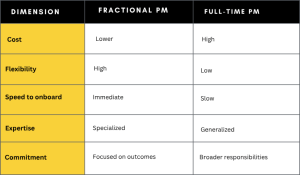
Fractional leaders focus on leverage.
Full-time leaders often manage complexity.
The Real Problem: Most Companies Don’t Need More Execution
They need clarity.
AI has made execution easier.
You can build faster than ever.
But most teams are building the wrong things.
Common issues:
- Building without validated problems
- Roadmaps driven by opinions
- No clear success metrics
- Teams moving fast in the wrong direction
Fractional product leadership addresses this root issue.
Fractional Product Management in the AI Era
This is where the model becomes even more relevant.
AI changes product development in three ways.
1. Faster Build Cycles
With AI tools, teams can prototype in days.
The constraint is no longer coding.
It is decision-making.
2. Higher Experimentation Volume
More experiments
More data
More signals
Without strong product leadership, this creates noise instead of insight.
3. New Product Paradigms
- AI agents
- Conversational interfaces
- Autonomous workflows
These require new thinking, not traditional product approaches.
Fractional leaders bring this perspective.
Common Mistakes When Hiring a Fractional Product Manager
1. Treating Them as a Consultant
If they are not embedded, they will not deliver results.
2. Lack of Internal Ownership
Fractional leaders need a team to execute.
Without execution capability, impact is limited.
3. Undefined Goals
No clarity = no outcomes.
4. Too Short-Term Thinking
Product transformation takes time.
Expecting results in weeks leads to failure.
How to Structure a Successful Engagement
Step 1: Define Outcomes
Not tasks.
Not hours.
Outcomes.
Example:
- Reduce onboarding time by 30%
- Increase activation rate
- Improve retention
Step 2: Align Stakeholders
Everyone must agree on priorities.
Step 3: Establish Cadence
- Weekly execution reviews
- Monthly strategy reviews
Step 4: Measure Impact
Track:
- Time to value
- Conversion rates
- Product adoption
Step 5: Iterate
Adjust based on real signals.
The ROI of Fractional Product Leadership
The value is not in cost savings alone.
It comes from:
- Faster time to market
- Reduced wasted development
- Better product-market fit
- Higher team efficiency
Companies report meaningful improvements in execution and alignment when product leadership is introduced correctly .
Where the Model Breaks
Fractional leadership is not always the answer.
It fails when:
- No execution team exists
- Leadership is not aligned
- Organization resists change
- No clear problem to solve
This is important.
Fractional leadership amplifies clarity.
It does not create it from nothing.
How ISHIR Helps
At ISHIR, we take the fractional product model further.
We combine:
- Product leadership
- AI-native development
- Outcome-based execution
Our approach is built around AI-Driven Product Development (ADPD).
Instead of just providing a fractional product manager, we deploy:
- Agentic Product Strategists
- AI-native engineering pods
- Embedded QA and validation
This ensures:
- Faster execution
- Clear alignment with business outcomes
- Reduced cost and risk
We do not stop at strategy.
We take ideas from concept to working product in weeks, not months.
This is critical in the AI era.
Why Fractional Product Leadership Is Not a Trend
This is not a temporary shift.
It reflects a deeper change in how companies operate.
We are moving from:
- Static roles → dynamic capabilities
- Headcount → outcomes
- Hierarchies → execution pods
Fractional leadership fits this new model.
The Future of Product Leadership
The next evolution is already happening.
Product leaders are becoming:
- More strategic
- More data-driven
- More AI-enabled
The role is no longer about managing backlogs.
It is about:
- Making better decisions faster
- Connecting product to business outcomes
- Driving continuous adaptation
Fractional models align perfectly with this.
Final Thoughts
Most companies do not fail because they lack talent.
They fail because they lack clarity.
Fractional product leadership is not about saving money.
It is about:
- Accelerating decision-making
- Aligning teams
- Delivering outcomes
In a world where execution is easier than ever, clarity becomes the competitive advantage.
Ready to Stop Building the Wrong Things Faster?
Book a 30-minute Fractional Product Strategy Call with ISHIR and discover how our AI-Driven Product Leadership can help you
FAQs
Q. What is a fractional product manager?
A fractional product manager is a senior product leader who works part-time with an organization, providing strategic and execution support without the need for a full-time hire. They integrate into the team and take ownership of product outcomes.
Q. How is a fractional PM different from a consultant?
A consultant provides recommendations. A fractional PM takes ownership, drives execution, and is accountable for results within the organization.
Q. When should a company hire a fractional product manager?
Companies should consider this model when they need senior product leadership but are not ready for a full-time hire, or when they need specialized expertise during growth or transition phases.
Q. What industries benefit most from fractional product leadership?
Technology, SaaS, healthcare, fintech, and enterprise innovation teams benefit the most due to the complexity and speed of product development.
Q. How much does a fractional product manager cost?
Costs vary based on experience and scope, but they are typically significantly lower than full-time roles since there are no long-term commitments or benefits involved.
Q. Can fractional PMs work with internal teams?
Yes. They are designed to integrate directly with internal teams and collaborate closely with engineering, design, and leadership.
Q. What outcomes should you expect?
Improved roadmap clarity, faster execution, better alignment, and measurable improvements in product metrics.
Q. How long should an engagement last?
Typical engagements range from 3 to 12 months depending on the business needs and product maturity.
Q. Is this model suitable for startups?
Yes. Especially for startups that need guidance without committing to expensive full-time hires.
Q. Does fractional leadership work for enterprises?
Yes. Enterprises use it for innovation, transformation, and bridging leadership gaps.
Q. What are the risks?
Lack of internal alignment, unclear goals, and insufficient execution capability.
Q. How do you measure success?
Through metrics like product adoption, retention, conversion, and time to market.
Q. Can fractional PMs help with AI products?
Yes. Many specialize in AI-driven product strategies and implementation.
Q. How quickly can they start?
Typically much faster than hiring a full-time role, often within weeks.
Q. Should a company transition to full-time later?
In some cases, yes. A fractional PM can help define the role before hiring full-time.
The post The Rise of the Fractional Product Manager in the AI Era appeared first on ISHIR | Custom AI Software Development Dallas Fort-Worth Texas.
Share
What's Your Reaction?
 Like
0
Like
0
 Dislike
0
Dislike
0
 Love
0
Love
0
 Funny
0
Funny
0
 Angry
0
Angry
0
 Sad
0
Sad
0
 Wow
0
Wow
0