The modern version of a fly trapped in amber: 3D printing your Gaussian Splat is one of the most amazing things I've seen in a long time
Want to DIY a perfect model of a local landmark to sit on your shelf in a 'dry snow globe' style? Now you can with a 3D-printed Gaussian Splat.

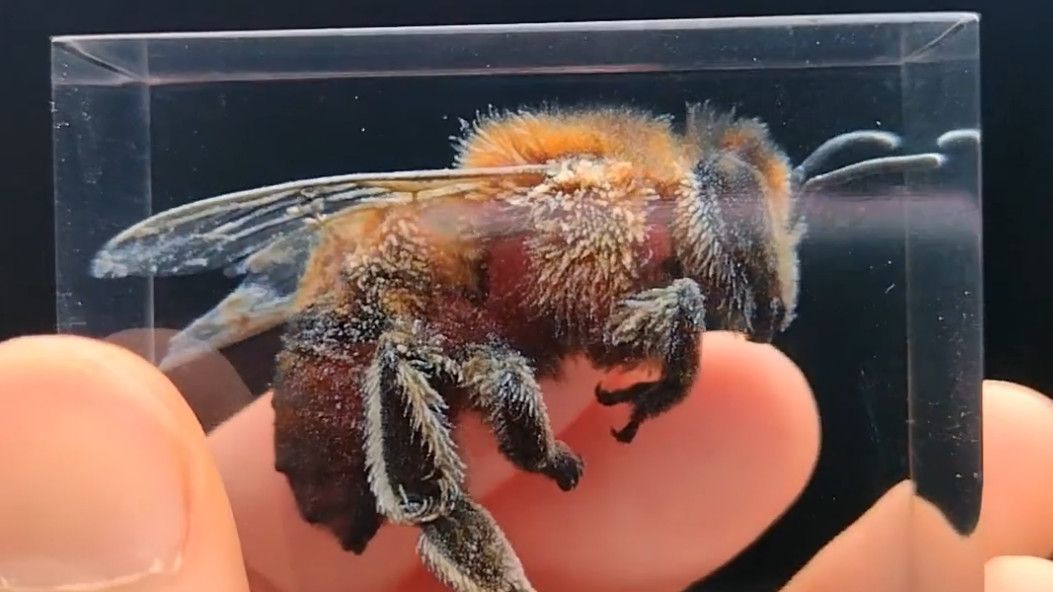
- Crysta can make a 3D printed model of a Gaussian Splat
- The detail level is quite remarkable
- It doesn't come cheap, but nonetheless, this is jaw-dropping stuff
Ever wanted to take a scene from real life and shrink it into a snow globe-style model (minus the snow) to sit on your shelf, preserved forever?
Well, maybe not forever, but you get the idea, and it's possible to do this now thanks to a firm called Crysta.
As Dany Bittel explains on Patreon, Crysta offered to turn one of their 'Gaussian Splats' – of a bee – into a real-world representation of the insect courtesy of a 3D printer.
@Crysta_AI printed one of my bees as a present! pic.twitter.com/HENIVMXaMJJune 18, 2026
The result, as you can see in the post on X above, is pretty spectacular. But wait a minute, I hear you ask (probably): a Gaussian what-now? If you're not familiar with the concept of a Gaussian Splat, it's a 3D model of a real place or thing, built from video footage that you've filmed on your camera (or maybe a drone for more adventurous constructs).
We've previously covered how this works in an in-depth article where we used a cloud-based service called Splatica to make our Splat, and suffice it to say, it's a very cool process with impressive results.
Going a step further with the impressiveness, though, is taking that Gaussian Splat model and 3D printing it. (Crysta can also do this with an alternative process, Neural Radiance Fields, or NeRF).
How is the model turned (back) into a physical rendition? Bittel notes that: "The Gaussian splat is first voxelated, a bit like a Minecraft level. Each voxel has a mix of inks and can be more or less transparent. This then gets printed on [a] special 3D printer, layer by layer."
Cubic cost
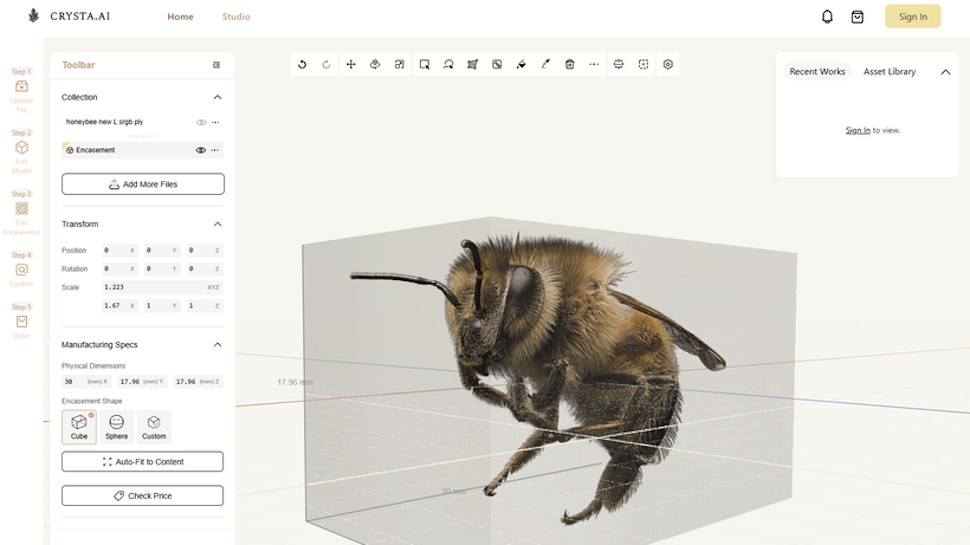
As Bittel observes, this is like a modern version of the fly trapped in amber, except it's an entirely artificial construct, built from an artificial model. I absolutely love the idea, and if you do too, you might be wondering how much it costs.
The truth is that it isn't cheap, as you might guess. You'll need to fork out for a Splatica subscription if you go the same way TechRadar did, which is quite pricey (or use an equivalent service or app).
The actual printing of the model by Crysta will run to something like $140 in the US for a 30mm cube, according to Bittel as a guide price (they got one for free, as a present, in case you were wondering). You can go up to a 300mm cube if you want an ornament with a real impact on your room (and likely your wallet, too).
The company ships the 3D printed models globally, although of course, it'll cost more to send outside of the US.
Share
What's Your Reaction?
 Like
0
Like
0
 Dislike
0
Dislike
0
 Love
0
Love
0
 Funny
0
Funny
0
 Angry
0
Angry
0
 Sad
0
Sad
0
 Wow
0
Wow
0