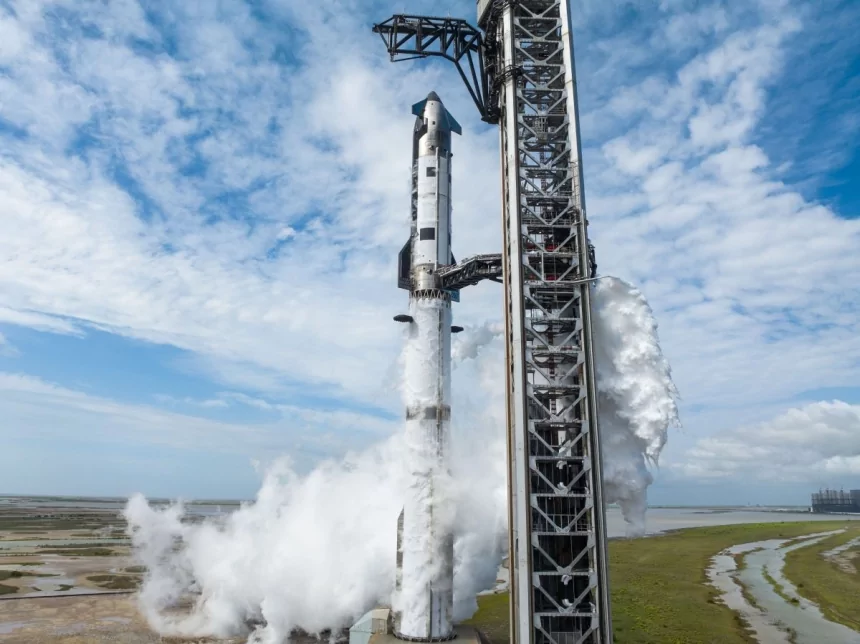
Orbiting space data centers may face an unexpected hurdle — from environmental politics
Environmental organizations want federal regulators to pause orbital data center approvals until comprehensive reviews examine cumulative environmental impacts and risks.


- Environmental groups seek broader review before massive satellite constellations receive approval
- More than one million proposed satellites face increased regulatory scrutiny
- FCC is reconsidering satellite environmental review rules
Environmental groups have petitioned federal regulators to pause approval of orbital data center satellite constellations pending a full environmental review process.
Earthjustice recently filed a petition on behalf of DarkSky International, Environment America, and Public Employees for Environmental Responsibility, known as PEER.
Combined proposals from SpaceX, Starcloud, Blue Origin, and Cowboy Space could place well over a million satellites into low Earth orbit.
Why regulators are being asked to slow down
The petition asks the Federal Communications Commission (FCC) to prepare a Programmatic Environmental Impact Statement before approving any pending applications currently under review.
Such a review, required under the National Environmental Policy Act, would examine risks, alternatives, costs, and cumulative impacts together across every proposal.
Environmental groups argue the agency's current approach treats satellite licenses as automatically excluded from any detailed environmental scrutiny under existing federal rules.
They say that framework no longer fits proposals measured in hundreds of thousands, or potentially millions, of individual spacecraft rather than dozens.
The filing lists specific concerns, including rocket emissions, reentry pollutants, ozone depletion, orbital debris, and disruption to astronomy research conducted worldwide.
The petition specifically challenges the FCC's default assumption that these projects individually and cumulatively carry no environmental impact whatsoever on nearby ecosystems.
It further warns that light pollution and wildlife disruption cannot be properly assessed through isolated regulatory reviews conducted individually rather than collectively.
The petition states that these proposals compound risk "synergistically and cumulatively" in ways single-project reviews cannot capture on their own.
Industry ambitions collide with regulatory uncertainty
Backers of orbital computing describe their projects in sweeping, civilization-changing language while offering few environmental details in return for regulatory approval.
Companies including SpaceX, Blue Origin, Starcloud, and Cowboy Space have not publicly detailed environmental mitigation plans for their satellites currently under regulatory review.
MOL and Hitachi have separately explored floating data center concepts, showing wider commercial interest beyond traditional orbital satellite proposals currently facing regulatory review.
The FCC is separately reconsidering its environmental review rules, acknowledging rapid growth across the broader commercial space industry over the past decade.
If the commission agrees, orbital data center operators could face considerable regulatory delay before launching any additional hardware skyward into low Earth orbit.
Some industry analysts have already questioned whether orbital data center economics make sense given high launch and maintenance costs involved in space deployment.
Analysts note that environmental reviews of this scope could take years, delaying deployment timelines.
This could delay deployment schedules and extend regulatory timelines if a comprehensive environmental review becomes mandatory.
Whether the FCC ultimately requires a full review remains uncertain, given ongoing industry pressure and competing national security interests tied to space dominance.
Until regulators decide, the fate of orbital computing may depend as much on environmental politics as on rocket technology or launch capacity itself.
Via The Register
Share
What's Your Reaction?
 Like
0
Like
0
 Dislike
0
Dislike
0
 Love
0
Love
0
 Funny
0
Funny
0
 Angry
0
Angry
0
 Sad
0
Sad
0
 Wow
0
Wow
0