OpenAI's ChatGPT Images 2.0 is here and it does multilingual text, full infographics, slides, maps, even manga — seemingly flawlessly
It's been only a few months since OpenAI released its last big improvement to AI image generations in ChatGPT and through its application programming interface (API) — namely, a new image generation model known as GPT-Image-1.5, released in December 2025, which brought about improved instruction following, colors, and lighting.Now, after weeks of testing, the company that kicked off the generative AI boom is unveiling a far more dramatic and even more impressive update: ChatGPT Images 2.0, which has been available not-so-secretly for several weeks on LM Arena AI, a third-party testing platform used by OpenAI and other major AI model providers to get early feedback, under the name "duct tape."Throughout that time, it's already blown early users' minds with its capacity to generate long blocks of text or disparate text panels within the same image, its insanely realistic generation of user interfaces and screenshots from popular websites and platforms, its reproduction of real life figur
It's been only a few months since OpenAI released its last big improvement to AI image generations in ChatGPT and through its application programming interface (API) — namely, a new image generation model known as GPT-Image-1.5, released in December 2025, which brought about improved instruction following, colors, and lighting.
Now, after weeks of testing, the company that kicked off the generative AI boom is unveiling a far more dramatic and even more impressive update: ChatGPT Images 2.0, which has been available not-so-secretly for several weeks on LM Arena AI, a third-party testing platform used by OpenAI and other major AI model providers to get early feedback, under the name "duct tape."
Throughout that time, it's already blown early users' minds with its capacity to generate long blocks of text or disparate text panels within the same image, its insanely realistic generation of user interfaces and screenshots from popular websites and platforms, its reproduction of real life figures like OpenAI co-founder and CEO Sam Altman, and its ability to perform web research and put the results into the image itself.
Now today, it's officially rolling out to ChatGPT users on all tiers, and OpenAI confirms it can also produce floor plans, image grids and sets of many smaller images, and character models from multiple angles, and apply almost all of these features to user-uploaded imagery as well.
The update, which encompasses the new gpt-image-2 model for API users and a suite of "Thinking" features for ChatGPT subscribers, represents a fundamental shift in how the company views visual media. As the official release notes state, "Images are a language, not decoration. A good image does what a good sentence does—it selects, arranges, and reveals".
OpenAI did not release benchmarks to us ahead of time on ChatGPT Images 2.0, but it is safe to say the model is performing at the "state-of-the-art" based on all the outputs I've seen.
The move comes as the AI image model space has seen increasing competition, especially with the release of Google's Nano Banana 2 image generation model (also known as Gemini 3 Pro Image or Gemini 3.1 Pro Image) in February 2026, which also offered dense text options "baked into" images similar to ChatGPT Images 2.0. But the latter's fidelity in reproducing user interfaces, screenshots, and multiple image packs at once seem to exceed even Google's latest image model's capabilities in my brief testing and anecdotal usage and observation of other users' images.
OpenAI spokespersons and researchers re-iterated the company's commitments to safety and tagging its image outputs with metadata as AI generated in the face of rising reports — including one recently from The New York Times — on AI user-generated characters (AI UGC) being used as the seed for realistic AI videos posted en masse on social media as part of political influence campaigns, including showing support for historically unpopular U.S. President Donald J. Trump with an army of fictitious people masquerading as "real Americans."
When VentureBeat asked in a closed press briefing directly about this story and GPT Images 2.0's potential for usage in deceptive campaigning or advertising/influence campaigns Adele Li, OpenAI's Product Lead for ChatGPT Images, responded:
"We take safety and security incredibly seriously. That includes anything when it comes to political or election interference. And so while other platforms and companies may not have those safeguards, ChatGPT does, and we take monitoring and protection of our users, as well as the influence that our photos as they are created, incredibly seriously..in the last couple years, we've seen a lot more new entrants into the image generation space with different standards and philosophies as ChatGPT, but we've stayed steady through all that, and we're really proud of releasing this model as it relates to advanced capabilities, but doing so in a safe and protected way."
OpenAI has also confirmed that it is deprecating GPT-Image-1.5 as the default model across its suite, though it will remain accessible via the API for legacy support. This transition signals OpenAI's confidence that the 2.0 model is a superior replacement for both casual and high-value creative tasks.
The reasoning era of AI image generation
The most significant technical advancement in Images 2.0 is the integration of OpenAI’s "O-series" reasoning capabilities.
Historically, image models have operated as black boxes: you provide a prompt, and a single output is generated. Images 2.0 introduces an "agentic" approach.
When a user selects a "Thinking" model within ChatGPT, the system no longer simply "draws"; it researches, plans, and reasons through the structure of an image before the first pixel is rendered.
During a live press briefing, Li demonstrated this reasoning by uploading a complex PowerPoint file regarding internal product strategies.
Rather than merely creating a related image, the model synthesized the document's core data, identified the correct logos, and produced a professional poster that preserved the specific stylistic inputs of the original file.
In my brief testing — I was given access last night and tested it on a few generations this morning — ChatGPT Images 2.0 is the first image model from OpenAI and one of only two (Nano Banana 2 being the other) that can seemingly accurately reproduce a map of the extent of the Aztec, Maya, and Inca empires at their respective heights along with a fully legible legend, making it useful for educational or internal training purposes on global knowledge and geography.
This reasoning capability also allows the model to search the web in real-time to ensure visual accuracy for current events or specific technical artifacts.
This is supported by a significantly more recent knowledge cutoff of December 2025, a major leap from previous iterations that struggled with modern context.
The underlying architecture has been "revamped from scratch," according to Research Lead Boyuan Chen. While Chen declined to confirm if the model uses a traditional diffusion or auto-regressive technique, he described it as a "generalist model" or a "GPT for images" that can handle 3D-style perspective shifts and complex spatial reasoning through simple text prompts.
Precision, multilingual support and a "wow" factor
The product experience for Images 2.0 is defined by three major pillars: typography, linguistic diversity, and sequential consistency.
One of the most persistent "tells" of AI-generated imagery has been the inability to render legible text. OpenAI claims Images 2.0 marks a "step change" in this department. The model is now capable of producing readable typography even in dense compositions, such as scientific diagrams, menus, or infographic posters.
A look at the provided "Magazine Cover" sample (Open Scifi) illustrates this precision: every headline, volume number, and even the "Display until" date on the barcode is rendered with crisp, professional alignment that mirrors human-designed layouts.
This capability extends into the "Thinking" mode, where the model can even generate three-page educational visuals—complete with quizzes—that maintain a consistent instructional flow.
OpenAI has also addressed a long-standing Western bias in AI imagery. Images 2.0 is described as a "polyglot" model with significant gains in non-Latin script rendering. Specifically, the model now supports high-fidelity text generation in Japanese, Korean, Chinese, Hindi, and Bengali.
In the "Global Language" diagram provided, which explains the water cycle, the model successfully renders complex Korean characters (Hangul) within an educational layout.
The text is not just translated; it is "rendered correctly but with language that flows coherently," ensuring that labels and explanations feel natively integrated into the design.
For creators working on storyboards or brand campaigns, the most impactful new feature is the ability to generate up to eight distinct images from a single prompt. Crucially, these images maintain "character and object continuity" across the series.
Li noted that this solves a "cumbersome" workflow where users previously had to prompt one image at a time and manually stitch them together. This feature enables the creation of entire manga sequences, children's books, or a family of social media graphics that share the same visual DNA.
Licensing and availability
OpenAI’s rollout strategy reflects a clear push toward professional and enterprise adoption. While the base model is available to all users—including those on the free tier—the advanced "Thinking" and "Pro" capabilities are reserved for paid tiers.
Free Users: Have access to the base ImageGen 2.0 model for standard tasks.
Plus and Pro Users: Can access "Thinking" capabilities, which include tool use, web search, and multi-image generation.
Pro Users: Receive additional access to "ImageGen Pro" models for more advanced image generation.
API Developers: Can integrate
gpt-image-2, which supports resolutions up to 4K (currently in beta) and flexible aspect ratios ranging from a wide 3:1 to a tall 1:3.
Pricing in the API is as follows, echoing GPT-Image-1.5, the predecessor model, but actually shaving off $2 on the output side:
Image $8.00 for inputs $2.00 for cached inputs $30.00 for outputs Text $5.00 for inputs $1.25 for cached inputs $10.00 for outputs
What is clear so far is that OpenAI is describing three practical layers of access, even if it has not published a precise tier-by-tier matrix.
The baseline is ChatGPT Images 2.0, which OpenAI's blog post states is available to all ChatGPT and Codex users and includes the core model improvements: better instruction following, stronger text rendering, multilingual gains, broader aspect ratios, and more polished, production-usable outputs.
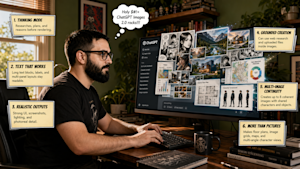
Above that is “thinking”, which the release defines more concretely: when a thinking model is selected, the system can take more time, use the web, analyze uploaded materials, reason through layout before generating, and produce multiple distinct images at once, including up to eight coherent outputs with continuity.
In the briefing, Li also framed thinking and Pro as “juiced-up” versions of the base model with tool use, and said these advanced modes are slower, not faster, because they do more reasoning and search behind the scenes. What remains unclear is the exact feature boundary between Thinking and Pro.
The materials say Pro users get access to more advanced image generation, but they do not spell out whether that means higher quality, higher limits, higher resolution, more outputs, or some other advantage distinct from thinking itself.
For enterprise users, the safest way to think about the differences is not as three totally separate products, but as a spectrum from fast default generation to slower, more agentic, more structured generation.
If a team needs quick creative drafts, marketing concepts, simple graphics, or everyday image edits, the base Images 2.0 model appears to be the relevant default.
If the task involves factual grounding, transforming internal documents into explainers, creating multi-image sets, or maintaining consistency across a sequence of assets, the more important distinction is whether the organization has access to thinking-enabled outputs.
Until OpenAI provides a clearer Pro-versus-Thinking breakdown, enterprise buyers should treat “thinking” as the meaningful functional upgrade and treat “Pro” as a possibly higher-end access tier whose exact incremental benefits still need clarification before procurement or workflow planning.
Safety standards
OpenAI’s says ChatGPT Images 2.0 offers a"multi-layered stack" of safety protocols, including:
Provenance: Adhering to industry standards for watermarking so that AI-generated images are identifiable.
Model Safeguards: Using advanced perception models to filter out harmful or abusive content for both adults and children.
Active Monitoring: Enforcing user policies through real-time reporting.
Li emphasized that while their philosophy is to "maximize user creativity," they maintain strict policies against election interference.
What it means for enterprise users
The shift from Images 1.5 to 2.0 is more than a resolution bump. By integrating reasoning, OpenAI is attempting to solve the "intent gap" that has plagued AI art since its inception.
When you ask an AI for an "infographic about supply and demand," you aren't just looking for a picture; you are looking for a logical layout of information.
The "Interior Design" sample (Japandi Furnishing Concept) highlights this systemic thinking. The model didn't just generate a room; it created a cohesive floor plan, a color palette, a list of materials, and "inspiration" shots that all adhere to a singular aesthetic.
This is what OpenAI calls moving from a "tool" to a "visual system". However, this increased capability comes with a trade-off in speed.
For the professional user, this is likely a worthwhile exchange: waiting an extra minute for a "production-ready asset" is still significantly faster than the hours required for manual design.
As ChatGPT Images 2.0 rolls out, it marks the beginning of an era where AI doesn't just assist in making art, but in conducting "economically valuable creative tasks".
Whether it can truly replace the intentionality of a human designer remains to be seen, but with 2K resolution, multilingual fluency, and the ability to "think" before it acts, OpenAI has certainly closed the distance.
Share
What's Your Reaction?
 Like
0
Like
0
 Dislike
0
Dislike
0
 Love
0
Love
0
 Funny
0
Funny
0
 Angry
0
Angry
0
 Sad
0
Sad
0
 Wow
0
Wow
0