Microsoft R&D jobs drop for second straight year as total headcount falls for first time in a decade
Microsoft's annual report shows the company employed 223,000 people as of June 30, down 5,000 from a year earlier and its first annual decline since 2016. Product R&D roles accounted for most of the drop. Read More

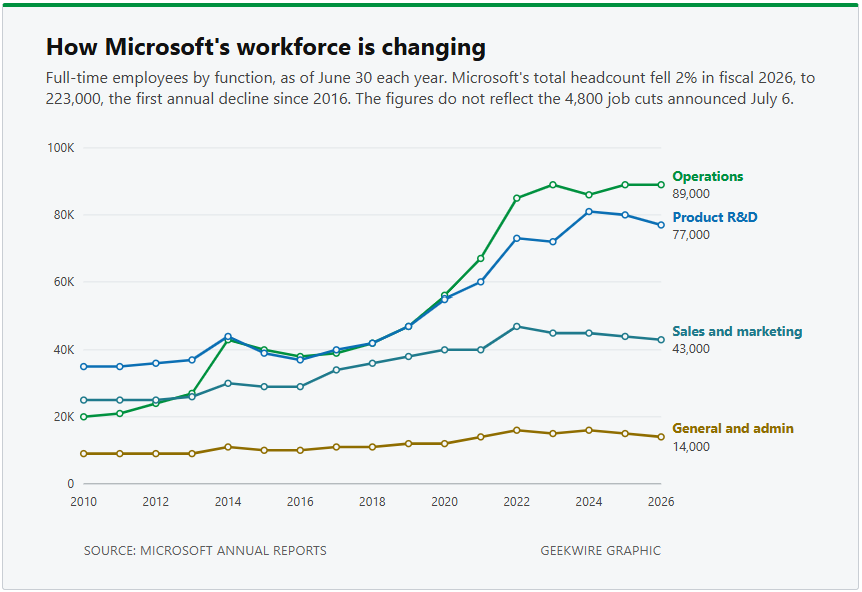
The number of product research and development roles at Microsoft declined for the second straight year, according to the company’s annual regulatory filing, offering a new indication of how the tech giant is reshaping its workforce in the AI era.
Microsoft’s total headcount declined by 5,000 people to 223,000 as of June 30, according to its Form 10-K, filed with the SEC this week. It’s the first annual employment decline for Microsoft since 2016, when the company was writing off and winding down its Nokia smartphone business.
The trend is notable in part because, over the same time period, Microsoft’s revenue rose 18%, or $50.1 billion, to $331.8 billion — the largest one-year increase in the company’s history.
Here’s how the employment trends break down:
- Product R&D roles represented the majority of the net decline, falling by 3,000, to 77,000 — down from a peak of 81,000 in 2024.
- Operations roles, now Microsoft’s largest employment category, held steady at 89,000 after growing by 3,000 the year before. It includes datacenter operations, product support, consulting, and manufacturing and distribution.
- Sales and marketing roles declined by 1,000, to 43,000, and general and administration by 1,000, to 14,000.
- The reductions fell disproportionately on Microsoft’s U.S. workforce, which declined by 4,000, to 121,000. International employment declined by 1,000, to 102,000.
The numbers reflect the roughly 9,000 jobs Microsoft cut on July 2, 2025, two days into its fiscal year. They do not reflect the 4,800 cuts announced July 6 of this year — spanning sales, consulting and Xbox — or the thousands of U.S. employees who left in early July under the company’s first voluntary retirement program.
On the earnings call Wednesday, CFO Amy Hood confirmed that “total company headcount declined 2% year over year.” She linked a 10% increase in operating expenses to “continued investment in R&D compute capacity, talent, and data to support product development across the portfolio.”
AI coding tools — including Microsoft’s own GitHub Copilot — have become a standard part of how software is built at Microsoft and across the industry, reducing the number of people and the amount of time it takes to ship products, while often expanding the total scope of the work.
Microsoft has repeatedly declined to link its job cuts to AI. Chief People Officer Amy Coleman said in a memo earlier this month that the roles being eliminated were not being directly replaced by AI, while acknowledging that “AI is changing how work gets done.”
Tech companies have been keeping a tighter rein on operating expenses, primarily through job cuts, in part to offset soaring capital expenses to support their AI infrastructure buildouts. Microsoft’s capex reached $41 billion in the June quarter alone.
Microsoft is also moving engineers out of product development and into customer-facing roles. The Microsoft Frontier Company, a $2.5 billion initiative announced July 2, brings together more than 6,000 people to embed engineers inside customers building AI systems — a group drawn “primarily from Microsoft’s existing engineering and forward-deployed teams,” according to the company.
Share
What's Your Reaction?
 Like
0
Like
0
 Dislike
0
Dislike
0
 Love
0
Love
0
 Funny
0
Funny
0
 Angry
0
Angry
0
 Sad
0
Sad
0
 Wow
0
Wow
0