Microsoft earnings preview: Record AI spending, and a stock near a one-year low
Microsoft reports fiscal fourth-quarter and full-year results Wednesday. A look at the key numbers to watch, including capital spending, Azure growth, cloud margins, Copilot adoption and the company's first capital spending forecast for fiscal 2027. Read More

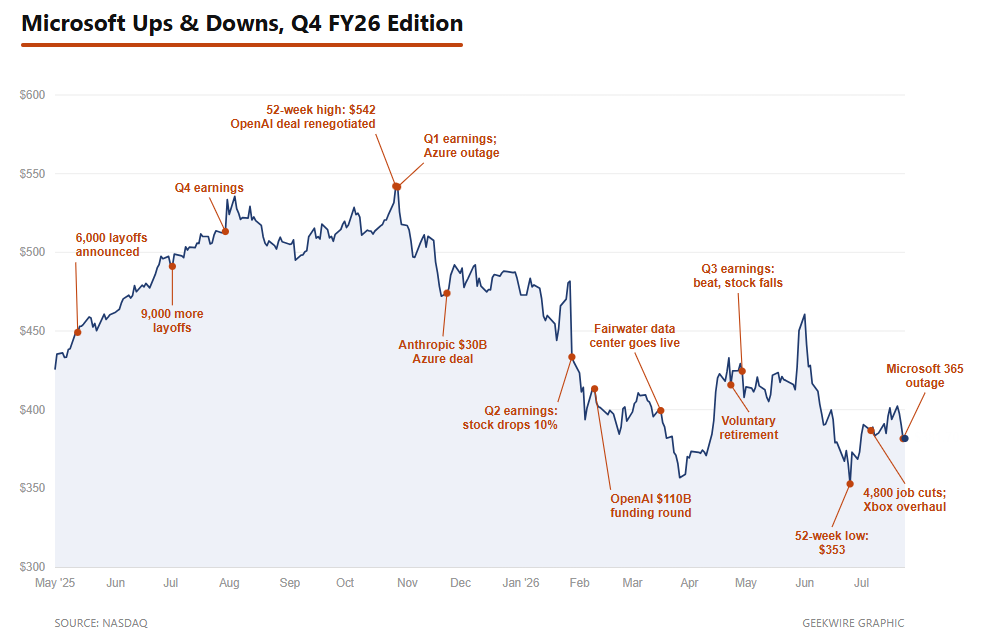
Microsoft has topped earnings expectations consistently in recent years, yet its stock is near a one-year low. So while it’s worth paying attention to revenue and profits when the company reports its fiscal year-end results Wednesday, there are clearly other forces at play on Wall Street.
Here are the key stats and trendlines to watch going into the earnings report for the fourth quarter of the company’s 2026 fiscal year, ended June 30.
Core numbers: Analysts expect revenue of about $87.7 billion for the quarter, up 14.7% from a year ago, and earnings of $4.24 per share, up 16%, according to Yahoo Finance. Microsoft’s own revenue guidance was $86.7 billion to $87.8 billion — meaning Wall Street is looking for a result at the very top of the company’s range.
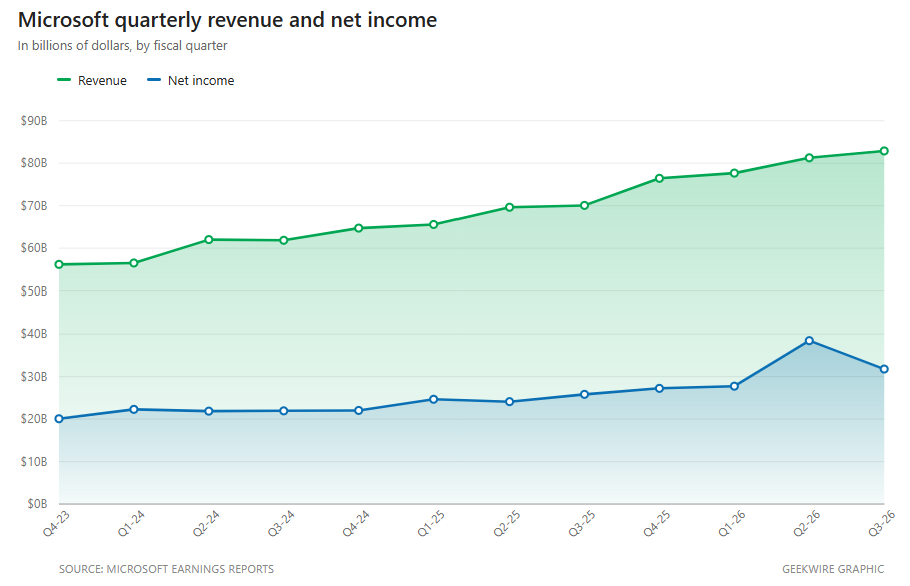
For the full fiscal year, that works out to roughly $329 billion in revenue, up 17% from $281.7 billion in fiscal 2025.
Capital expense: This is the big one. Microsoft told investors to expect more than $40 billion in capital spending for the quarter, which would be a record — up from $31.9 billion in the March quarter and $37.5 billion in the one before that. About two-thirds goes to GPUs and other short-lived hardware.
For the calendar year, the company expects to spend roughly $190 billion. Chief Financial Officer Amy Hood said about $25 billion of that total is the result of higher component prices.
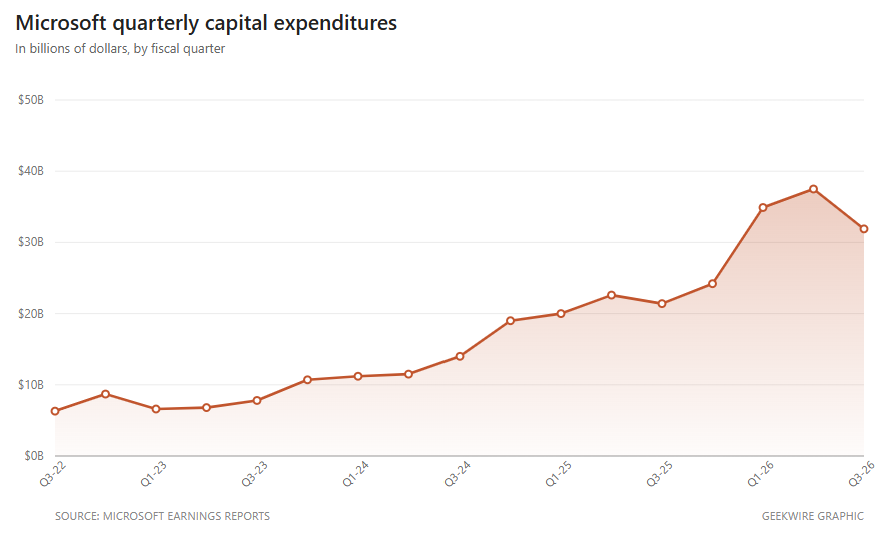
One big question this week will be the company’s guidance for capex going forward. Because this is the fiscal year-end, Wednesday brings the company’s first capital spending guidance for fiscal 2027, which began July 1.
Capex concerns: Google parent Alphabet last week foreshadowed what may happen to Microsoft. It reported revenue up 24% and cloud revenue up 82%, then raised its own capital spending forecast to as much as $205 billion — well above the roughly $188 billion analysts expected. The stock fell 7% the next day and Alphabet fell below its prior $4 trillion market valuation.
Big picture, investors seem to have decided the capital spending is getting ahead of the payoff. Data centers and chips cost money now, while the AI revenue meant to justify them arrives over years — if it ever reaches the scale these companies are promising.
Moody’s Ratings raised its own red flags about this last week, saying the six largest cloud and AI platforms will spend about $785 billion this year and close to $1 trillion in 2027. Demand is real and accelerating, the ratings agency said, but “the ultimate return on investment is unclear.”
Cloud margins: This is where the capital spending starts to become evident in the company’s core quarterly results. Microsoft Cloud gross margin — the share of cloud revenue left after the cost of delivering the service — has slipped from 72% three years ago to 66% last quarter.
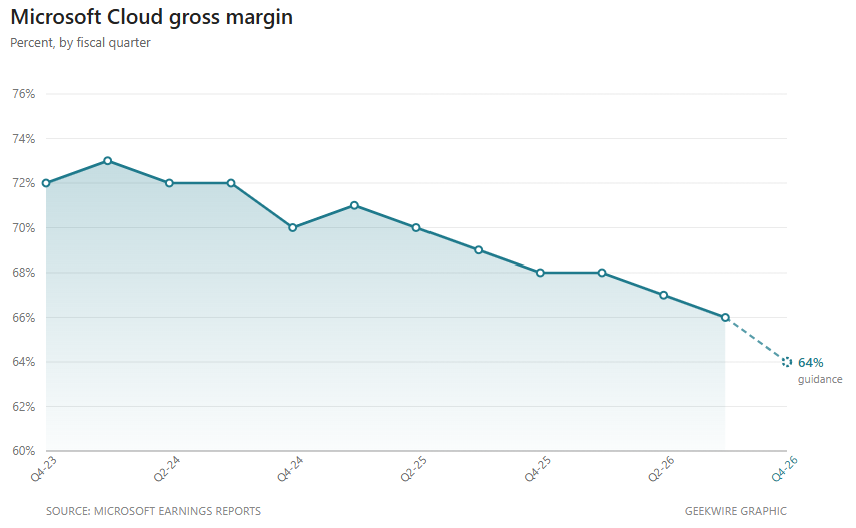
For the quarter it reports Wednesday, Microsoft told investors to expect about 64%. On the prior earnings call, Hood attributed the decline to AI infrastructure costs and growing use of GitHub Copilot, partly offset by efficiency gains in Azure.
Microsoft doesn’t absorb the cost of a data center all at once. It spreads the expense across the years the equipment is expected to last. That cost shows up here, in the expense of running the cloud — making this one of the first places where the capital spending hits earnings.
Microsoft Azure: On its prior conference call, Microsoft said it expected the Azure cloud business to grow 39% to 40% in constant currency in Q4, a slight acceleration from the 39% posted in Q3. Analysts expect roughly the same, with some outliers such as BNP Paribas looking for 41%.
But the published expectations aren’t the real bar. In January, Azure grew 38% — ahead of Microsoft’s guidance — and the stock fell 10%, because Wall Street had privately been expecting 39.4%.
Azure’s growth rate also reflects a choice as much as it does demand. Microsoft has been routing scarce computing capacity to its own products first — Copilot, GitHub Copilot, internal research — and selling what remains to Azure customers. Hood has said the growth rate would have been higher had that capacity gone to customers instead. Demand continues to outrun supply, and the company expects to stay “constrained at least through 2026.”
Business Insider reported Sunday that the shortage of supply has pushed Microsoft to shop for additional computing capacity outside its own data centers, evaluating capacity from Amazon and Google, and that Amazon stepped in following a series of GitHub outages.
Copilot and AI revenue: Microsoft said in April that its AI business had reached a $37 billion annual revenue run rate, up 123% from a year earlier. It was the first update to that number since January 2025, when the company put it at $13 billion. Whether Microsoft discloses it a third time Wednesday is a signal in itself.
Microsoft 365 Copilot passed 20 million paid seats last quarter, up from 15 million in January. That’s about 4.4% of the 450 million commercial seats across Microsoft 365 — the gap that has drawn skepticism from investors all year. Microsoft said it expects the number of new paid seats to grow again this quarter.
Meanwhile, the company is launching new initiatives to drive adoption of AI among its customers. Earlier this month it launched the Microsoft Frontier Company, a $2.5 billion effort to put 6,000 engineers inside customer organizations to help them deploy AI.
Wednesday is also the first report since Microsoft changed how it charges for GitHub Copilot. As of June 1, customers pay based on usage rather than a flat fee per user.
The OpenAI backlog: Microsoft’s remaining performance obligations — RPO, a measure of contracts customers have signed but the company has not yet fulfilled — reached $627 billion last quarter, up 99% from a year earlier. About a quarter of that is expected to become revenue in the next 12 months. It’s the strongest evidence that there’s real demand supporting the AI buildout.
But the RPO is also highly concentrated. In January, when it stood at $625 billion, 45% was tied to OpenAI — roughly $281 billion committed by a single customer that is still losing money. Take OpenAI out of last quarter’s figure and the growth drops from 99% to 26%.
Then in April, Microsoft and OpenAI revamped their partnership, and OpenAI ended its exclusive commitment to run on Azure.
Reliability: On July 23, a bug in Microsoft’s automated network maintenance tooling cut a West US Azure data center off from the company’s global network, knocking out Teams, SharePoint, OneDrive and Copilot Chat for about five hours. Microsoft has published a preliminary post-incident report, and a final one is due within two weeks.
The outage falls in the quarter that began July 1, so it won’t appear in Wednesday’s numbers. But it comes as Microsoft is asking businesses to hand AI agents real control of their operations.
Retirement charge: Wednesday’s results will include about $900 million in one-time costs from Microsoft’s voluntary retirement program, the first in the company’s 51-year history. Hood said roughly $350 million falls in the cost of revenue and $550 million in operating expenses.
About 8,750 U.S. employees were eligible — 7% of Microsoft’s U.S. workforce — and about 30% accepted, Chief People Officer Amy Coleman confirmed in an interview with GeekWire, in line with what the company expected. Those departures reduced the size of the 4,800-job cut Microsoft announced July 6, which happened after this quarter ended.
Even with the retirement costs, Microsoft told investors it expects operating margins for the full fiscal year to be about a point higher than last year. Hood also said on last quarter’s call that headcount declined year over year and will keep declining in fiscal 2027.
Windows: Microsoft expects Windows OEM revenue — what PC makers pay to put Windows on their machines — to decline close to 20% this quarter.
A few factors are driving this:
- Last year’s wave of PC upgrades, when support for Windows 10 ended, makes for a tough comparison.
- PC makers stocked up on parts and machines ahead of rising memory prices and are now working through them.
- The PC market itself is slower, because memory prices have made computers more expensive.
The memory shortage is hitting Microsoft a few different ways. In addition to adding about $25 billion to the company’s capital spending this calendar year, as noted above, it lowers what Microsoft earns from Windows. Also, in late June, Microsoft raised Xbox console prices by $100 to $150, saying storage and memory costs had risen more than 2.5 times.
This week: Facebook parent Meta reports the same afternoon as Microsoft, with Apple and Amazon on Thursday and Alphabet already out. Check back Wednesday afternoon for coverage.
Share
What's Your Reaction?
 Like
0
Like
0
 Dislike
0
Dislike
0
 Love
0
Love
0
 Funny
0
Funny
0
 Angry
0
Angry
0
 Sad
0
Sad
0
 Wow
0
Wow
0