Kimi AI review
Kimi is Moonshot AI's AI assistant built on K2.6, offering deep research, agentic workflows, and developer-friendly pricing for demanding workloads.

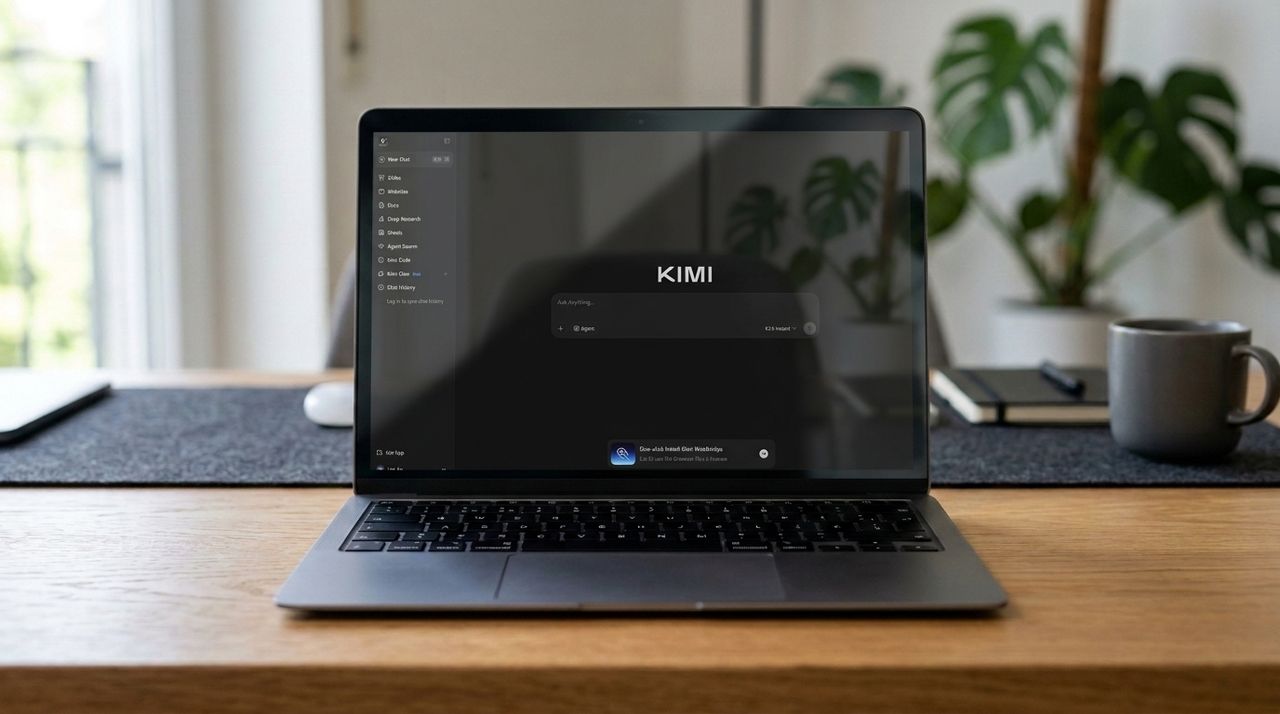
Kimi is the AI assistant developed by Moonshot AI, a Beijing-based company that built its reputation on long-context processing long before that became standard. The platform runs on Kimi K2.6, an open-weight Mixture-of-Experts model released in April 2026, and it has made real inroads among developers looking for frontier-quality AI at a lower cost than OpenAI or Anthropic.
Two things set Kimi apart. Its API pricing sits around $0.55 per million input tokens against GPT-5.4's much higher rates, and its Agent Swarm architecture can coordinate up to 300 parallel sub-agents for large-scale automated workflows. The platform also covers the full office productivity stack with Slides, Docs, Sheets, and a website builder under one subscription.
We've been reviewing B2B software at Techradar Pro since 2012. You can also check out our other generative AI coverage, including our best AI tools roundup and our 2026 vibe coding buying guide.
What is Kimi?
Kimi is an AI chat assistant and agent platform from Moonshot AI. It launched in October 2023 with a focus on long-context processing, and its first version handled 128,000 tokens of context, which was exceptional at the time. The platform has since grown into a broader productivity suite covering deep research, document creation, coding, and multi-step agentic automation.
The underlying K2.6 model uses a 1-trillion-parameter Mixture-of-Experts architecture with around 32 billion parameters activated per token, keeping inference costs low while maintaining strong benchmark performance. It supports a 256K–262K token context window and processes text, images, code, and video natively.
Kimi targets developers, researchers, and teams running demanding workloads. Casual users get good value from the free tier, but the platform's design clearly aims at power users who need more than a chatbot.
Kimi: At a glance
Attribute | Notes |
Underlying model(s) | Kimi K2.6 — 1T-parameter MoE, 32B active params, 256K–262K context, native multimodal |
Best for | Deep research, long-document analysis, agentic coding, full-stack web generation |
Distinguishing functions | Agent Swarm (300 sub-agents), Kimi Code, Deep Research, Claw Groups, WebBridge |
UI features | Four response modes: Instant, Thinking, Agent, Agent Swarm; available on web, iOS, Android |
Subscription costs | Adagio (Free), Moderato ($19/mo), Allegretto ($39/mo), Allegro ($99/mo), Vivace ($199/mo) |
API pricing | Around $0.55/M input tokens and $2.65/M output tokens; OpenAI-compatible; context caching cuts input costs by up to 75% |
Buy it if…
- You need a capable coding assistant at a lower price point. Kimi Code, available from the Moderato tier upward, pairs K2.6 with terminal and VS Code integration and holds up well on multi-file refactors.
- Your work involves very long documents. The 262K-token context window lets you work through large contracts, codebases, or research papers in a single session without manually chunking content.
- You're building agent-driven automation. Agent Swarm on the Allegretto plan can coordinate up to 300 parallel sub-agents across 4,000 coordinated steps, a serious option for teams with research or data processing pipelines.
Don't buy it if…
- You need live customer support. Kimi's support is self-serve through a help center and community channels, with no live chat or phone line.
- Data residency is non-negotiable. Moonshot AI is a Chinese company. Teams in regulated industries or with strict EU/US data sovereignty requirements should verify Kimi's data policies before committing.
- Agent Swarm is your main draw but you want entry-level pricing. Full agentic features only unlock at $39/month and above, while the free tier limits you to one concurrent task.
My time with Kimi
My first session was document-heavy. I dropped two long PDFs into the same conversation and asked Kimi to cross-reference specific sections. The results were accurate and well-organized, and the platform held up when I pushed with follow-up questions. That long-context handling is one of Kimi's strongest suits, accessible even on the free tier.
I also tested Kimi Code on a Python refactoring task. The output was clean, and when I asked it to explain architectural decisions, the reasoning held up. It's not quite at the same level as Claude Code for structured explanations, but the price difference makes the trade-off easy to accept for many workflows.
Agent Swarm on the Allegretto plan handled a competitive research task reasonably well, but the orchestration was not always transparent. A few sub-tasks returned incomplete results without flagging them as such, so I had to verify outputs manually. The platform has improved since K2.5, where tool call failures reportedly ran around 12%, but production users should still build in a review step.
Kimi: Features
Kimi's four response modes cover most use cases without requiring much configuration. Instant works for quick answers, Thinking for step-by-step reasoning, Agent for research and creation tasks, and Agent Swarm for parallel execution at scale.
Deep Research runs multi-step research workflows autonomously, pulling from web sources and producing structured reports. The output quality is good enough for first drafts, and the process shows which sources were used. Kimi Code supports multi-file editing and autonomous bug-fixing; Moonshot's documentation references coding sessions running continuously for over 13 hours on complex tasks.
The productivity suite covers Slides, Docs, Sheets, and Websites, giving Kimi a broader surface area than most chat platforms. The Websites tool generates full-stack sites from a single description, including frontend, backend, and database layers. These tools aren't the most polished in their respective categories, but having them integrated into one platform adds real convenience for teams with varied workflows.
Kimi: User experience
The main Kimi interface is clean and web-first. The four response modes are clearly labeled, and mode-switching during a conversation is straightforward. A memory system carries context across sessions when you want it to. Mobile apps on iOS and Android work well for basic tasks, though agent workflows are better suited to desktop.
There's no structured onboarding tutorial, so new users will spend time with the help center. It covers everything from getting started through API usage across roughly 12 categories. Community channels on Discord and Reddit are active enough that you'll usually find someone who's hit the same issue.
Kimi: Customer support
Support is self-serve. The help center at kimi.com/help covers memberships, billing, API usage, and troubleshooting in detail. Discord and Reddit communities fill in the gaps for newer features.
What's missing is human support. There's no live chat, no prominently listed support email for general users, and no phone line. For a platform targeting developers running production workflows, that's a gap worth knowing about before you sign up. Enterprise arrangements may exist but aren't clearly documented publicly.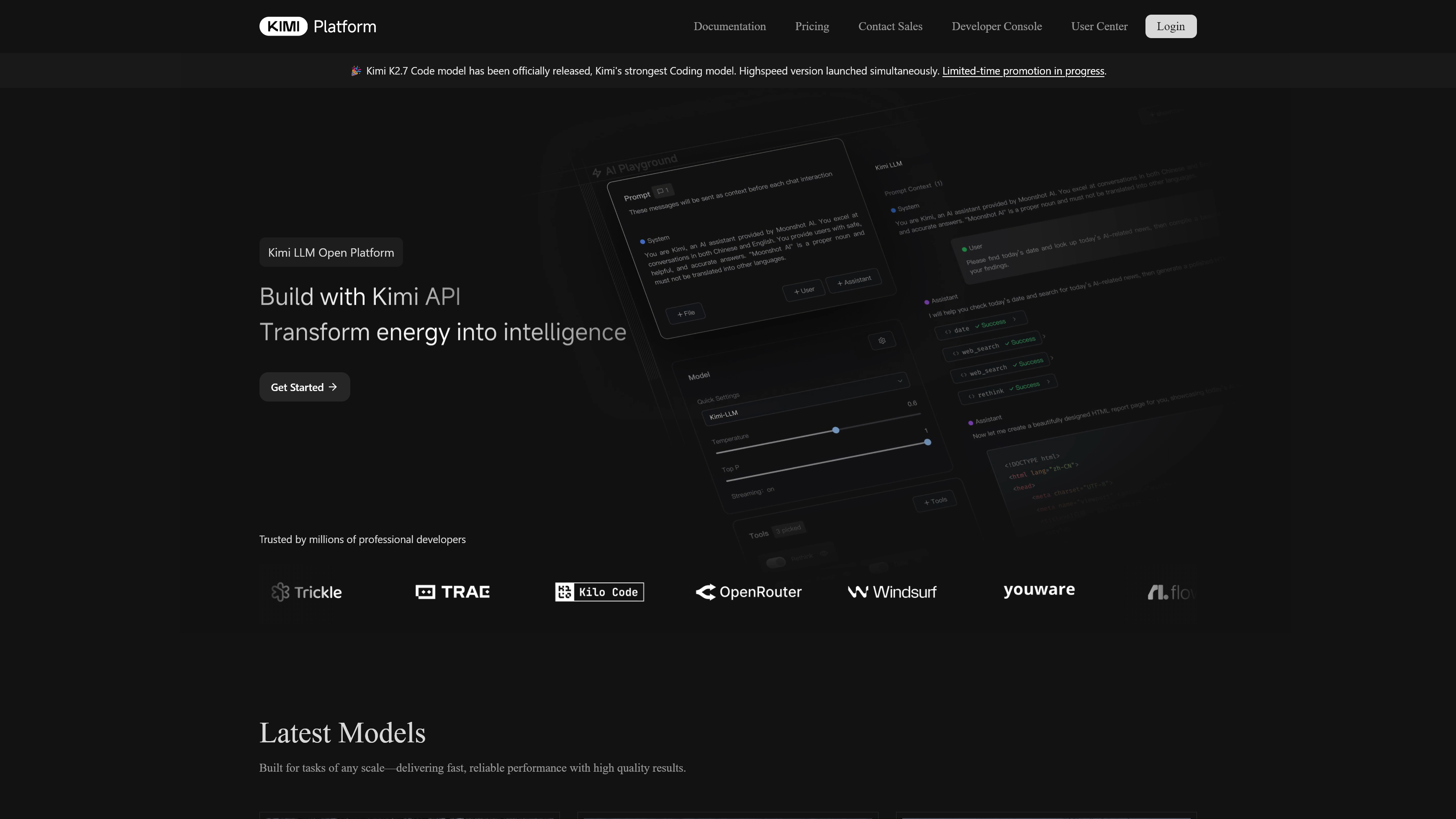
Kimi: Pricing
- Free (Adagio): Basic K2.6 access, limited agent usage, one concurrent task, no Agent Swarm, no Kimi Code quota.
- Moderato ($19/month): K2.6, Deep Research, Kimi Code, Slides, Websites.
- Allegretto ($39/month): Adds Agent Swarm and a higher professional data quota.
- Allegro ($99/month) and Vivace ($199/month): High-volume tiers; Vivace includes 30x Kimi Code usage and 240 swarm uses per month.
The free tier has no hard daily message limit as of mid-2026, which compares well to ChatGPT's free plan. For developers, API pricing is where Kimi's value is sharpest: around $0.55 per million input tokens and $2.65 per million output tokens, with an OpenAI-compatible endpoint. Context caching cuts input costs by up to 75% for applications sending repeated prompts, making it one of the more cost-efficient frontier options for teams building at scale.
Kimi alternatives you should consider
- ChatGPT (OpenAI): The most widely used AI assistant, with a mature plugin ecosystem. Its $20/month Plus tier is roughly equivalent to Kimi's Moderato plan, but API costs are significantly higher for developers building at scale.
- Claude (Anthropic): Claude Pro at $20/month is a strong choice for document-heavy workflows and structured outputs. Claude Code is well-regarded for teams that prioritize explainability in AI-generated code.
- Gemini Advanced (Google): A natural fit for teams already in the Google Workspace ecosystem, with strong document workflow integration through Drive.
How I tested Kimi
- Ran multi-document research tasks and stress-tested the context window with long technical files to evaluate accuracy across extended sessions.
- Tested the VS Code extension and CLI agent on Python and JavaScript tasks, including multi-file refactors and debugging workflows.
- Ran research and synthesis tasks using Agent and Agent Swarm modes on the Allegretto plan, checking output accuracy and how the platform handled incomplete results.
Kimi is available at kimi.com on a freemium model, with paid plans starting at $19/month. API access is available separately through Moonshot AI's open platform.
Share
What's Your Reaction?
 Like
0
Like
0
 Dislike
0
Dislike
0
 Love
0
Love
0
 Funny
0
Funny
0
 Angry
0
Angry
0
 Sad
0
Sad
0
 Wow
0
Wow
0