I spent a month with the Motorola Razr Plus 2026, and it's a great flip phone with a worryingly short lifespan
I tested the Motorola Razr Plus 2026 (or Razr 70 Plus), and while it boasts impressive hardware, I fear for its longevity.

Motorola Razr Plus 2026: Two-minute review
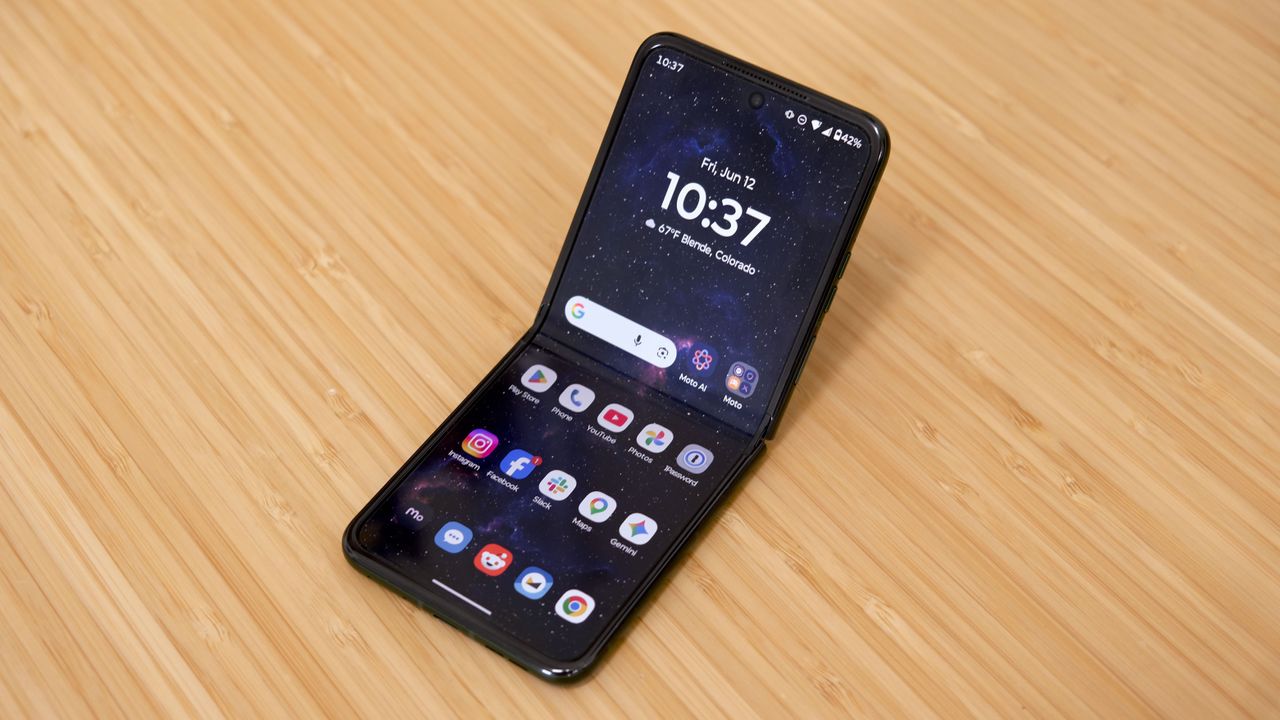
The Motorola Razr Plus 2026 (or Razr 70 Plus, as it's known in some regions) is as puzzling as it is pleasing to use. On the plus side, it boasts a sturdier hinge, all-day battery life thanks to its 4,500mAh cell, two displays that are easily visible in direct sunlight, and a main camera that takes stunning portrait photos that are sure to impress your friends and family.
But Motorola made some odd decisions with the Razr Plus that I'm still scratching my head over. In the US, it costs $100 more than its predecessor, which, given the rising cost of pretty much everything right now, might make sense on its own. However, Motorola used the same processor in this new model as it used in the previous two generations of the Razr Plus family. And while it's still snappy and can handle everyday tasks and some gaming with ease, paying more for the same ol' tech doesn't sit right.
What's more, Motorola is promising Razr Plus 2026 owners three years of OS upgrades and five years of security updates, both of which trail Samsung and Google's seven-year guarantee.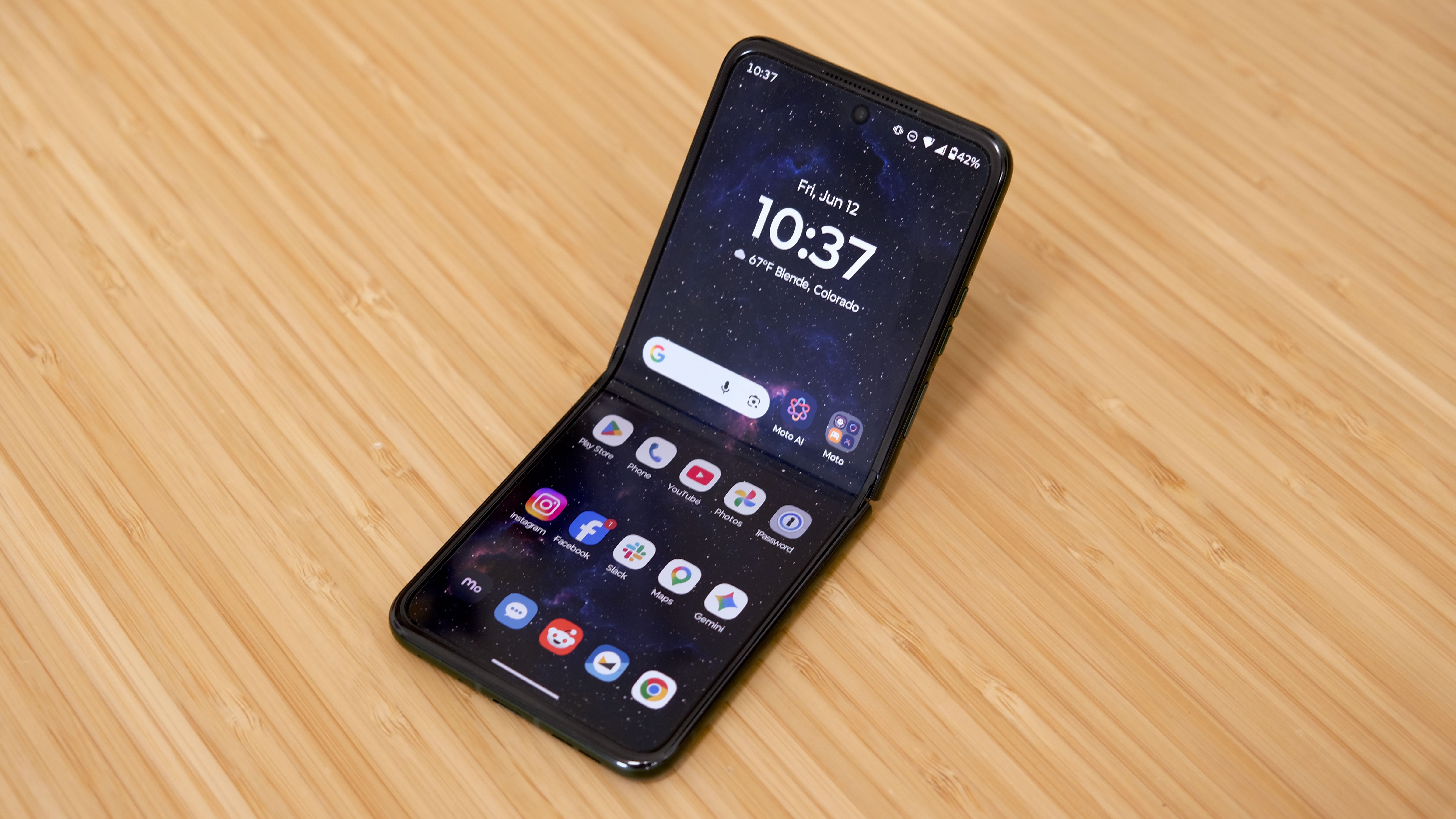
The camera setup is a mixed bag. Motorola removed the telephoto camera and replaced it with an ultra-wide shooter. If you take a lot of wide-angle photos, you'll be smitten. However, if you ever find yourself wanting to zoom in on anything — your kid's performance at school or a sign across the room — you're sure to be disappointed.
Ultimately, the Razr Plus 2026 is an excellent clamshell flip phone that is incredibly fun to use, but its recycled hardware places it in an awkward position. If you want a phone that will confidently turn heads, give you an intuitive cover screen experience, and last all day, it delivers — just don't expect it to keep up with the fast-evolving world of on-device AI a few years down the road.
Motorola Razr Plus 2026 review: Price and availability
- 12GB + 256GB for $1,099 in the US
- 12GB + 512GB for £1,000 in the UK
- Not available in Australia
The Motorola Razr Plus launched on May 21, 2026 and is available to purchase from Motorola directly. In the US, it's also available at third-party retailers like Amazon, but only in a single configuration of 12GB of RAM and 256GB of storage, for $1,099. That's a price increase of $100 over last year's model.
In the UK, Motorola sells a slightly different configuration of the Razr Plus, known as the Razr 70 Plus. It also comes with 12 GB of RAM, but doubles the storage to 512GB for £1,000.
At the time of writing, the Razr Plus 2026 is not available in Australia.
For reference, the Samsung Galaxy Z Flip 7 and Galaxy Z Flip 7 FE cost $1,099 / £1,049 / AU$1,799 and $899 / £849 / AU$1,499, respectively, while the cheaper Razr 2026 and Razr Ultra 2026 cost $799.99 / £799.99 and $1,499.99 / £1,199.99, respectively.
In other words, the Razr Plus 2026 is in the middle of the pack in terms of price. It's not the most expensive flip phone you can buy, but it's far from cheap.
- Value score: 3 / 5
Motorola Razr Plus 2026 review: Specs
Here's a breakdown of the Motorola Razr Plus 2026's key specs:
Dimensions: | Closed: 3.5 x 2.9 x 0.6 in |
Weight: | 189g |
Display: | Cover display: 4-inch AMOLED |
Resolution: | Cover display: 1272 x 1080 |
Refresh rate: | Cover display: 165Hz |
Peak brightness: | Cover display: 2,400 nits |
CPU: | Qualcomm Snapdragon 8s Gen 3 |
RAM: | 12GB |
Storage: | 256GB |
OS: | Android 16 |
Cameras: | 50MP main, 50MP ultra-wide |
Selfie Camera: | 32MP |
Battery: | 4,500mAh |
Charging: | 45W wired, 15W wireless, 5W reverse wireless |
Colors: | Pantone Mountain View |
Motorola Razr Plus 2026 review: Design
- New titanium hinge is more durable
- Mesh pattern on the back adds some grip
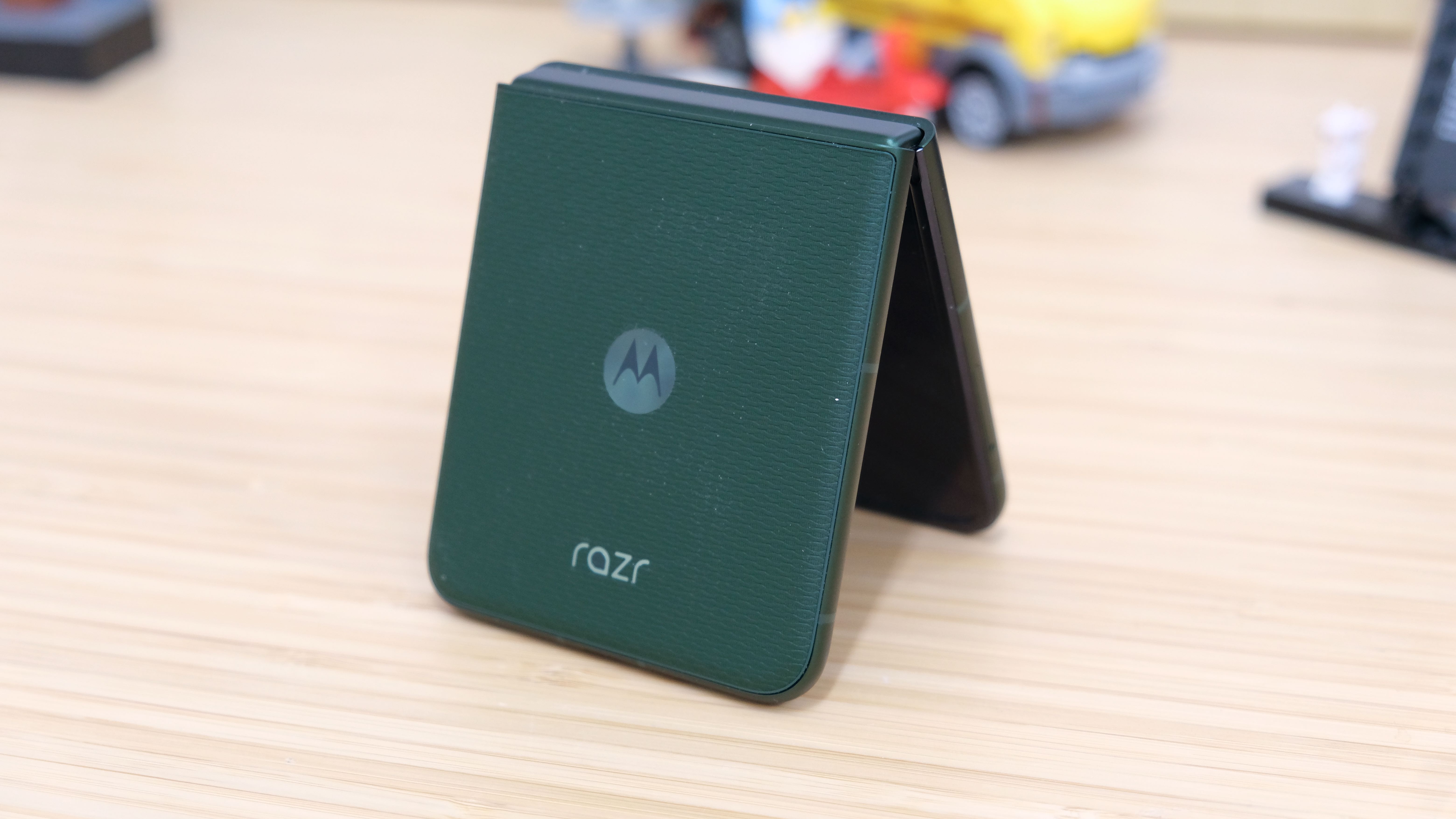
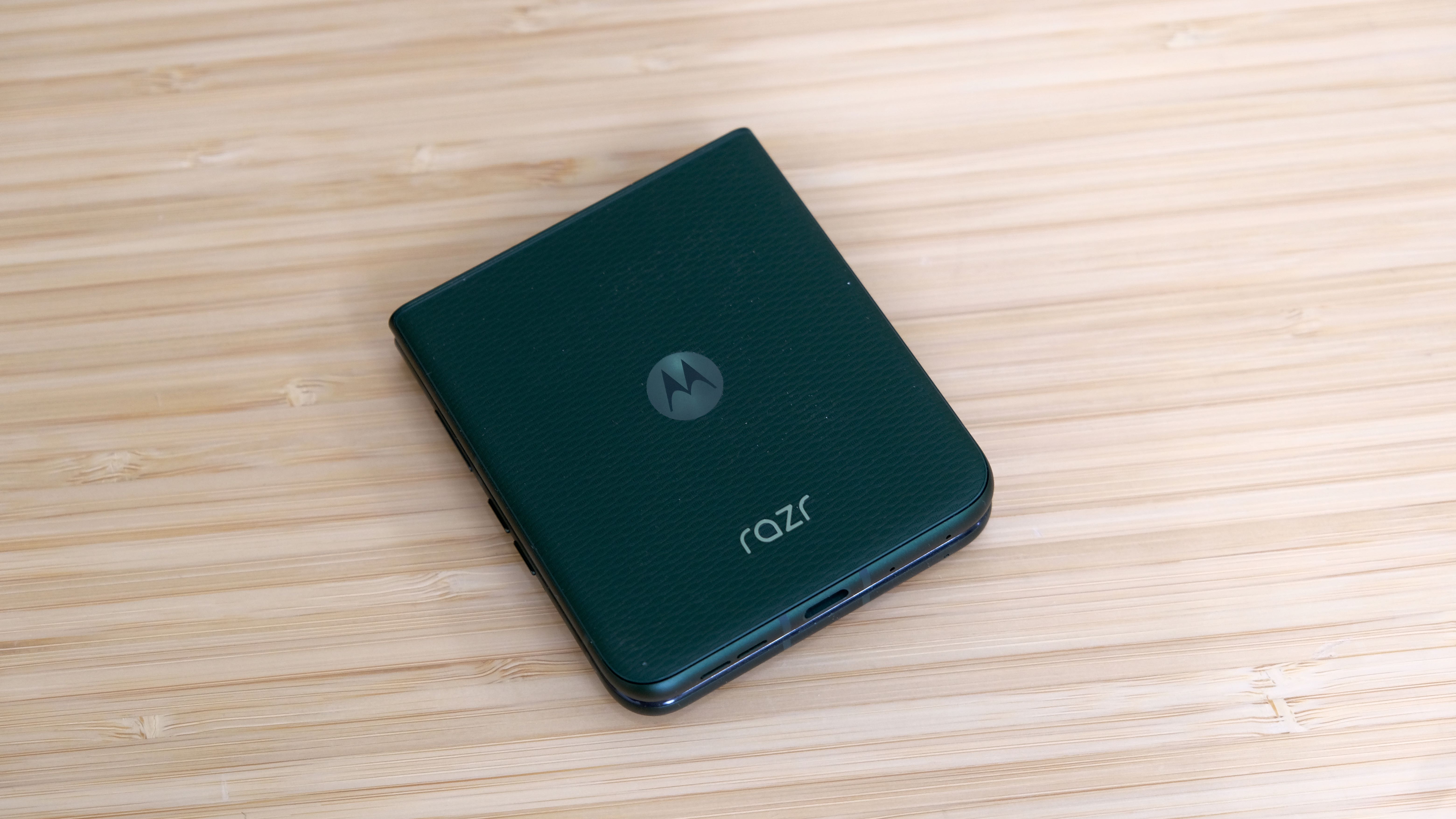
The 2026 version of the Motorola Razr Plus is available in one color: Pantone Mountain View. That's a fancy name for what I'd consider forest green. Although, because of the flip design, the color of the phone doesn't dominate the overall aesthetic, with the back panel (when closed) and the frame of the phone being the only areas that show off any sort of color. The rest of the phone is black — well, until you wake it up and realize it's all screen.
The back panel features a textured pattern Motorola is referring to as a "woven jacquard-inspired finish." The woven pattern adds some much-needed grip to the back of an otherwise slick phone. You won't find any MagSafe-like support on the Razr Plus, nor does it support Qi2 wireless charging. Instead, you'll get 15W wireless charging and 5W reverse wireless charging for topping off your smartwatch or wireless earbuds.
It's been a few years since I last used a foldable phone that flips instead of opening like a book, and I've definitely missed using a clamshell phone. When it's closed, its compact size doesn't feel overly bulky in my pocket like my iPhone 15 Pro Max or Samsung Galaxy Z Fold 7.
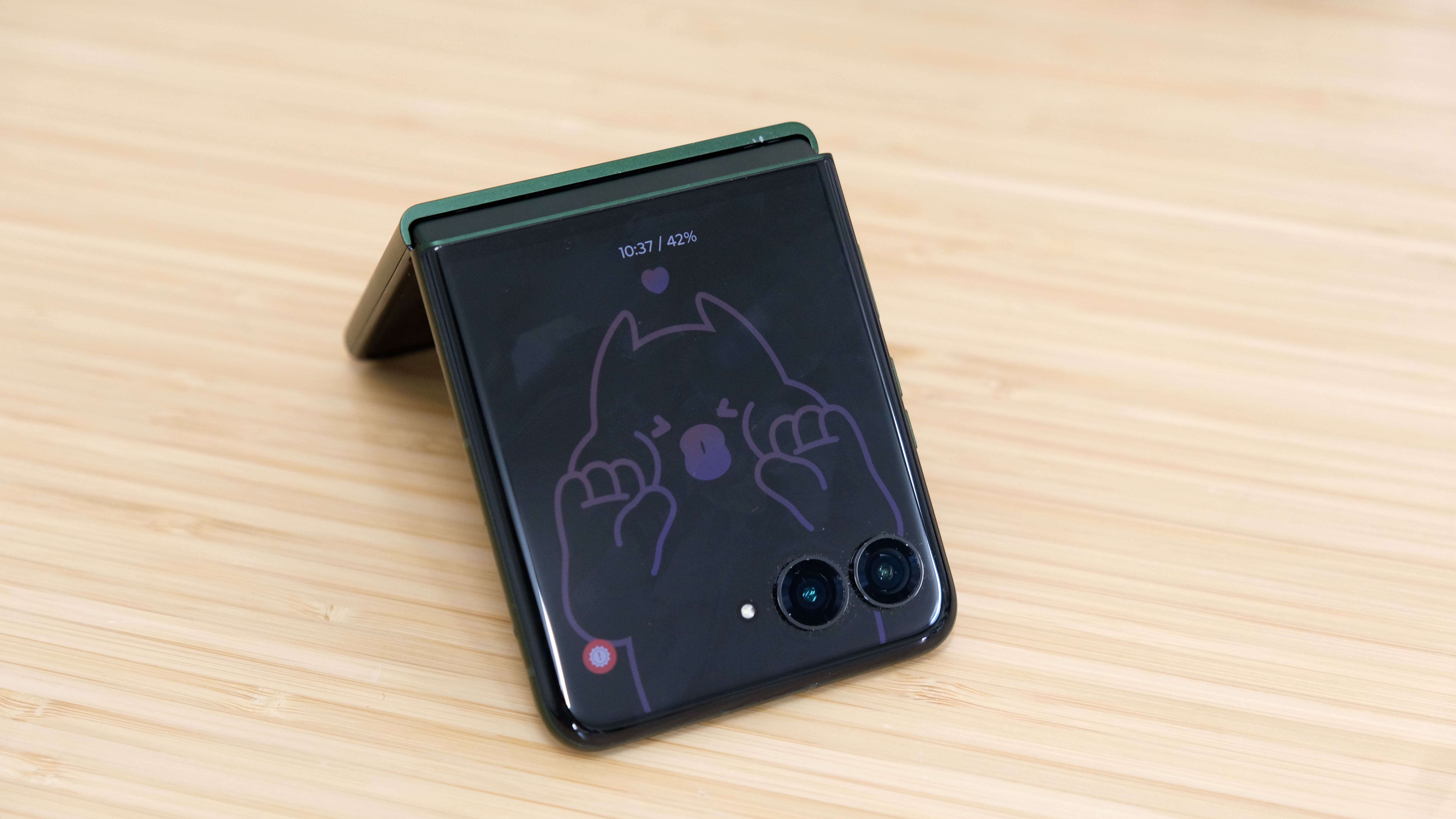
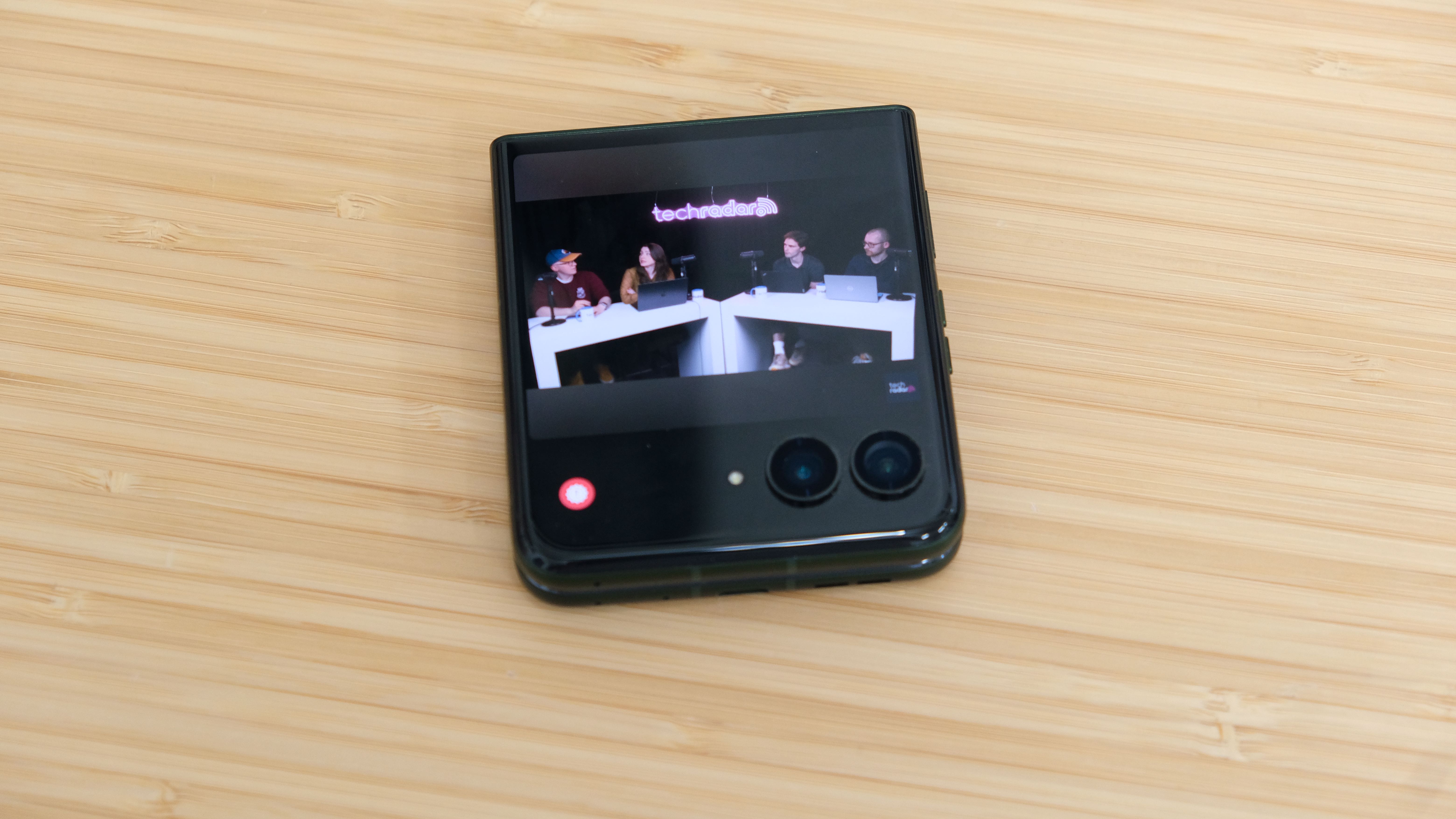
When closed, the Razr Plus fits almost perfectly in the palm of my hand, allowing one-handed use of the front display. The volume buttons, along with the lock/wake button that doubles as a fingerprint sensor, are easily accessible, making unlocking the phone or adjusting the volume while listening to music or streaming a YouTube video a breeze.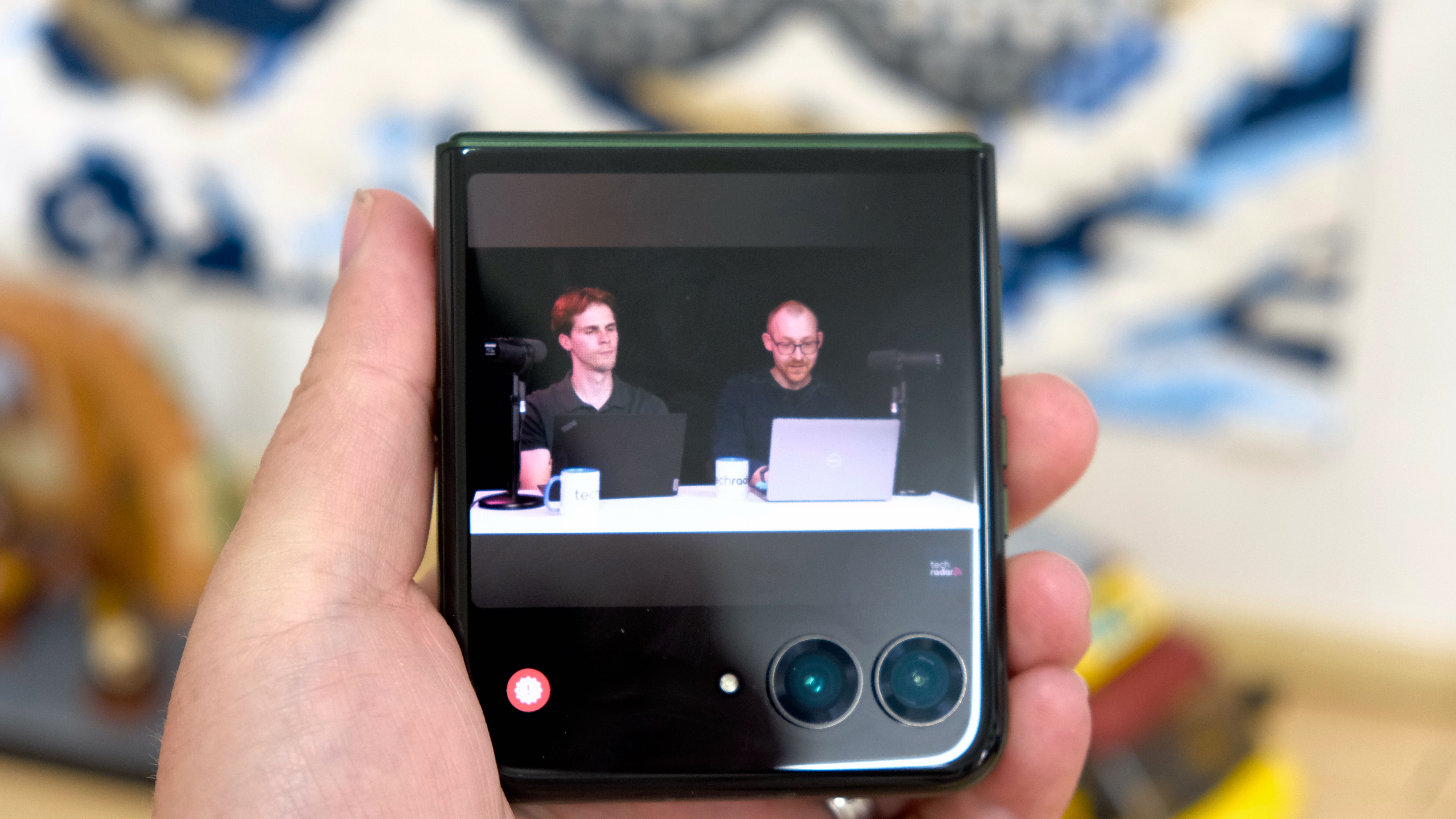
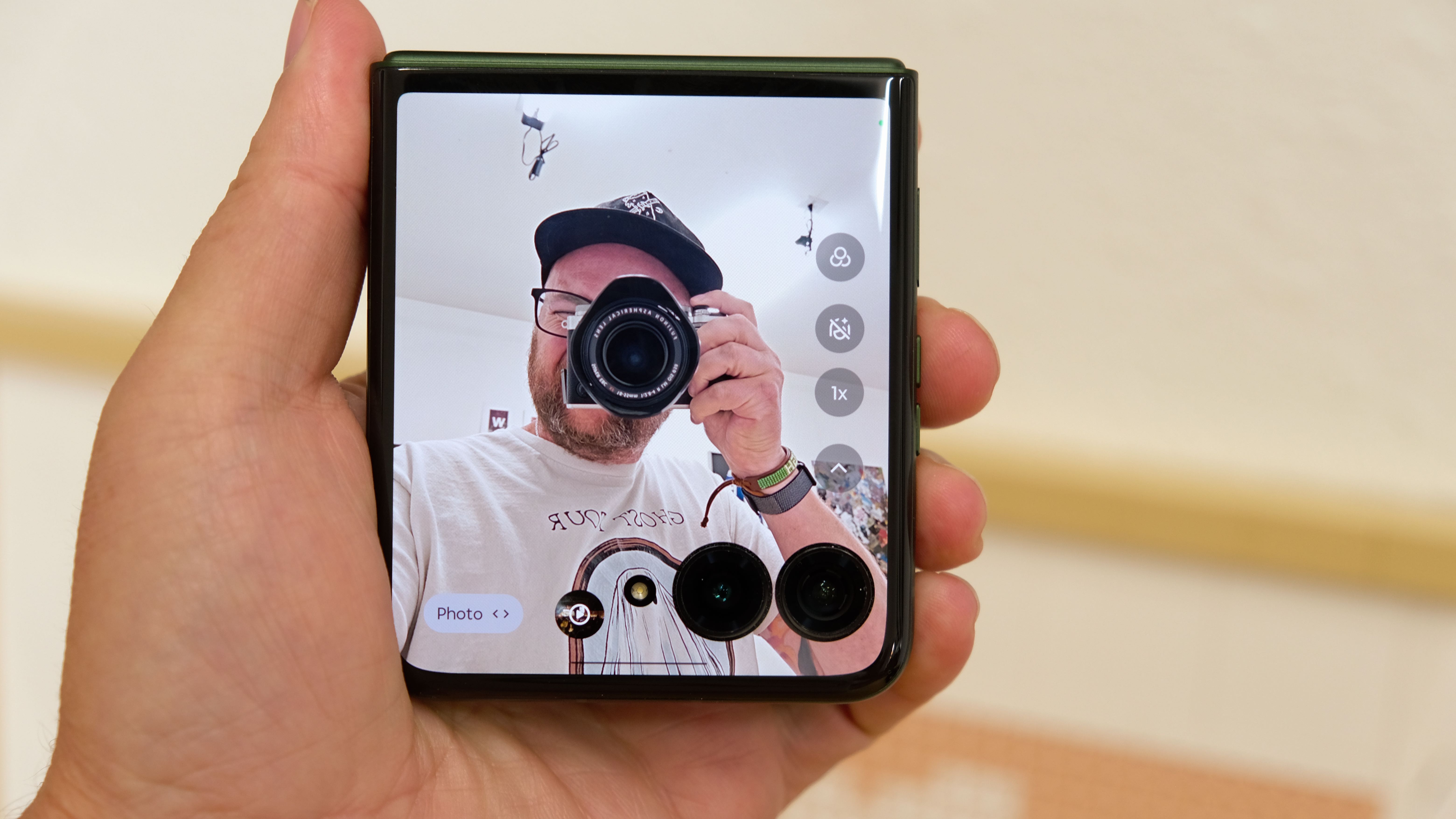
I do wish the front screen wasn't broken up by the two camera lenses in the bottom right corner, but that's a byproduct of this form factor.
When opened, the phone is narrower and taller than my iPhone 15 Pro Max and Pixel 10 Pro XL, which means there's a bit of a learning curve at first. I found it difficult to reach the top third of the screen or so when using the phone one-handed. The taller aspect ratio also puts the volume controls and that fingerprint sensor higher up on the right side of the housing. This positioning isn't a deal-breaker, by any means, but it does take some getting used to.
There's a new titanium-reinforced hinge in this year's model, and while I can't speak to how much more durable it is than previous hinges in the Razr line, I can say it feels smooth and sturdy.
The USB-C charge port, capable of charging at up to 45W, is located on the bottom of the phone, as is common practice for all modern smartphones.
The Razr Plus has an IP48 rating, meaning it'll survive an accidental swim in a pool or bathtub. It'll also stand up to pocket lint and everyday debris, but don't drop it at the beach — the sand could wreak havoc.
The Razr Plus doesn't break the design mold for a clamshell-style flip phone, and adapting to the taller design takes some time, but it's a phone that's sure to garner some attention whenever you pull it out and flip it open.
- Design score: 4 / 5
Motorola Razr Plus 2026 review: Displays
- Plenty of brightness, inside and out
- Two displays are better than one
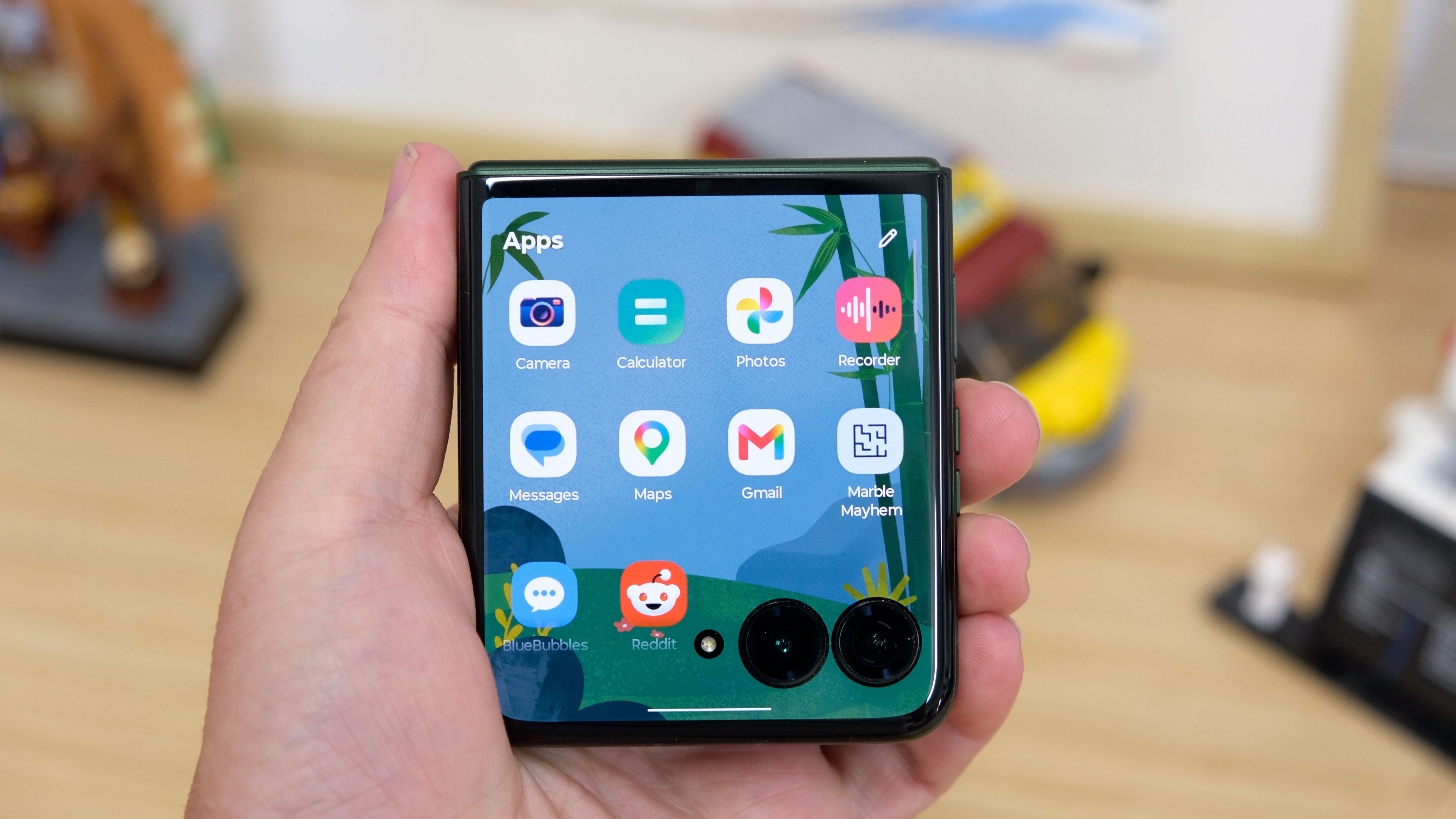
The Motorola Razr Plus has two different displays. When closed, the front of the phone features a 4-inch AMOLED cover display with a resolution of 1272 x 1080, a 165Hz refresh rate, and a peak brightness of 2,400 nits. All of that distills down to a compact screen that looks clear, crisp, and is easy to see in direct sunlight.
As I said earlier, my biggest gripe is that even though the cover display is listed at 4 inches, you don't get to take full advantage of that space because the dual-camera lens setup in the bottom-right corner gets in the way.
Still, I rather enjoyed quickly checking my email or scrolling through my Reddit feed while waiting in line at a food truck. I didn't enjoy typing out long messages on a cramped keyboard, but it was nice to send a quick yes/no or short message without opening the phone.
On the inside is a 6.9-inch AMOLED display, with a 1084 x 2640 resolution, a 165Hz refresh rate, and a peak brightness of 3,000 nits. That peak brightness is on par with the likes of the Pixel 10 Pro XL and iPhone 17 Pro Max, and beats out the Samsung Galaxy Z Flip 7's 2,600-nit peak brightness. At those levels, you should have no issues seeing the display in direct sunlight.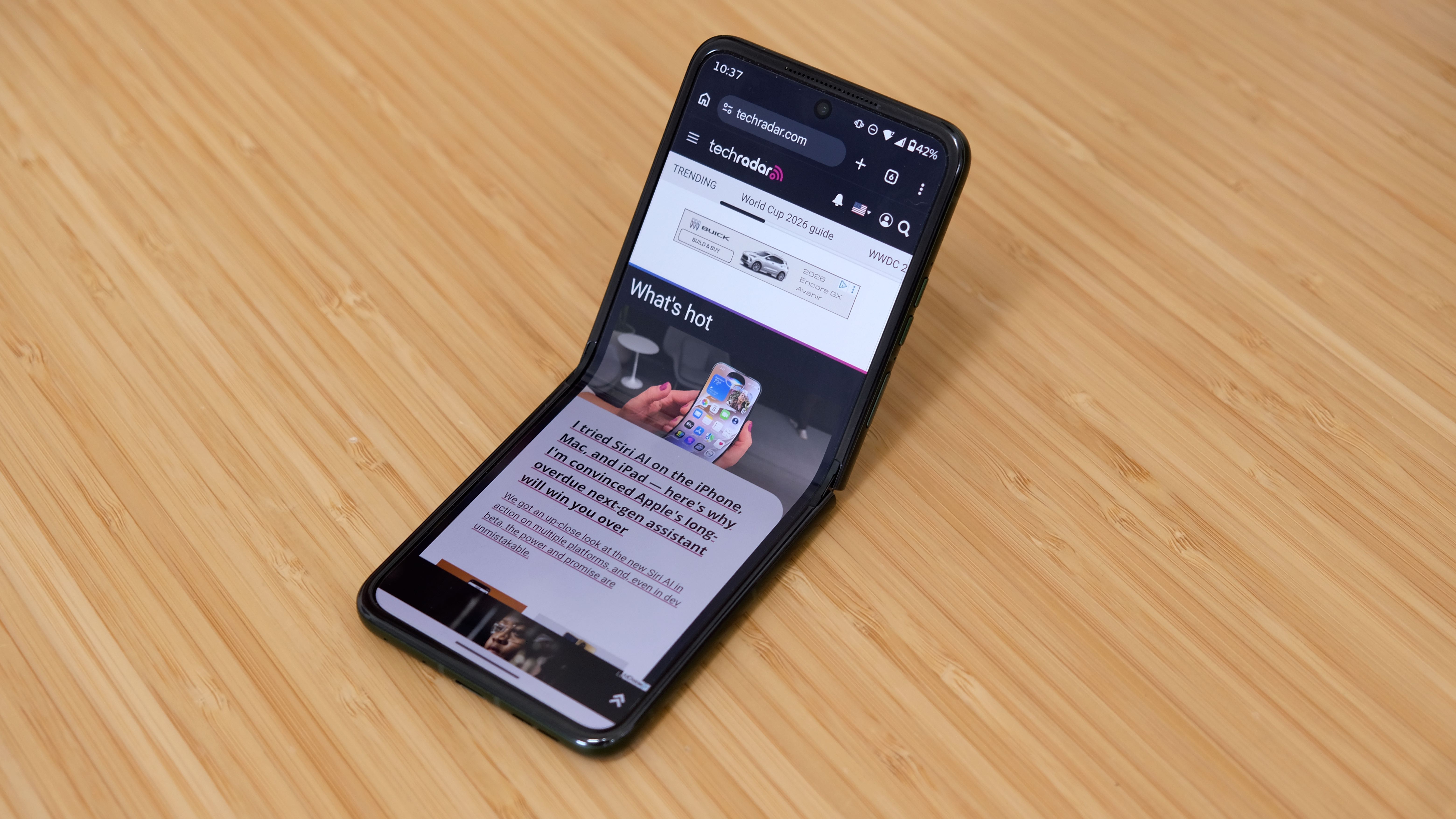
The inner display uses LTPO technology to adjust the refresh rate all the way down to 1Hz when you're looking at a webpage or reading an email, and all the way up to 165Hz when you're gaming or quickly scrolling a social feed.
There's a noticeable crease in the screen that's easily seen and felt as you tap and swipe across the display. But doesn't get in the way or completely distract from the overall experience — in fact, after a few days, I rarely even thought about its presence.
Specifications aside, the inner screen looks sharp, with deep blacks and bright, vivid colors. The surrounding bezel is thin and sits slightly higher than the screen panel itself. That means there's a slight lip around the edge, similar to the raised border of a phone case.
- Display score: 4 / 5
Motorola Razr Plus 2026 review: Software
- Comes with Android 16
- Will only get 3 years of OS updates
- 5 years of security updates
The Motorola Razr Plus runs Android 16 with Motorola's custom Hello UI skin layered on top, adding customizations and features. I'm a big fan of Google's Pixel lineup and the clean Android experience it offers, but I also appreciate when phone makers like Motorola tweak Android and add to the overall experience.
Google Gemini is baked into the Razr Plus, of course. You can easily access the AI service using your voice or through the Gemini app. It's confusing to me, then, that Motorola has its own Moto AI app on the Razr Plus that duplicates a lot (if not all?) of what Gemini brings to the table.
Inside the Moto AI app, you can use Image Studio to create images from scratch and make stickers to use in your messages. There's also a feature that catches you up on your missed notifications, a playlist creation feature, and even a note-taking transcription service.
I totally get the desire to add AI to all the things right now, but as someone who regularly uses Gemini across all of my devices, I don't want to start investing my time (and data) into another AI tool.
Moto AI aside, my long-standing favorite tweaks Motorola makes to Android are present: Gestures. I love being able to twist my wrist a couple of times and launch the camera app, for example. I wish more phones had a similar capability.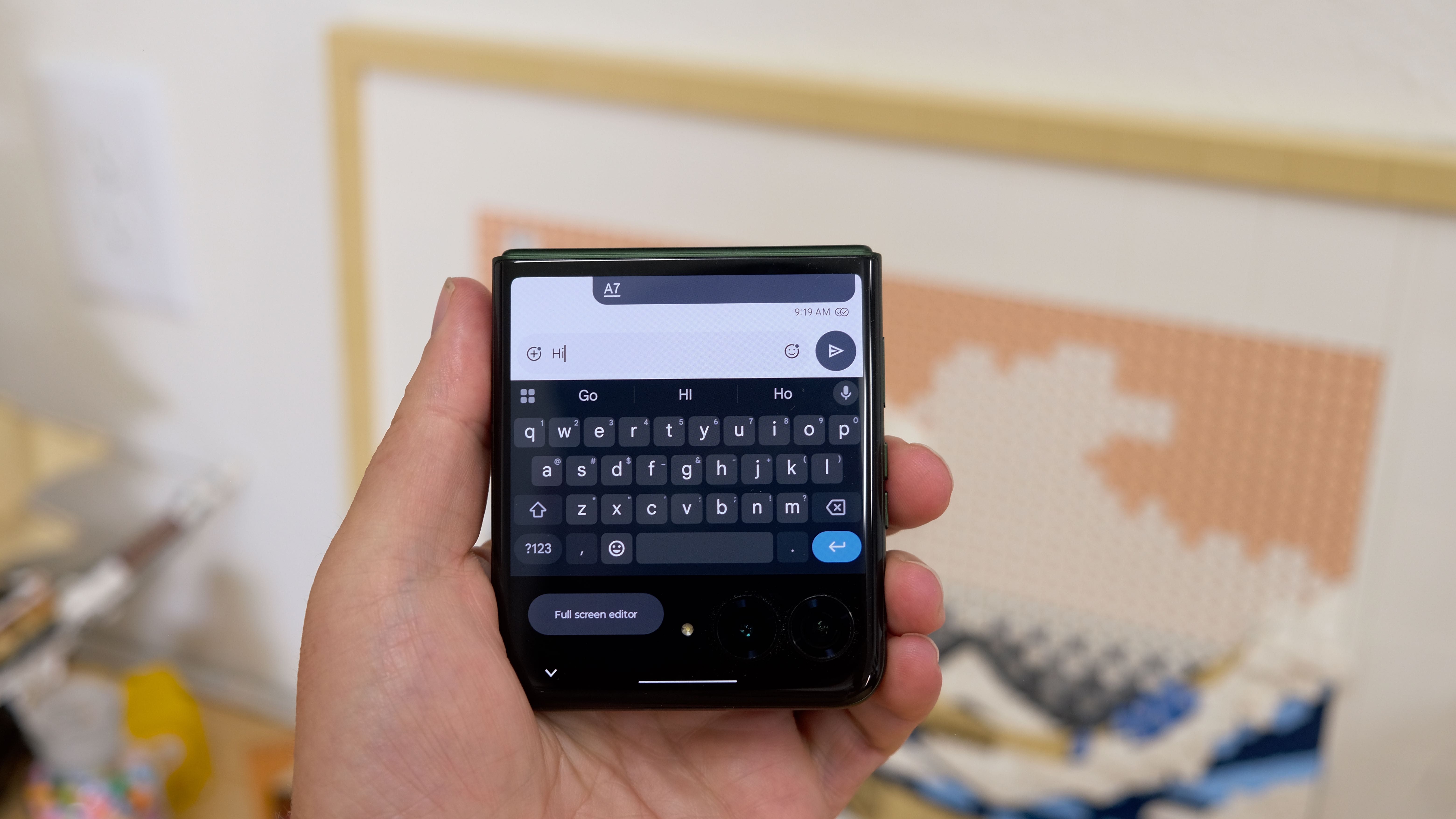
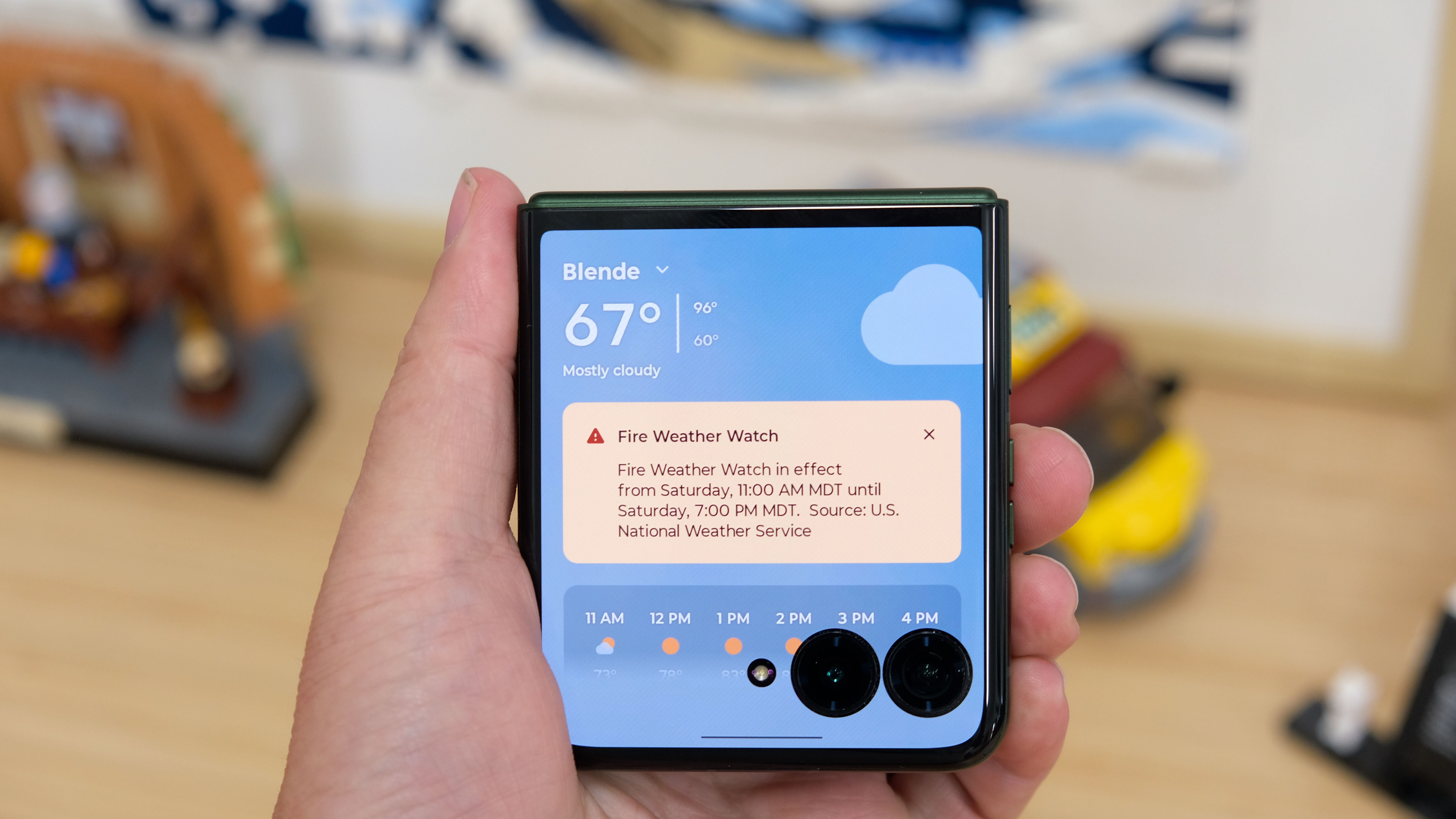
With the cover screen, Motorola effectively manages two different home screens. There's, of course, the internal screen, but instead of just duplicating and shrinking it down to fit the cover screen's size, it's an entirely different experience. You can add apps to a dedicated app drawer, manage calendar or weather panels (basically widgets) you swipe between, and even take pictures of video right from the front of the phone. It's all super easy to understand and intuitive to navigate.
Motorola promises three years of major OS updates and five years of security updates for the Razr Plus, falling well short of Google and Samsung, both of which promise seven years of OS updates and security patches to their respective foldables. Motorola's equivalent commitment is disappointing, even more so when you consider the nearly $1,100 price tag of the Razr Plus 2026.
- Software score: 3 / 5
Motorola Razr Plus 2026 review: Cameras
- 50MP main camera
- 50MP ultra-wide camera
- No telephoto camera this year
The two camera lenses that break up the front display I've complained about a few times already are a 50MP wide camera and a 50MP ultra-wide camera. On the inside is a 32MP hole-punch selfie camera.
For the 2026 version of the Razr Plus, Motorola did away with the telephoto lens and replaced it with an ultra-wide camera. When I first read about the lack of a telephoto lens, I didn't give it much thought — until I actually started taking pictures and realized just how much I was going to miss it.
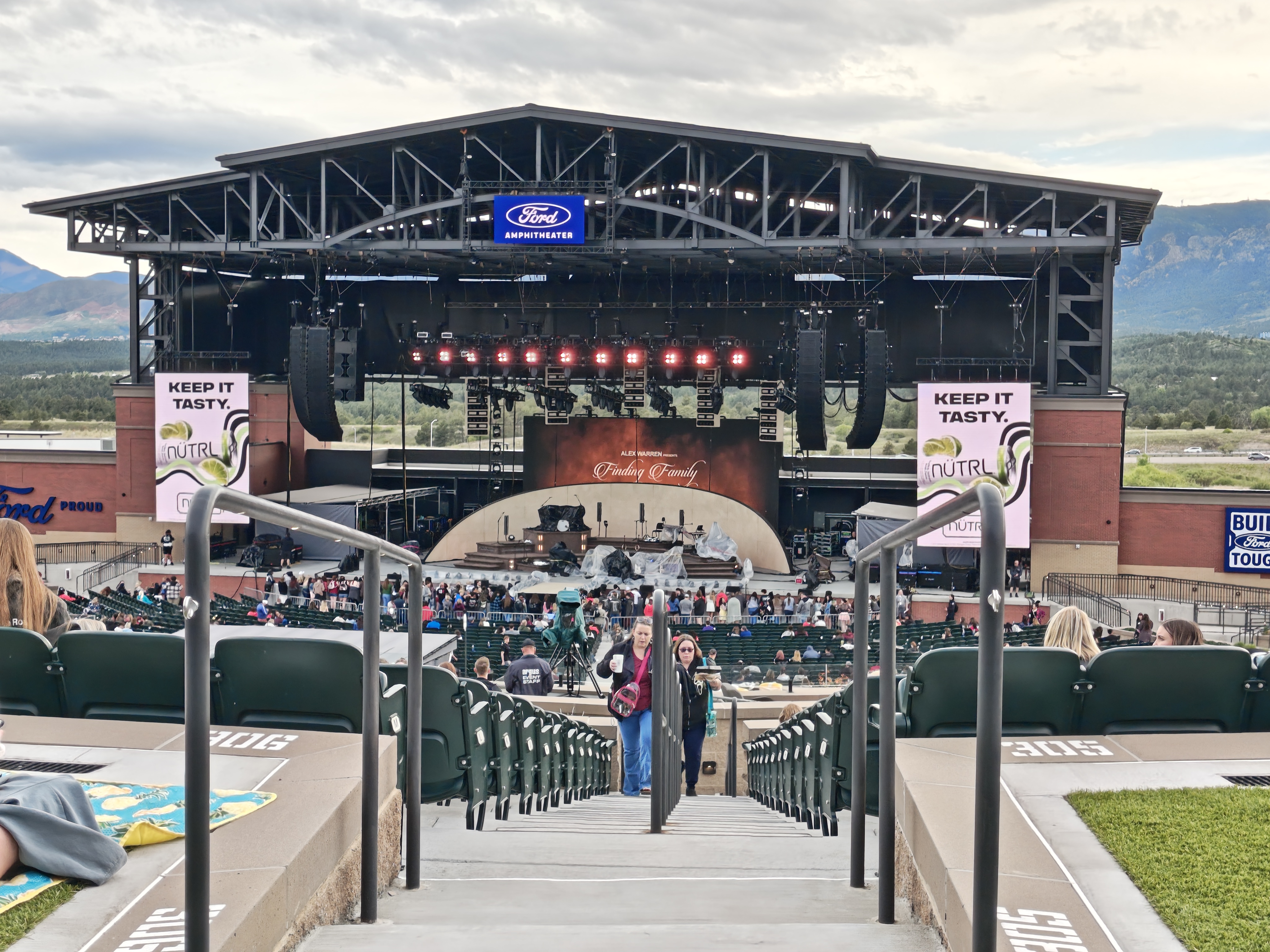
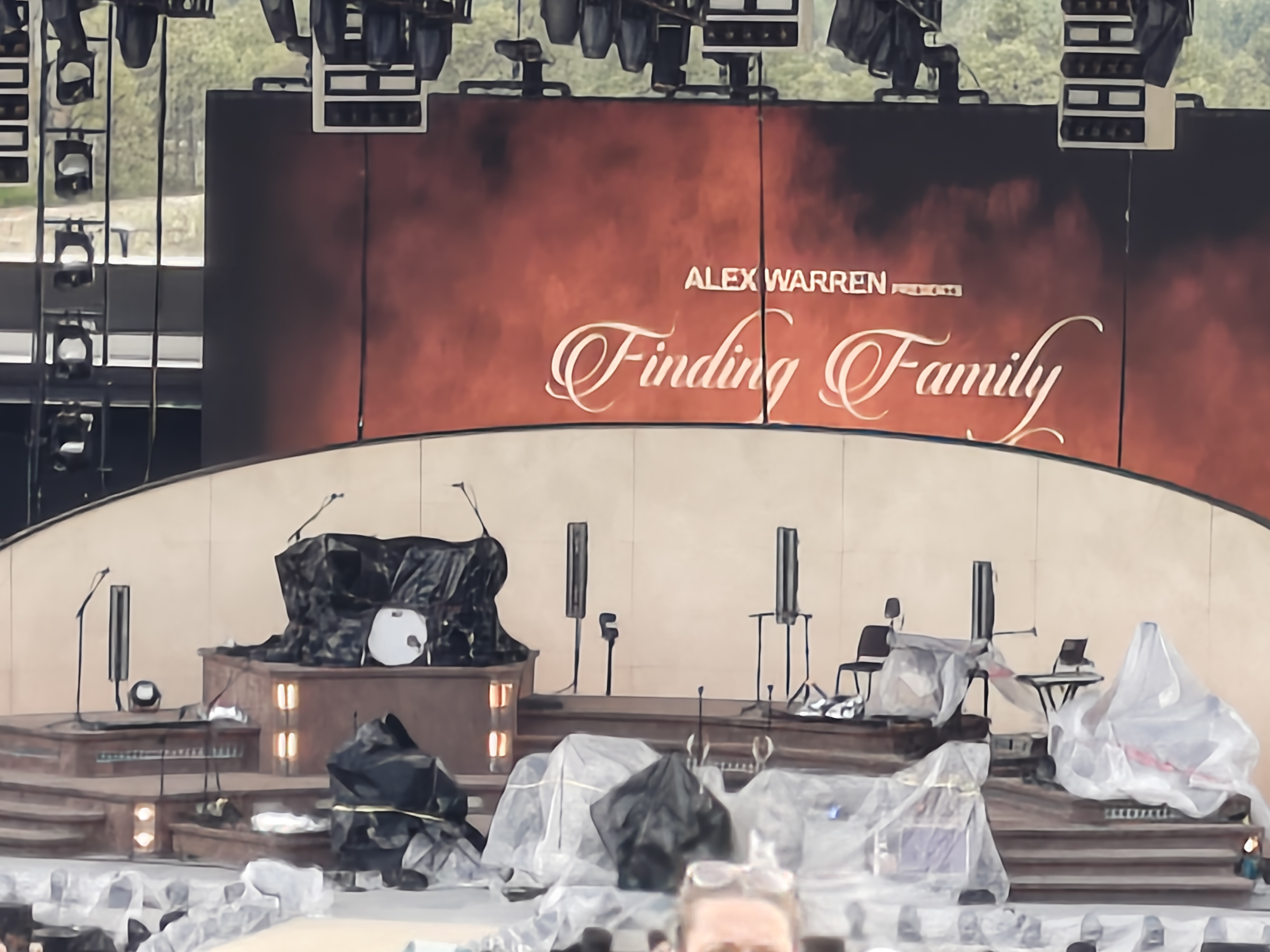
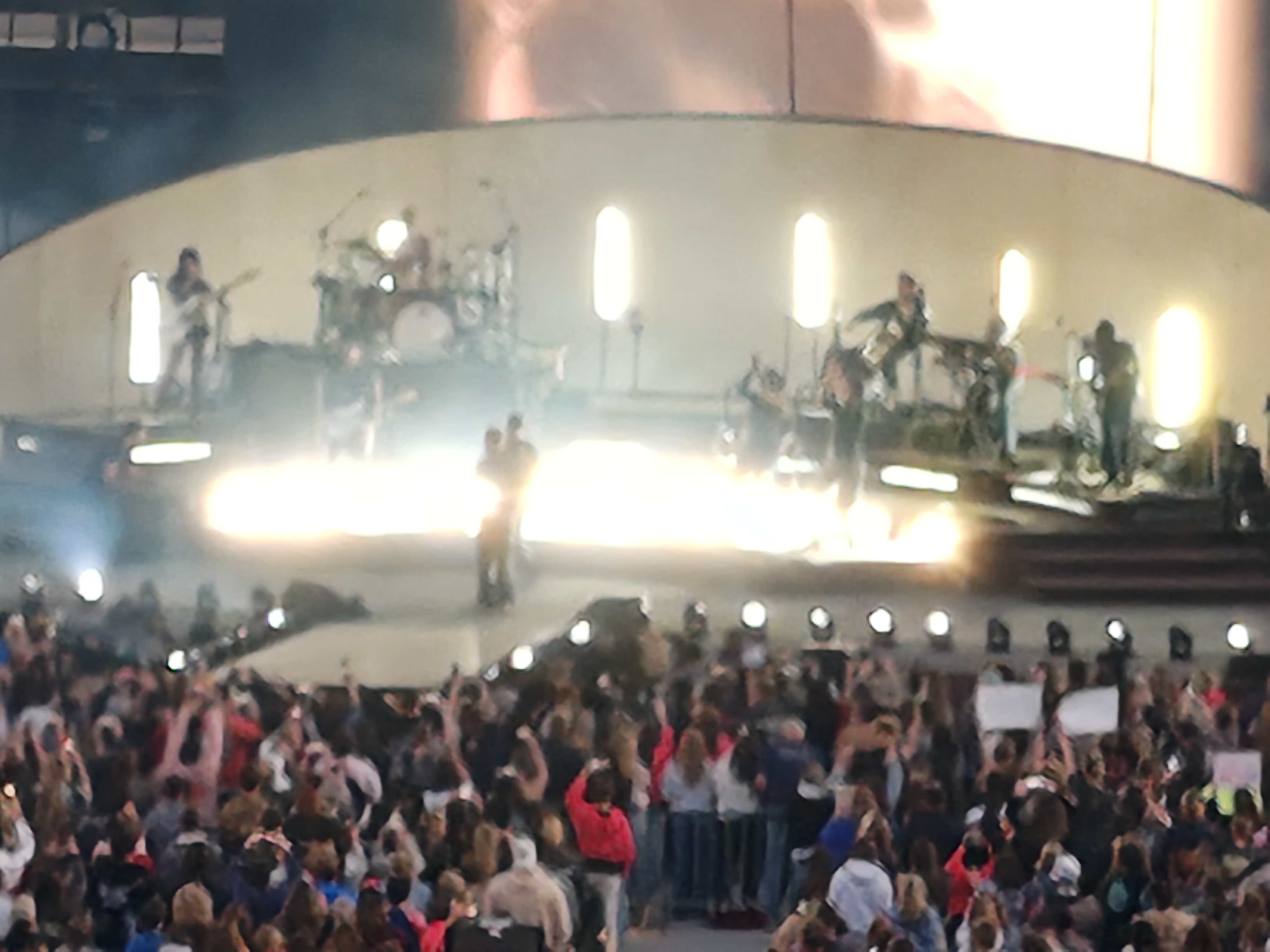
When I took the Razr Plus to an Alex Warren concert at an outdoor amphitheater, I was really disappointed as I tried to zoom in on the stage and saw nothing but out-of-focus blobs.



The first few selfies I took using the main camera and the front display as a viewfinder didn't leave me overly impressed, either. Each one was muted and downright blurry.
It wasn't until a night out with my family, as we waited for our dinner to arrive, and I started taking portrait photos of everyone, that I realized just how much potential the Razr Plus 2026 has as a camera phone.





Every portrait shot was clear, crisp, and had ample color saturation. You could make a case that the colors are a little too saturated and unnatural-looking, but that's nitpicking. Every person at the table wouldn't stop talking about how good the photos looked, and I was equally impressed.
Then I started taking pictures of our pizzas as they arrived, and I saw that same blurry, out-of-focus look start to creep into some shots. Maybe it's user error? Maybe the camera is just finicky.


The ultra-wide camera has a 122-degree field of view, which was more than enough to capture the entire amphitheater and the audience. However, if you look at the edges of the picture, you'll see it gets blurry and out of focus, while the back of my son's head is perfectly in focus.
Overall, then, the Razr Plus' camera setup is mixed. It's impressive when taking portrait photos, and occasionally when taking normal photos. But replacing the telephoto camera with an ultra-wide shooter feels like a step backward from last year's model — the ability to zoom and take high-quality pictures feels like a must-have in 2026, and the Razr Plus 2026 can't deliver.
- Camera score: 3 / 5
Motorola Razr Plus 2026 review: Performance
- It's plenty fast... for now
- Same exact processor used in the previous two models
Probably the most controversial thing Motorola did with the 2026 Razr Plus is stick with the exact same processor it used in the 2024 and 2025 Razr Plus, while also raising the price of the new phone by $100. Motorola even kept the memory at 12GB and storage at 256GB across all three generations.
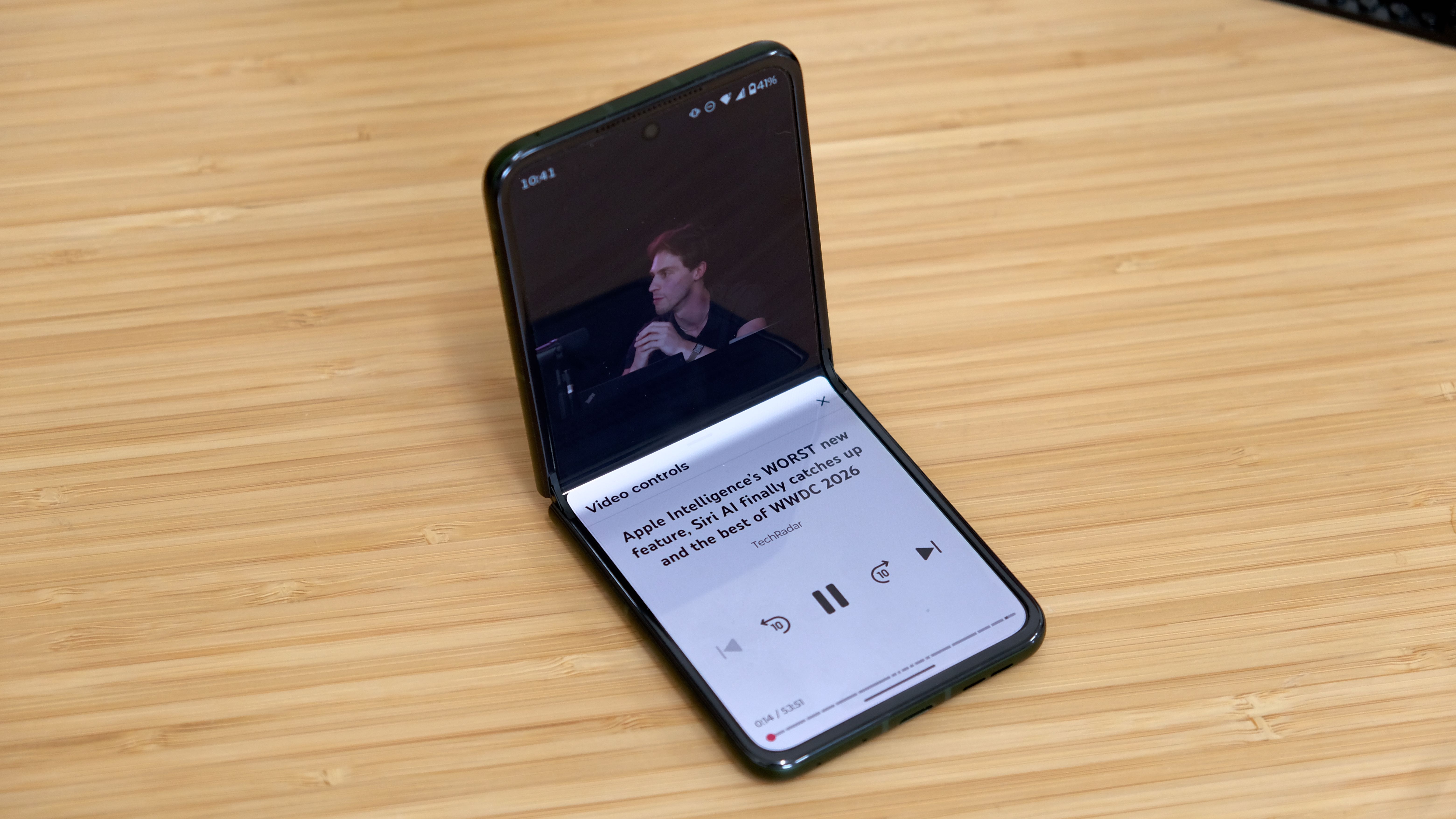
In all fairness, the processor — the Snapdragon 8s Gen 3 — is no slouch. Over the last month, I haven't noted any glaring performance issues. I've been able to move between apps and multitask, and the Razr Plus kept up with whatever paces I put it through. That often meant watching a YouTube video in picture-in-picture mode, while checking my email, texting my wife, or browsing the web in Chrome. Doing a few laps in Asphalt: Legends also presented no issues (and was actually quite fun).
With AI as a whole at the forefront of almost every tech-related conversation right now, the Razr Plus would surely benefit from an upgraded processor, but I digress.
Just know that if you opt to pick up a Razr Plus, you shouldn't expect any performance issues today — but with an already aging chipset, there's no promise that it won't start showing signs of its age as Android and Motorola's Hello UI software continue to evolve.
For those interested, here's a summary of the Razr Plus' benchmark scores:
Motorola Razr Plus 2026 | |
Geekbench 6 single-core | 1835 |
Geekbench 6 multi-core | 4476 |
3D Mark Wildlife Extreme Best | 2202 |
3D Mark Wildlife Extreme Low | 1660 |
3D Mark Solar Bay | 5110 |
- Performance score: 3 / 5
Motorola Razr Plus 2026 review: Battery
- 4,500mAh battery
- 45W wired charging
- All-day battery life
Tucked inside the thin housing of the Razr Plus is a 4,500mAh battery, which Motorola promises will deliver over 31 hours of use.
From my testing, I'd say that's only slightly more than what you get in everyday use. I was routinely able to go an entire day of doom scrolling, bouncing between basically any social media app you can name, chatting with friends in Slack, managing my inbox, and texting my wife and kids without needing to charge.
Like most people, I find it's second nature to plug in my phone as I get ready for bed and start the next day with a full charge. On several occasions, I forgot to plug in the Razr Plus, but instead of waking to a phone that had turned off, I found anywhere from 20% to 30% of its juice left.
When you run out of juice, though, using a 45W wall adapter will net you a 20% charge in 15 minutes. A full charge from a completely drained tank, meanwhile, took around 1 hour and 35 minutes in my testing.
As mentioned earlier, there's no MagSafe-equivalent wireless charging feature, nor does the Razr Plus support Qi2. However, you can wirelessly charge at 15W or charge another device using reverse wireless charging at 5W. You won't want to use the latter feature to charge another phone; it's incredibly slow and inefficient.
- Battery score: 5 / 5
Should you buy the Motorola Razr Plus 2026?
Attributes | Notes | Rating |
|---|---|---|
Value | A $100 increase year-over-year for old tech. | 3 / 5 |
Design | An upgraded hinge, IP48 rating and a very usable front display are all welcome features. | 4 / 5 |
Displays | The front and inner displays look great, even in direct sunlight. | 4 / 5 |
Software | Three years of OS updates falls well short of industry standards. | 3 / 5 |
Camera | Swapping the telephoto camera out for an ultra-wide isn't ideal, but the main camera takes solid pics. | 3 / 5 |
Performance | The older processor powers through daily tasks with relative ease. | 3 / 5 |
Battery | It just keeps going and going and going. | 5 / 5 |
Buy it if...
You want a compact foldable phone
The cover display is fully functional, allowing you to triage your messages or quickly check your calendar, then it opens to a full-size smartphone that fits easily in your pocket. Win-win.
You want all-day battery life
The 4,500mAh battery provides more than enough power to get through a full day of use and then some.
You want high-quality portrait photos
If you primarily take portrait photos of friends and family, then this phone will be your jam.
Don't buy it if...
You want the latest tech
Motorola's reuse of a processor from 2024 is sure to show signs of its age as we move further into the AI era and Android continues to evolve.
You want a telephoto lens
Do not get the Razr Plus if you routinely zoom in and take photos. It just doesn't do a great job at a distance.
Motorola Razr Plus 2026 review: Also consider
Samsung Galaxy Z Flip 7
If you want a foldable flip phone, Samsung's Galaxy Z Flip 7 offers a similar experience to the Razr Plus, but with Samsung's software (love or hate it) and a front display that's just as useful.
Read our full Samsung Z Galaxy 7 Flip review
Motorola Razr Ultra 2025
Last year's Moto Razr Ultra checks a lot of the same boxes as the 2026 Razr Plus, but adds in a better processor, more memory, and more storage. However, it too lacks a telephoto lens.
Read our full Motorola Razr Ultra 2025 review
How I tested the Motorola Razr Plus 2026
I lived with the Razr Plus 2026 for over a month. I used Android's restore tool to transfer over accounts and apps from my Google Pixel 10 Pro XL, then signed into the apps I use every day — Slack, Fastmail, Reddit, Mastodon, YouTube, Facebook, Immich, Instagram, and Gemini, to name a few.
I used the Razr Plus as I would my own personal phone throughout each day and over the weeks, taking pictures, watching YouTube, listening to music, and doing all of the other mundane tasks one does on a phone, being sure to take note of my overall impressions along the way.
Read more about how we test
First reviewed June 2026
Share
What's Your Reaction?
 Like
0
Like
0
 Dislike
0
Dislike
0
 Love
0
Love
0
 Funny
0
Funny
0
 Angry
0
Angry
0
 Sad
0
Sad
0
 Wow
0
Wow
0