Anthropic ships major Claude Design overhaul with design system imports, code round-trips, and a fix for its token-burning problem
When Anthropic quietly released Claude Design in April as a "research preview," it generated the kind of instant traction most product teams dream about: more than one million users in its first week. It also generated a problem. The tool consumed tokens so voraciously that a PCWorld reviewer burned through 80 percent of his weekly Claude Pro allowance in roughly 25 minutes, producing just three variations of a single webpage prototype. "We're talking another token-hungry Claude product here," the reviewer wrote, "one that Pro users in particular will barely be able to use before burning through their usage limits."Two months later, Anthropic is shipping a substantially overhauled version of Claude Design that attempts to fix the consumption issue while simultaneously repositioning the product from a flashy demo into something far more strategically important: a design system compliance layer that connects to code, connects to the tools enterprises already use, and — critically — keeps

When Anthropic quietly released Claude Design in April as a "research preview," it generated the kind of instant traction most product teams dream about: more than one million users in its first week. It also generated a problem. The tool consumed tokens so voraciously that a PCWorld reviewer burned through 80 percent of his weekly Claude Pro allowance in roughly 25 minutes, producing just three variations of a single webpage prototype. "We're talking another token-hungry Claude product here," the reviewer wrote, "one that Pro users in particular will barely be able to use before burning through their usage limits."
Two months later, Anthropic is shipping a substantially overhauled version of Claude Design that attempts to fix the consumption issue while simultaneously repositioning the product from a flashy demo into something far more strategically important: a design system compliance layer that connects to code, connects to the tools enterprises already use, and — critically — keeps everything on brand.
The update, announced Wednesday, arrives at a moment when Anthropic is executing one of the most aggressive product expansions in the AI industry's brief history. In the past ten weeks alone, the company has launched Claude Opus 4.8, released (and then suspended) the Mythos-class Fable 5 model, shipped ten agent templates for financial services, announced a multi-year alliance with DXC Technology to embed Claude inside the IT infrastructure of the world's largest banks and airlines, rolled out Claude for Small Business with integrations into QuickBooks and PayPal, and published research showing that Claude Code users now average 20 hours per week on the tool.
Claude Design's transformation from prototype toy to enterprise platform is the latest move in a company-wide strategy to make Claude not just an assistant people talk to, but a worker embedded in the systems where work actually happens.
How design system imports make Claude Design an enterprise brand-compliance tool
The headline feature in Wednesday's update is not the new drag-and-resize editor, nor the expanded list of export destinations, though both matter. The feature that signals where Anthropic is heading is the rebuilt design system import.
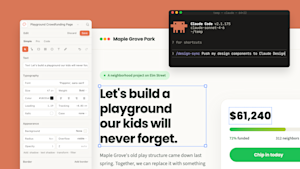
Users can now bring one or several design systems into Claude Design from a GitHub repository, design files, or raw uploads. Once imported, Claude builds with those components, checks its output against the design system, and auto-corrects before the user ever sees the result. For larger organizations, a new admin role can approve a single standard system and lock down edits, ensuring that every asset Claude produces conforms to company guidelines.
This is a meaningful departure from the tool's original positioning. In April, Claude Design was a blank canvas: give it a prompt, and it would generate something visually impressive but stylistically arbitrary. Business Insider tested it against Canva AI for a photography workshop slide deck and found that Claude Design "anticipated my needs" and "identified its own errors and corrected them without prompting." But the output reflected Claude's aesthetic judgment, not the user's brand. For an individual freelancer or a startup founder sketching ideas, that was fine. For a 10,000-person enterprise with a 200-page brand standards document, it was a non-starter.
The design system import changes that equation. By ingesting a company's actual components — its buttons, typography, color tokens, spacing rules — and then validating output against them before surfacing results, Claude Design is attempting something that most human designers struggle with: consistent brand compliance at speed and scale. The admin lockdown feature, which prevents individual users from overriding the approved system, is a direct play for the enterprise procurement conversation, where "can we control what it produces?" is often the first question.
Why the Claude Code round-trip could end the design-to-engineering handoff problem
The second major update is the bidirectional integration between Claude Design and Claude Code. Users can now run /design-sync in Claude Code to import their local codebase's design system into Claude Design, ensuring that prototypes start from real components rather than approximations. When a design is ready to ship, it hands off to Claude Code, which picks up exactly where the designer left off — no screenshot, no rebuild. The integration works in reverse, too. From a Claude Code terminal, the /design command lets developers create, edit, and sync design projects without leaving their workflow.
This matters because the handoff between design and engineering has been one of the most persistent friction points in software development for decades. Tools like Figma's Dev Mode and Zeplin have tried to bridge the gap by generating specifications and code snippets from design files, but the translation has always been lossy. A designer's prototype and an engineer's implementation inevitably diverge, creating a cycle of visual QA, redlines, and "that's not what the mockup looked like" conversations.
Anthropic is betting that if the same AI system both designs and codes — and if both modes share the same underlying component library — the gap disappears. It is, in effect, arguing that the design-to-code problem was never really about better specification formats or smarter handoff tools. It was about the fact that two different humans (or two different tools) were interpreting the same intent. A single AI system that operates on both sides of the workflow doesn't need to interpret; it just continues.
The timing of this integration is also significant in light of Anthropic's own research. Just yesterday, the company published an analysis of roughly 400,000 Claude Code sessions showing that domain expertise — not coding proficiency — is the primary driver of successful outcomes. Every major occupation succeeded at coding tasks at nearly the same rate as software engineers. If designers can now move fluidly between visual prototyping and code implementation through a single AI system, the research suggests they will succeed not because they learned to code, but because they deeply understand the design problems they are solving.
Token consumption gets a fix, but the economics of generative design remain tight
The token consumption issue that dogged Claude Design's launch was not just a user experience annoyance — it was a structural threat to the product's viability. If a $20-per-month Pro subscriber could exhaust their entire weekly allowance in a single 30-minute session, the tool was effectively inaccessible to the individual users and small teams who drove its initial viral adoption.
Anthropic's response is twofold. First, Claude Design now shares usage limits with chat, Claude Cowork, and Claude Code, rather than drawing from a separate, smaller pool. This gives most users significantly more headroom. Second, the company says it has reduced the average token consumption per turn while maintaining output quality, and that error rates have dropped sharply.
Whether this is enough remains an open question. The fundamental tension is architectural: generative design is inherently token-expensive. Every variation Claude produces requires the model to reason about layout, typography, color, spacing, responsiveness, and content simultaneously, then generate a complete, functional artifact. That is a fundamentally different workload than answering a question in chat, and it consumes tokens accordingly. Anthropic's efficiency improvements may push the breaking point further out, but they do not eliminate the underlying economics. For enterprise customers on Team and Enterprise plans with higher limits, this may be a non-issue. For Pro subscribers, the math is still likely to be tight.
The new editor helps mitigate this somewhat by giving users direct control over individual elements — drag, resize, and align — without burning a model turn for every small adjustment. Hundreds of stability fixes also mean fewer wasted turns on errors and regenerations, which were a significant source of token drain in the original release. These are not glamorous improvements, but they are the kind of grind work that separates a research preview from a daily-use tool.
Nine new export partners position Claude Design as a creative hub, not a destination
The update's third pillar is an expanded set of export destinations. Claude Design now sends work to Adobe, Base44, Canva, Gamma, Lovable, Miro, Replit, Vercel, and Wix, in addition to PDF and PowerPoint. The breadth of this list reveals a deliberate positioning strategy: Anthropic is building Claude Design not as a place where work is finished, but as the place where it begins.
The partner quotes tell the story. Replit's president Michele Catasta frames the integration as meeting "builders wherever ideas begin." Canva's Anwar Haneef describes the flow from Claude Design as turning "a first draft" into "a finished asset — kept on-brand, personalized for the moment." Vercel's Andrew Qu talks about pushing a concept "straight to Vercel to ship." In each case, Claude Design is the origin point, and the partner tool is where polish, collaboration, and deployment happen.
This hub-and-spoke model also serves as a defensive moat against the open-source alternative that has emerged with surprising speed. Open Design, a community-built project tracked by Augment Code, reached 57,400 GitHub stars and 310 contributors in just eight weeks after Claude Design's launch. It offers local-first operation, model flexibility supporting 16 different coding agents, and 259 skills with 142 design systems — all without cloud lock-in. Augment Code's Paula Hingel noted that for "teams that need to self-host, use their own API keys, or swap models, Open Design is currently the only local-first option with this level of skill and design system coverage."
Anthropic's answer to this competitive pressure is not to match Open Design on self-hosting or model flexibility — those are philosophical concessions the company is unlikely to make. Instead, it is building an integration ecosystem that open-source projects cannot easily replicate. A native Adobe Express connector, a verified Canva export pipeline, a first-party Vercel deployment path — these are partnerships, not features, and they require business relationships that community projects cannot forge at the same pace.
Claude Design fits into Anthropic's broader push to embed AI across the entire enterprise stack
To understand why Claude Design's evolution matters, it helps to zoom out. Anthropic is building a product surface that now spans creative work (Design), code (Code), knowledge work (Cowork), and enterprise operations (Managed Agents) — all unified by the same underlying models and, increasingly, by shared context that carries across tools.
The trajectory of the past quarter makes the pattern unmistakable. In May, Anthropic launched Claude for Small Business with connectors to QuickBooks, PayPal, and HubSpot, putting Claude inside the tools that small business owners already use for payroll, invoicing, and marketing. The same month, the company released ten agent templates for financial services covering everything from pitchbook creation to KYC screening, with connectors to FactSet, S&P Capital IQ, and Morningstar. Claude Opus 4.8 shipped on May 28 with a "dynamic workflows" feature enabling hundreds of parallel sub-agents in a single Claude Code session. Then came the Fable 5 and Mythos 5 launch on June 9, followed almost immediately by a US government export control directive that suspended access to both. DXC Technology announced a multi-year alliance to train tens of thousands of Claude-certified engineers to embed Claude inside the systems it operates for major banks, airlines, and insurers.
The design system you import into Claude Design is the same component library that Claude Code uses to implement. The financial model you build in Claude for Excel can flow into a pitchbook created in Claude Design and exported to PowerPoint. The brand assets a small business owner creates through Claude Design can be pushed directly to Canva for team collaboration. This is not a chatbot strategy. It is a platform strategy, and the Claude Design update — with its design system imports, code round-trips, and export ecosystem — is one of the clearest expressions of it yet.
Anthropic also published an engineering deep-dive last month detailing how it contains Claude across products using sandboxes, virtual machines, and egress controls — infrastructure that becomes more critical as tools like Claude Design gain access to proprietary design systems and brand assets. The containment architecture reveals both the ambition and the risk: the more deeply Claude embeds into enterprise workflows, the higher the stakes when something goes wrong, and the more sophisticated the security envelope must become.
Three questions will determine whether Wednesday's update delivers on its ambitions. First, whether the token economics actually work for the broadest user base — shared limits and efficiency gains help, but generative design remains expensive. Second, whether the design system import proves robust enough for real enterprise use, because ingesting a GitHub repository of React components and faithfully using them across dozens of design variations is a genuinely hard technical problem. And third, whether the Claude Code round-trip actually eliminates the design-engineering gap or merely shifts it.
Claude Design launched two months ago as a thing people tried once and marveled at. Anthropic is now trying to make it a thing people use every day — and more than that, a thing their entire team trusts to stay on brand while they do. In the AI industry, the distance between a viral demo and an indispensable tool has swallowed more products than it has produced. Anthropic just bet that design systems, not just design prompts, are the bridge across.
Share
What's Your Reaction?
 Like
0
Like
0
 Dislike
0
Dislike
0
 Love
0
Love
0
 Funny
0
Funny
0
 Angry
0
Angry
0
 Sad
0
Sad
0
 Wow
0
Wow
0