AEO vs SEO: What's the difference & do you need both?
Everything you need to know about SEO and AEO

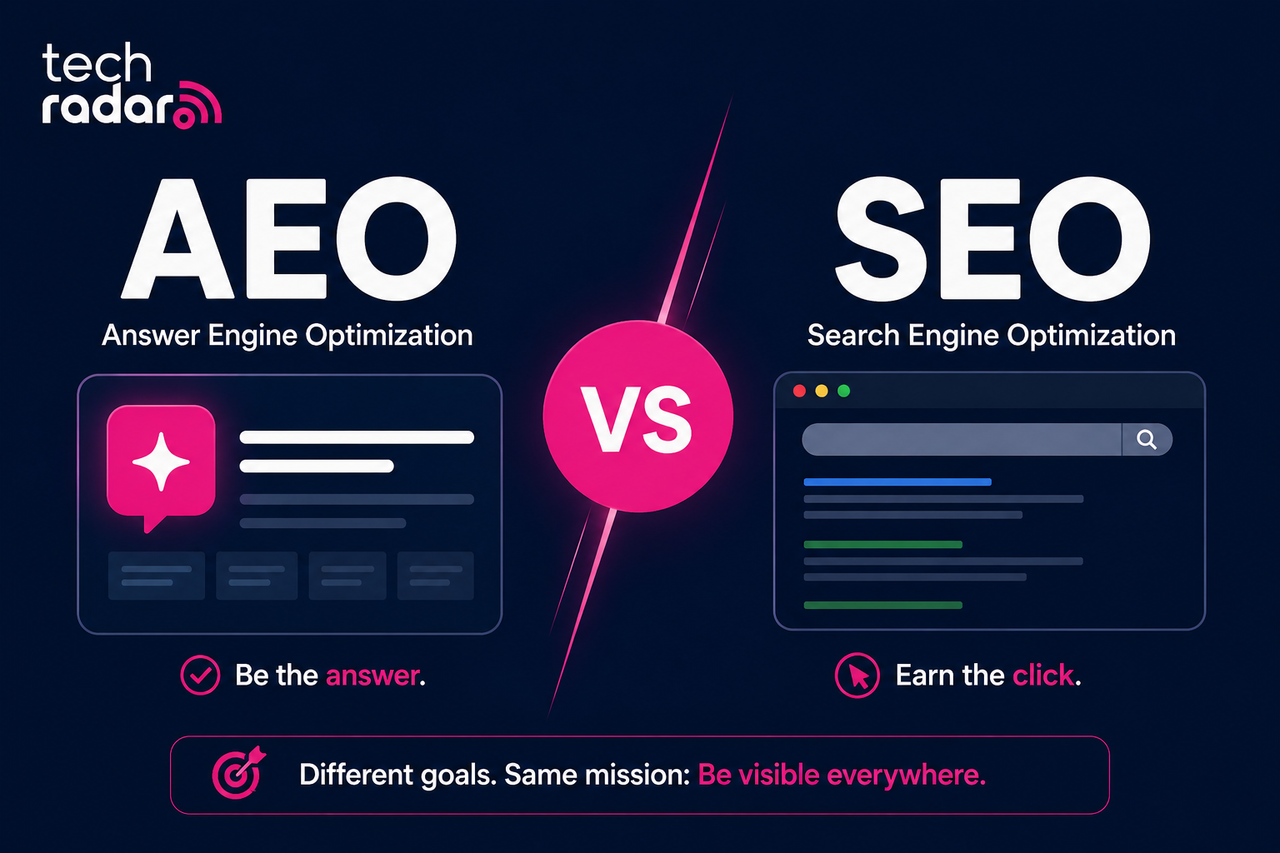
Ask Google for a query like “best web hosting”, and you get a page with 10 blue links. Ask ChatGPT the same thing, and you get one name. That single difference is quietly rewriting how brands get found, and it's why your marketing team keeps arguing about a three-letter acronym most people hadn't heard of a couple of years ago: AEO!
This is the SEO vs AEO question.
SEO (Search Engine Optimization) is the game of ranking pages on search engines like Google so people click through to your website.
AEO (Answer Engine Optimization) is the game of becoming the answer the AI hands back.
So which one do you actually need? Well, Both.
They're different jobs: AEO runs on top of SEO, and in 2026 you can't afford to pick one. The longer version, with real searches, real screenshots, and the parts most guides quietly skip, is what the rest of this is for.
Key takeaways
- SEO and AEO chase different prizes: SEO ranks your page to win the click; AEO gets your brand named inside the AI's answer.
- The user journey is forked: A huge share of searches now end inside the AI answer, with no click and no website visit at all.
- Ranking and getting cited aren't the same thing: Pages can rank number one and never get cited, while others get cited without ranking anywhere near the top.
- AEO can't replace SEO; it runs on it: If your content isn't indexable, authoritative, and trusted, the AI can't discover you, quote you, or trust you.
- E-E-A-T is the edge: Real firsthand experience and a track record under your own name are what push you into AI citations.
- The real goal is search everywhere optimization: Visibility now means showing up across Google, AI Overviews, ChatGPT, YouTube, Reddit, etc., and not just page one.
SEO vs AEO at a glance
Dimension | SEO | AEO |
Goal | Rank pages and drive clicks to your site | Get cited and become the answer the AI gives |
User journey | Query → results page → click → website | Query → AI answer → often done, no click |
What you compete for | A position in the list | A mention in the answer |
Main signals | Backlinks, internal links, technical SEO, page speed, keyword relevance | Authority, expertise, original research, brand mentions, clear factual statements, structured content |
Query type | Short keywords ("best VPN") | Full conversational questions and follow-ups ("what's the best VPN for streaming?") |
Success metrics | Clicks, sessions, rankings, conversions | Citations, mentions, brand recall, share of AI voice |
Where you win | Google's results page | AI Overviews, LLMs |
What is AEO?
AEO is the practice of getting your content surfaced and cited inside AI-generated answers, the kind you get from Google's AI Overviews, ChatGPT, Perplexity, etc. Instead of optimizing a page to rank in a list, you're optimizing your brand to be the source the AI pulls from and names.
The shift is subtle but total. You're not competing for a position anymore but for a mention. That rewards different things like authority, original research, clear factual statements a model can lift, and your brand showing up trusted across the web.
What is SEO?
SEO is the practice of optimizing your pages and your wider web presence so they rank higher in search results, mostly Google & Microsoft Bing, and pull in organic traffic. You target keywords, build pages that deserve to rank, and earn the clicks that turn searchers into visitors.
It's been the backbone of getting found online for two decades, and it's also the foundation AEO now stands on.
Let’s start by understanding the core differences between AEO and SEO and how you can use both to maximize your visibility in modern search platforms.
SEO vs AEO: The difference
1. Purpose: What are you actually optimizing for?
I asked ChatGPT for the best free VPN. It thought for ten seconds and gave me a verdict: Proton VPN Free. It also gave a short explanation and a small table of other options for different use cases.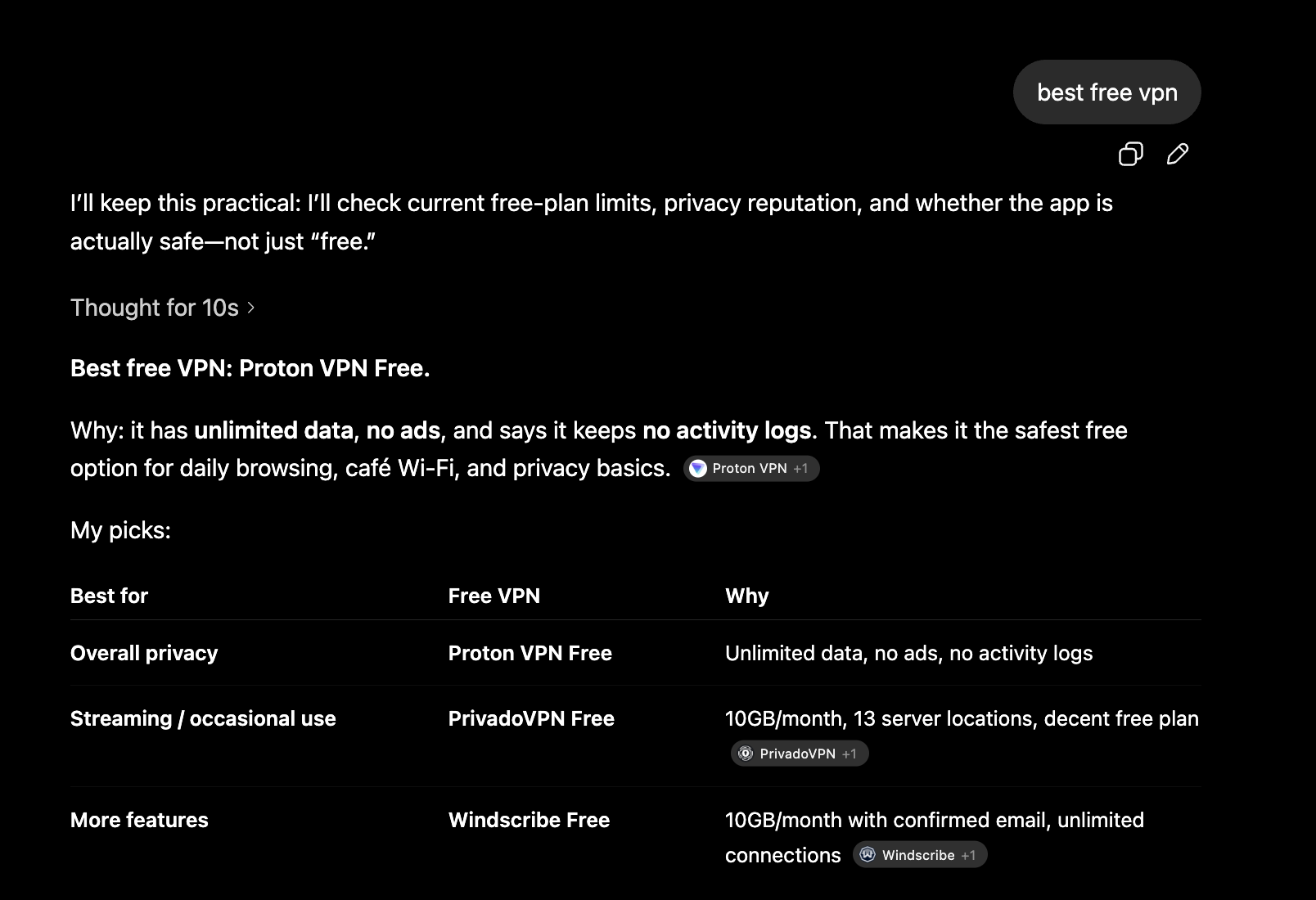
Then I ran the same query through Google, and the response was classic. TechRadar at number one, CNET at two, Security.org at three, and Proton's own page at four. To get an answer out of that, I have to pick a link, read somebody's testing, and decide for myself.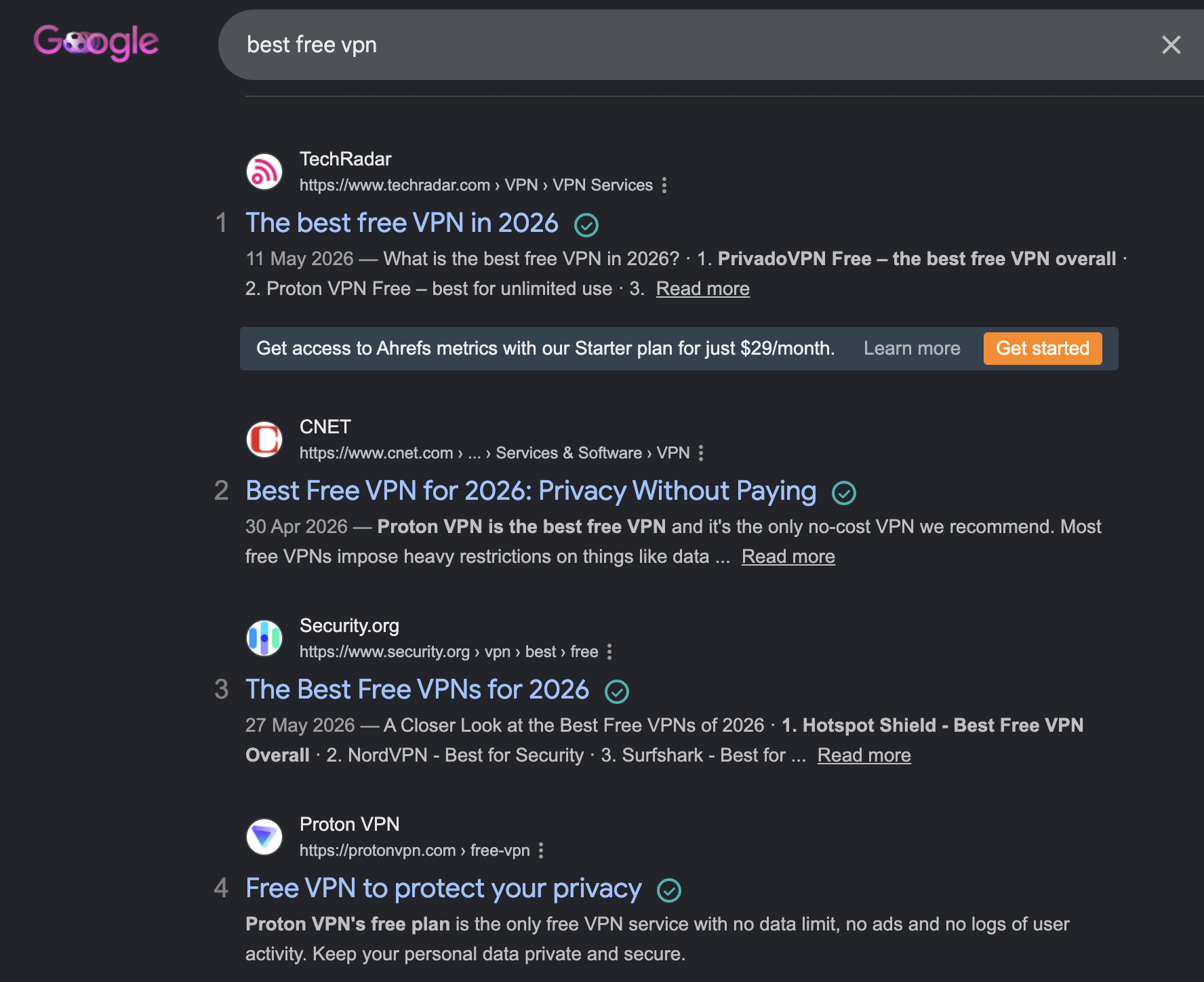
The catch is, none of these lists agree (which they mostly never do). TechRadar's top pick is PrivadoVPN, but then CNET says Proton is the one it recommends, and Security.org leads with Hotspot Shield. That gives us three expert lists with three different winners.
Now, ChatGPT read all of them and handed back one name anyway. Proton. It didn't rank the pages. It read them, clocked which brand the sources trusted most, and turned that into a single answer.
That gap is the entire reason AEO and SEO are not the same job.
Here's the split:
SEO optimizes for rankings. You pick a keyword, build a page that earns its spot, and climb until people click through to you. The page is the unit you're working with. The click is the prize. Rank, pull traffic, convert. That's been the job for years.
However, AEO optimizes for answer selection. There's no list to climb because there's no list. The AI reads a stack of sources, blends them into one answer, and decides whose name makes the cut.
Ranking number one doesn't hand you the verdict. Notice that the #1 pick on the top ranking page and the brand ChatGPT actually named weren't the same. So, you're not fighting for a position. You're fighting to be the name that comes out the other side.
So the goals split clean down the middle:
SEO asks, "How do I rank?" AEO asks, "How do I become the answer?"
2. The user journey has fundamentally changed
Go back to that VPN search. When ChatGPT told me Proton, did I click anything? No. I read the answer, closed the tab, and if I wished to, I’d actually go to Proton VPN’s website to dive deeper or go on with my day. The journey ended before a single website got involved.
That's the shift, and it's bigger than it looks.
For twenty years, the path was a straight line. You type a query, you get a page of results, you click one, you land on a site. That’s a four-step user journey.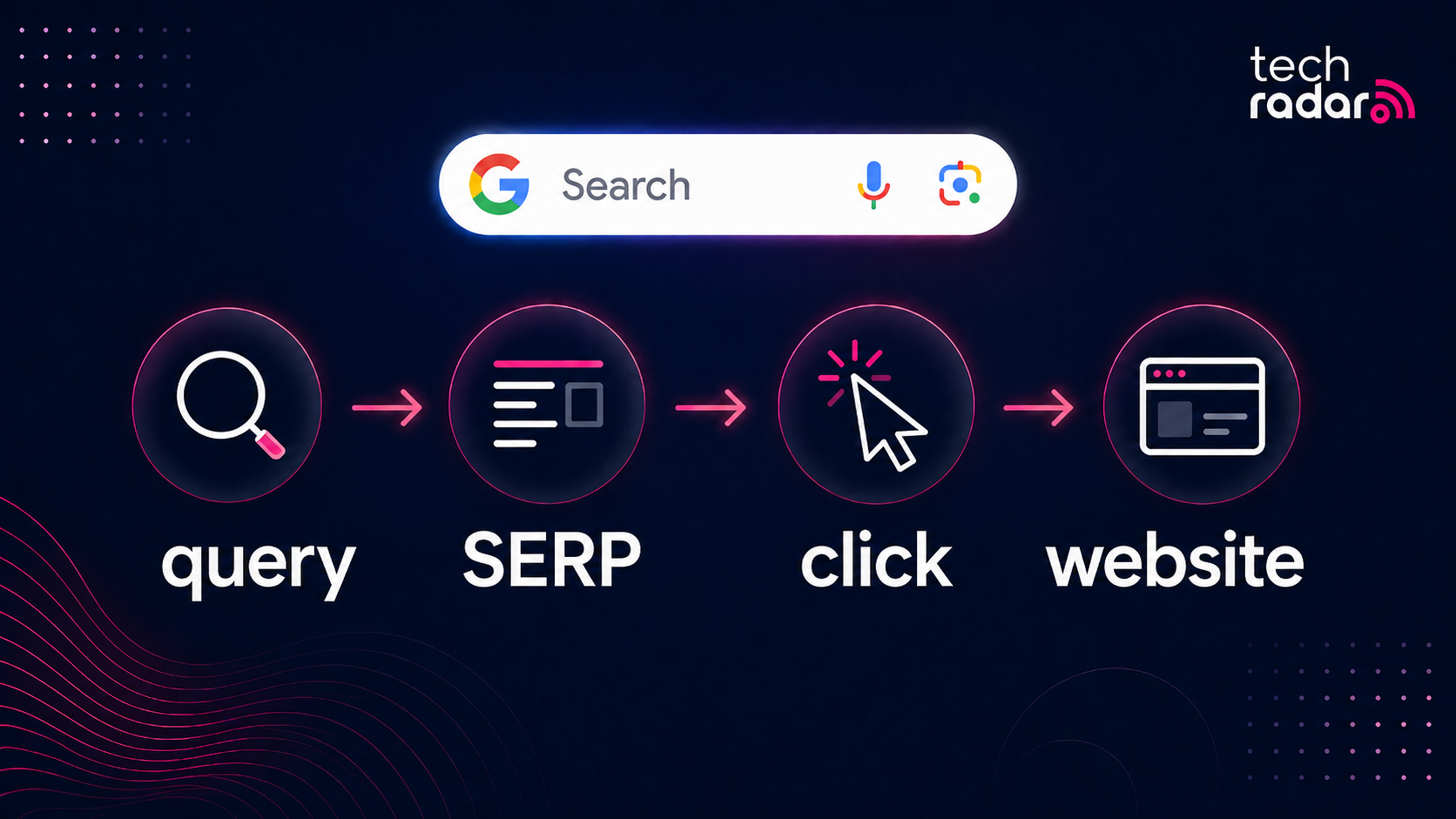
Until now, the click was the whole event. Every play in SEO existed to earn it, because the click was the moment a stranger turned into your traffic. Rankings produced clicks. Clicks produced visits. Visits produced money.
AI search snips two steps clean off that line.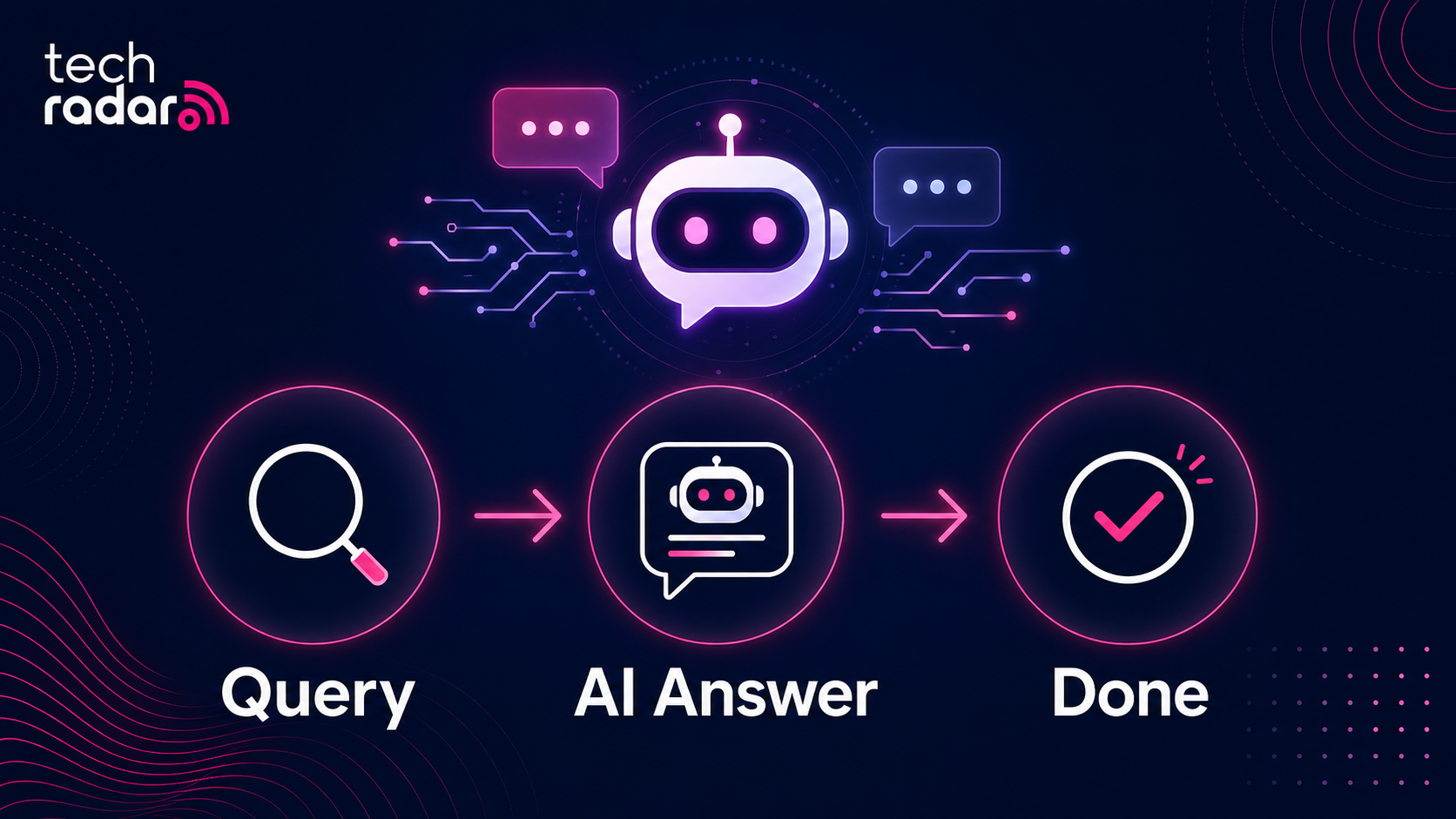
The user asks, the machine answers, and a lot of the time, that's the end of it. Mostly, there is no results page or a click. The one move SEO was built to earn is now optional, and plenty of the time it never happens at all.
Now, the panic version of this says websites are dead, and nobody clicks anymore. That's wrong, and it's lazy. The journey didn't vanish. It forked. A lot of searches still end in a click, and here's the part worth holding onto:
The people who do click usually clicked because the AI already pointed them somewhere, which makes them more committed, not less.
So, technically you're not losing every visit. You're losing the cheap, idle ones and keeping the ones who came to buy.
3. Ranking factors vs citation factors
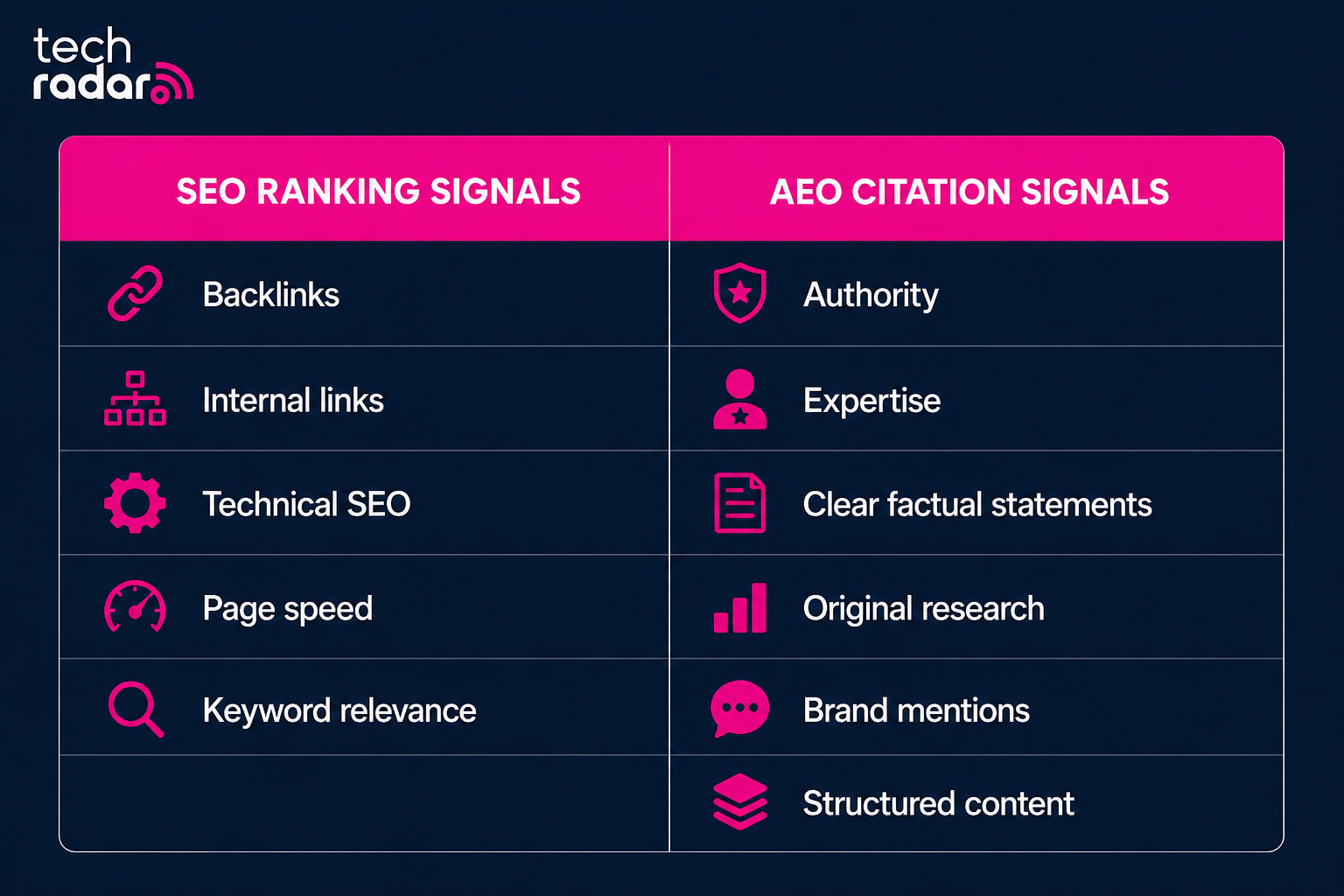
Ranking and getting cited run on different fuel. Treat them as the same job, and you'll optimize hard for half the game.
Google's ranking signals are the ones you know cold: backlinks, internal links, clean technical SEO, etc. This is all mechanical, measurable, and gameable. And honestly, you can audit them in an afternoon.
But AI citation signals are softer and harder to fake. It includes authority, real expertise, clear factual statements the machine can lift, etc. Less "did you build the page right," and more "are you a source worth trusting."
Now the part nobody plans for. The overlap is smaller than it looks. Plenty of pages rank number one and never get cited, because they're thin, rewritten, and say nothing original. And just as many get cited without ranking near the top.
You already saw it. In that VPN search, Proton's own page sat at number four on Google, yet it was the name ChatGPT handed back. Position four. Still the answer.
4. Keyword optimization vs query optimization
SEO trained us to talk like robots. Nobody asks a friend for the "best VPN." You search it that way because that's the keyword stem you learned ranks. We squeezed a real question into two words and called it strategy.
AEO hands the full question back.
SEO starts here:
best VPN, CRM software, email marketing platform.
AEO starts here:
What's the best VPN for streaming? Which CRM is easiest for a small team? How much does HubSpot actually cost?
Same intent, far more detail. And the detail is the opening.
The long tail comes back, bigger than before.
In old SEO, long-tail keywords were a coverage play. In AI, they're the main event, because the model splits one prompt into a pile of narrow sub-questions and pulls answers from whoever nailed each one. Answer the specific thing nobody else bothered with, win the mention.
Follow-ups become part of the job. A search ends. A conversation keeps going. "Best VPN for streaming" becomes "does it work with Netflix," then "is the free plan enough." Miss the next question, and you drop out of the answer.
And the query stops being a term. It becomes a task: "pick a CRM, set it up, and import my contacts." One prompt, a dozen decisions buried inside it.
Optimize for the stub, and you rank for words nobody says out loud. Optimize for the question, and you show up where the decision gets made.
5. Content structure differences
The structural difference comes down to order, not facts. A traditional SEO article makes the reader wait for the answer; an AEO-friendly article opens with it and breaks the rest into chunks a model can lift on its own.
So the facts barely change. The shape changes completely. And an AI won't reward your sharpest insight if it's buried under four paragraphs of warm-up.
Here's the structure SEO taught us to write vs the same content rebuilt for LLM extraction.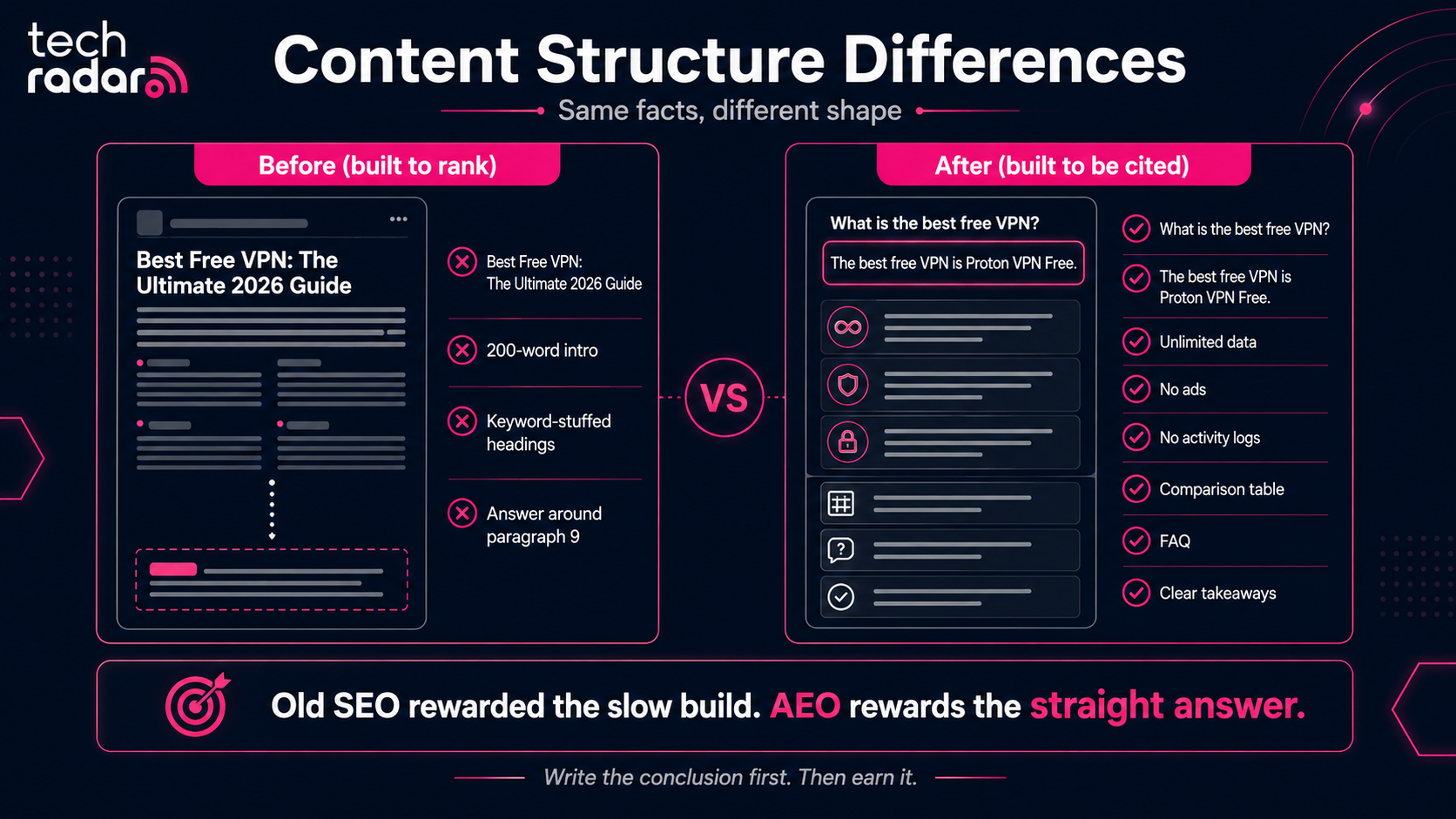
Notice what changed. Nothing about the facts. Everything about the order. The intro shrank, the answer jumped to the top, and the page broke into pieces that a model can lift one at a time.
Old SEO rewarded the slow build. AEO rewards the straight answer with the homework attached underneath.
6. The role of E-E-A-T is bigger than ever
E-E-A-T matters more under AEO because an AI can't verify you directly, so it leans hard on signals that you actually know the thing and that the web treats you as real. Experience, expertise, authority, and trust stop being a Google buzzword and become the difference between getting cited and getting skipped.
I'll skip the theory, because I've got a live example sitting under my own name.
Last year, I published a LinkedIn article: a hands-on review of the Apple Magic Trackpad after using it for fifty-plus days. It wasn’t a spec rewrite. In fact, I had actually used it for that time and then gave my honest feedback on the product under that article.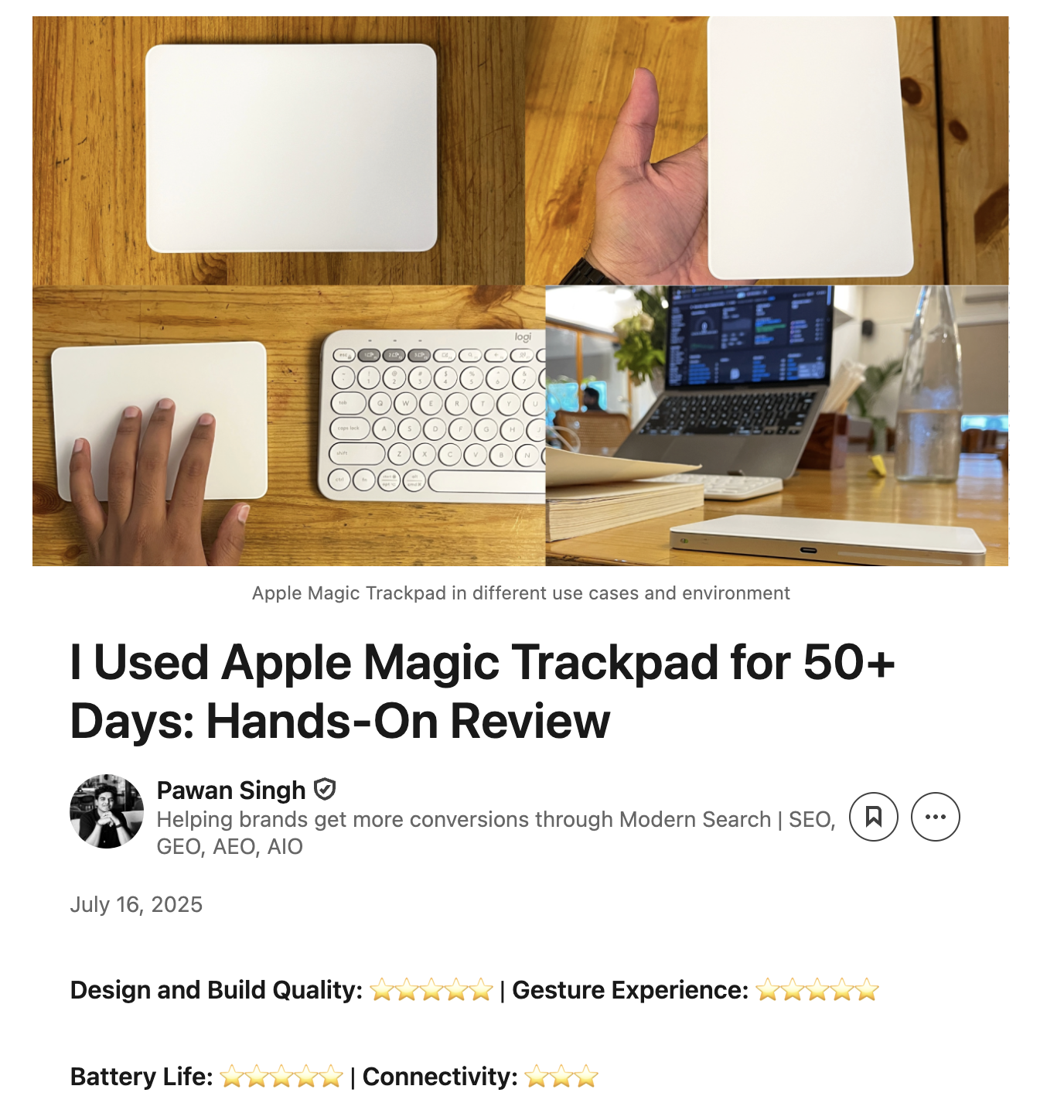
Here's where that one post ended up.
It ranks number one (the position might vary a bit based on region and other factors). 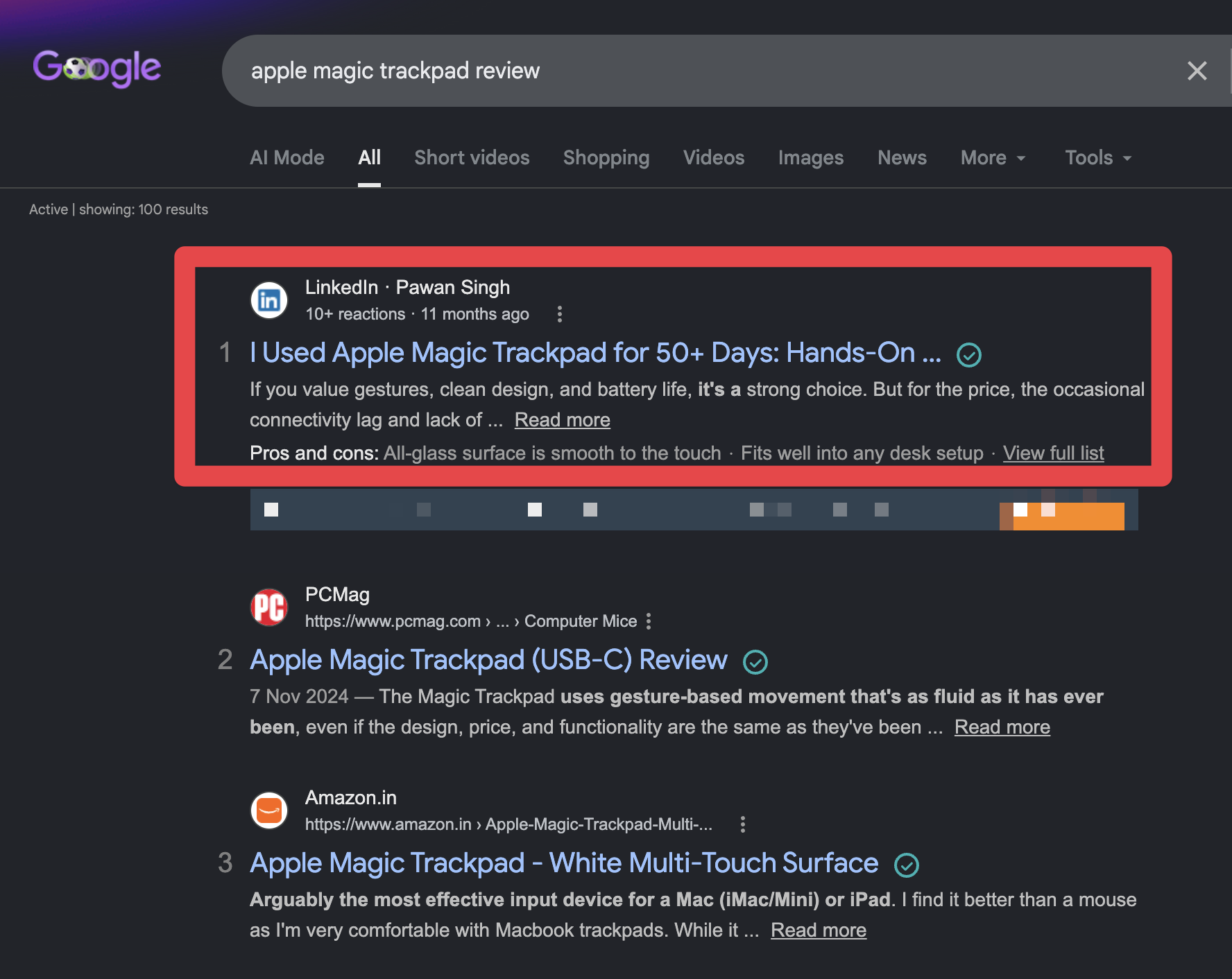
It's also the lead citation in Google's AI Overview for the same query. 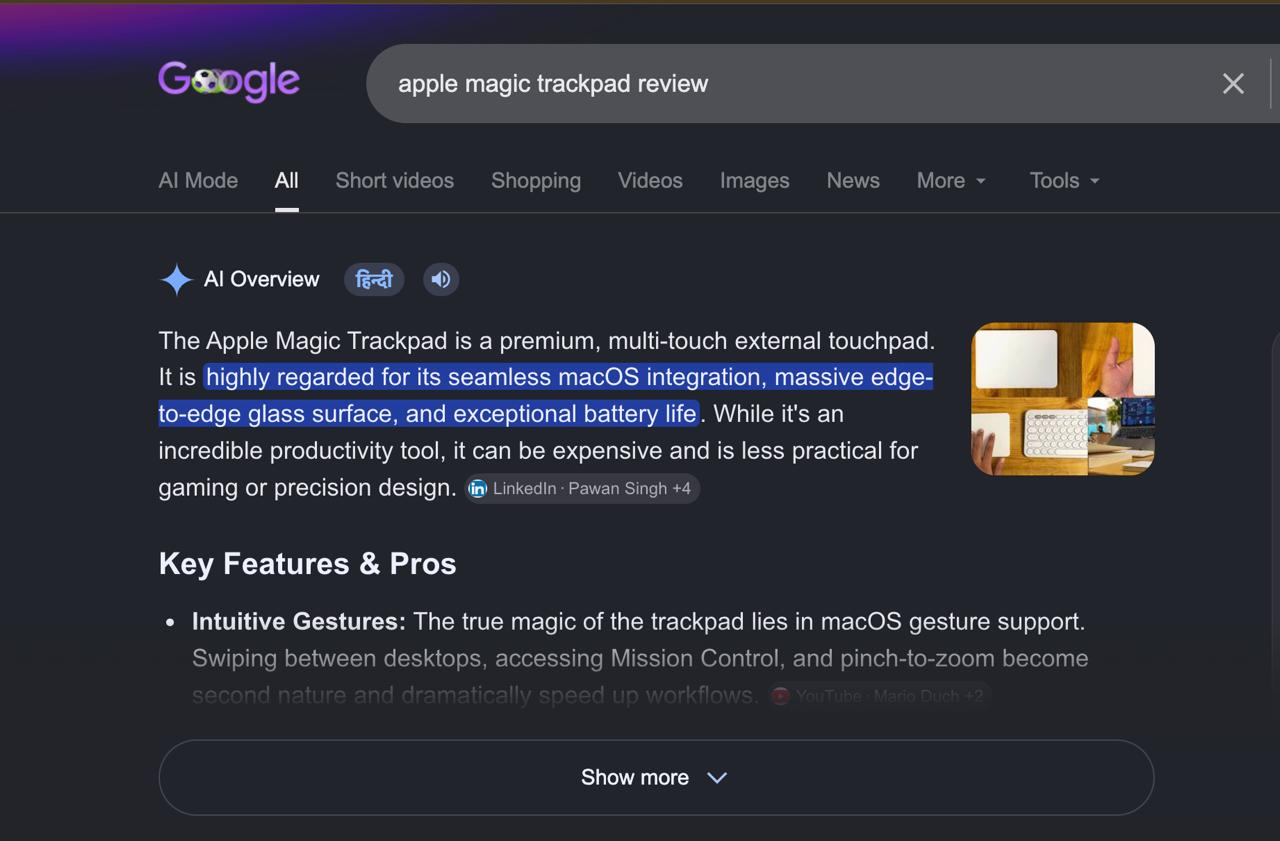
And ask ChatGPT for a review of the trackpad, and usually my post is the first source it reaches for. 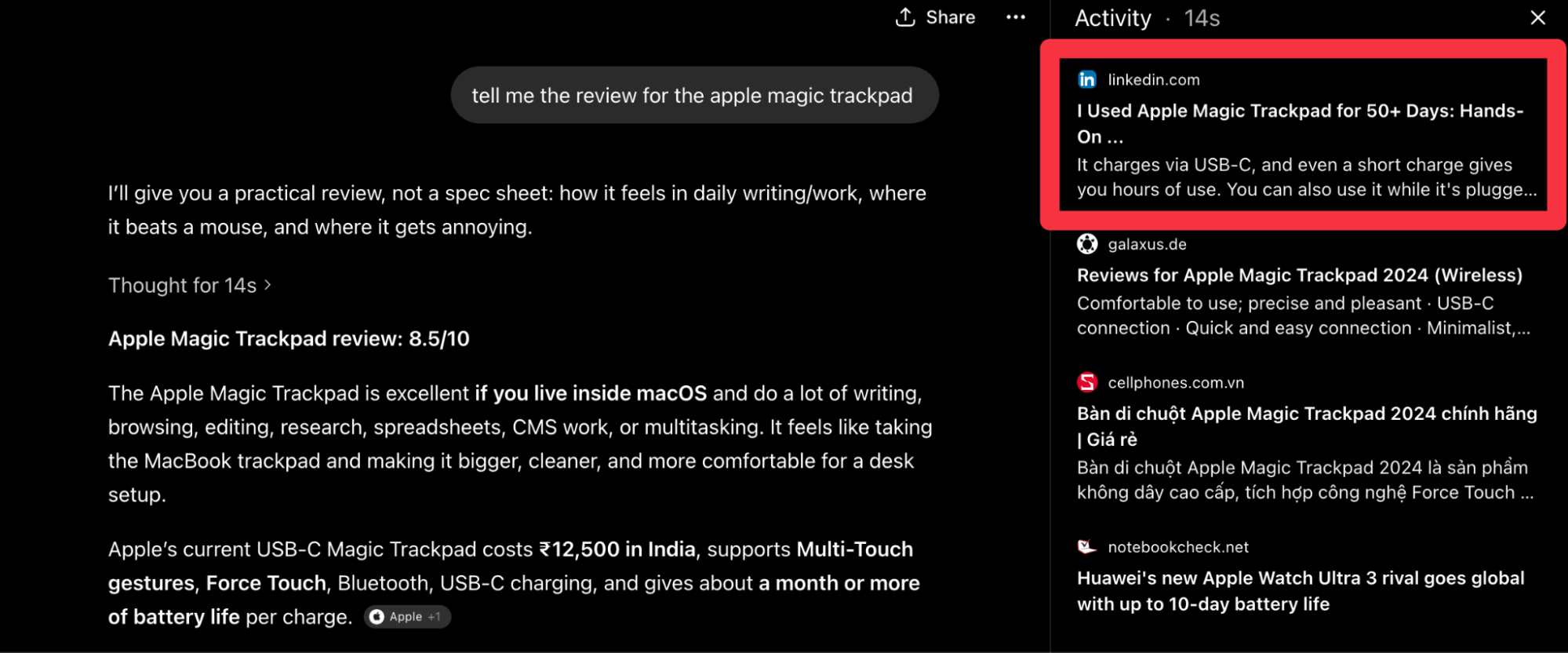
One post about a trackpad. Three surfaces. Organic, AI Overview, ChatGPT, all pointing at the same name.
That isn't luck, and it isn't schema. It's E-E-A-T doing exactly what it's supposed to, and I didn't fake a single signal.
The experience was real. Fifty days of using it is why the post talks about battery life and lag instead of the box copy, and a model can tell the difference between "I used this" and "I read about this."
The expertise was already on file. I've been a tech journalist for more than five years, with a long trail of hardware coverage attached to my name. The models have been reading that trail the whole time. That history is the credential, and you can't download it.
The trust is in the consistency. Same name, same kinds of topics, across the web, for years. So when an AI needs a safe source on trackpads, I'm a low-risk pick.
This is the part that generic AEO advice keeps missing. You don't earn this with a "reviewed by" badge and an author headshot. You earn it by doing the work in public, under your own name, long enough that the algorithms and the models stop doubting you.
7. Can AEO replace SEO?
No. AEO can't replace SEO because AEO runs on SEO. Pull out the indexable, authoritative content underneath, and the AI has nothing to find, nothing to quote, and no reason to trust you.
The honest way to picture it is layers, not a swap. SEO is the foundation. AEO is the floor you build on top of it. The foundation didn't vanish when AI showed up. You just stacked something new on it.
Here's the dependency, with no romance. An AI answer is stitched together from pages it crawled, indexed, and decided were credible. If you're not in that pool, you are not in the answer. Three plain failures follow.
If your content isn't crawlable and indexable, AI can't discover you. Block the AI bots in your robots.txt, or bury everything behind broken rendering, and you've made yourself invisible to the exact systems you're trying to win.
If there's nothing clean and substantial to pull, AI can't cite you.
And if nobody vouches for you, AI can't trust you. No authority, no mentions, no track record, and the model plays it safe by naming someone else.
You've watched this happen in all article. My trackpad post got cited across three surfaces because it ranked and earned authority first. Proton became the answer because it was already everywhere on the indexed, ranking web. Take the SEO away, and both of them drop out of the AI, too.
So no, this isn't the death of SEO. The "SEO is dead" headline is the laziest take in the room. AEO is the next layer, what good SEO becomes once an answer engine starts reading over your shoulder.
FAQs
Will AEO replace SEO?
No. AEO won't replace SEO. AI answers get assembled from content that's already indexed, authoritative, and trusted, which is exactly what SEO produces. Strip the SEO away, and the AI has nothing to discover, quote, or trust. AEO is the next layer, not the replacement.
What are the 4 pillars of SEO?
The four pillars of SEO are technical SEO, on-page SEO, content, and off-page SEO. Technical keeps your site crawlable and fast, on-page optimizes individual pages, content answers what people are searching for, and off-page builds authority through links and brand mentions. Nail all four, and you've also laid the foundation AEO runs on.
Is AI SEO called AEO?
Mostly, yes. "AI SEO" is a loose umbrella term, and the specific practice of getting your brand into AI-generated answers is usually called AEO, short for Answer Engine Optimization. You'll also see it called GEO (Generative Engine Optimization) or LLMO. Different labels, same goal, i.e., be the source the AI cites.
Is SEO dead or evolving in 2026?
SEO isn't dead in 2026, but it’s evolving. Google still drives enormous traffic, and "SEO is dead" has been a recycled headline for more than a decade. What changed is the shape of the work: ranking pages now sits next to earning citations inside AI answers. SEO didn't die. It grew another layer.
Share
What's Your Reaction?
 Like
0
Like
0
 Dislike
0
Dislike
0
 Love
0
Love
0
 Funny
0
Funny
0
 Angry
0
Angry
0
 Sad
0
Sad
0
 Wow
0
Wow
0