97. The Great Sobering
When Your Trillion-Dollar Hangover Meets Reality (But You Keep Drinking Anyway)

Greetings. It’s been a month. Ever empty a basement after 26 years? For the love of God, start early and often.
Let’s get to it.
The Year in Review Advance
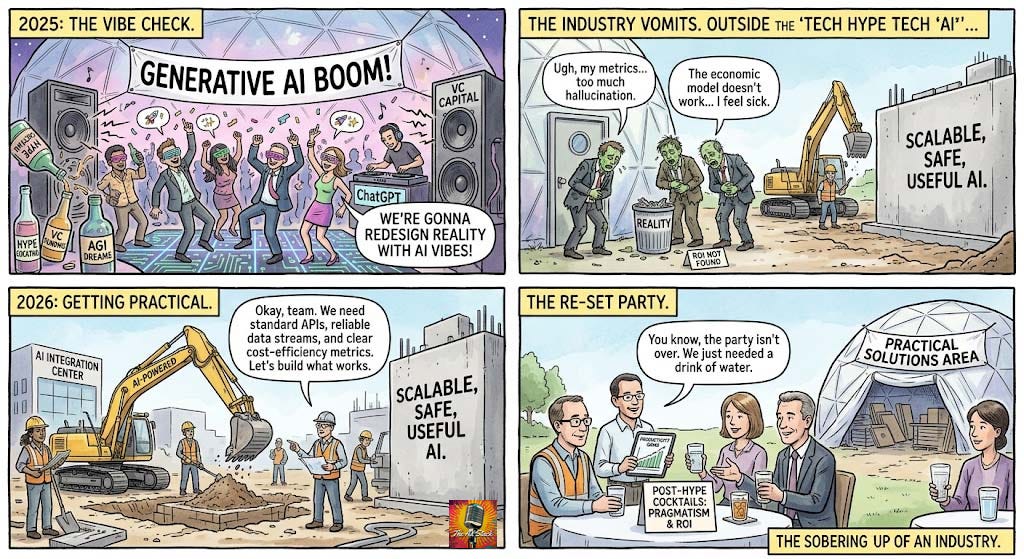
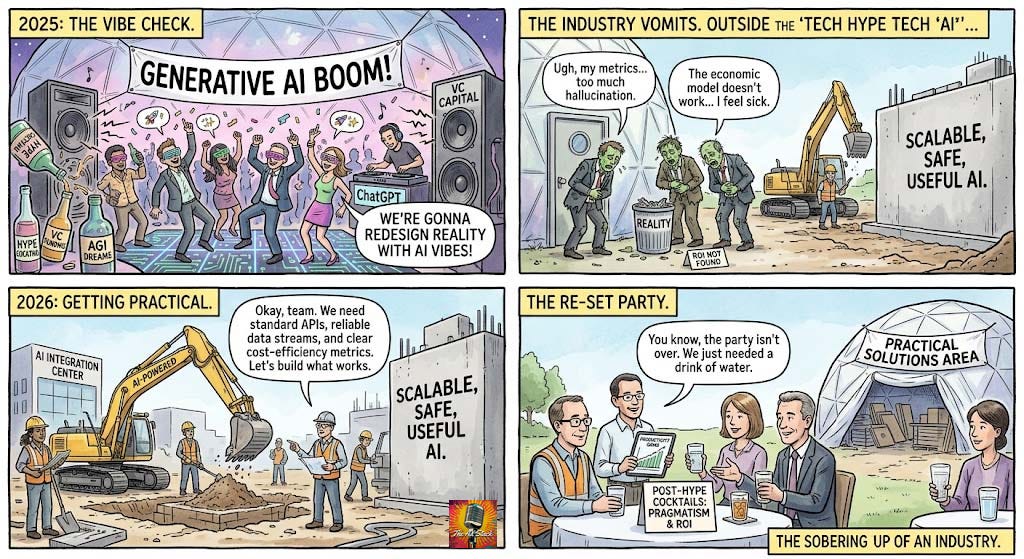
TechCrunch recently delivered the industry’s new favorite reassuring fairy tale: “If 2025 was the year AI got a vibe check, 2026 will be the year the tech gets practical. The party isn’t over, but the industry is starting to sober up.”
How comforting. The drunk driver insists he’s only had two beers while careening toward a cliff at 90 miles per hour with his foot welded to the accelerator.
Let’s examine what “sobering up” actually looks like when you’re a $47.32 billion industry projected to hit $107 billion by 2028, despite the inconvenient fact that only 1% of businesses actually recover their generative AI investment.
The Sentient Shell Game
Remember when artificial general intelligence was going to arrive in 2027? Sam Altman certainly does, though he’d prefer you didn’t. That “few thousand days” timeline he floated has now quietly stretched into the 2030s, according to consensus among the luminaries who previously couldn’t stop promising imminent superintelligence.
The walkback follows a familiar pattern. Silicon Valley spent years forecasting AGI by 2027. Altman declaring it “basically a solved problem,” Anthropic’s Dario Amodei pegging it to 2026-2027, Google’s Demis Hassabis narrowing it to “probably three to five years.” Then in late 2025, podcast interviews with Richard Sutton, Andrej Karpathy, and Ilya Sutskever established a new consensus: the AGI window now extends into the 2030s “at the earliest.”
That’s not sobering up. That’s moving the goalposts after you’ve already spent the victory parade budget.
Dell’s Honesty Gets Punished By Reality
At CES 2026, Dell Technologies demonstrated what actual sobriety looks like in this industry and the market immediately punished them for it. The company’s stock dropped 4% after executives committed the cardinal sin of telling the truth: their “AI PC” marketing had failed spectacularly.
Vice Chairman Jeff Clarke took the stage to admit they’d “gotten off course” by retiring the XPS brand for generic “Dell Premium” branding, a confession so rare in tech that he wore an XPS t-shirt as a symbolic mea culpa. Then he warned about unprecedented memory shortages and rising component costs in a stagnant demand environment.
The reaction from investors: sell immediately. Because in 2026’s version of “sobering up,” honesty about AI’s limitations gets treated like a bankruptcy filing while continued delusion gets rewarded with fresh capital.
CES has now officially “stripped away the glossy veneer of the AI PC revolution, revealing a market still tethered to the harsh realities of supply chain economics and consumer psychology.” Which is industry-speak for: we spent billions convincing people they needed AI-powered laptops and they responded with a collective “Say wha?”
The Infrastructure Ponzi Scheme Accelerates
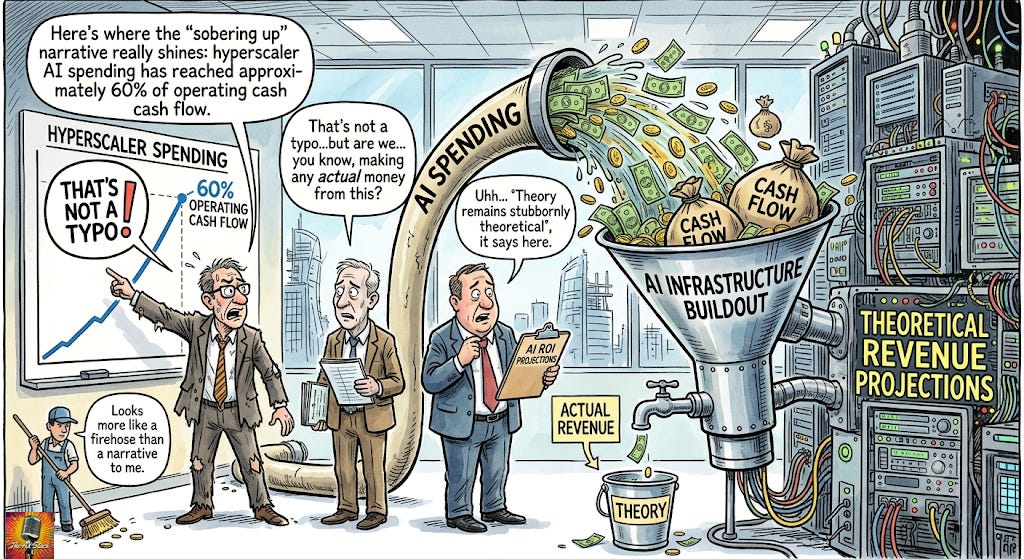
Here’s where the “sobering up” narrative really shines: hyperscaler AI spending has reached approximately 60% of operating cash flow. That’s not a typo. These companies are dedicating more than half their operating cash to AI infrastructure buildouts based on revenue projections that remain stubbornly theoretical.
Average AI data center construction time: two years. Which means projects announced in 2024 and funded in 2025 should be coming online in 2026, ”except they’re not. Construction delays started appearing in Q4 2025, with supply chain bottlenecks for everything from semiconductors to transformers, generators, cooling units, and switchgear.
The “TSMC Brake” perfectly captures the absurdity: despite 50% revenue growth since 2022, TSMC (Taiwan Semiconductor Manufacturing Company Limited - manufacturing advanced microchips for major global tech companies like Apple, Nvidia, and AMD) increased capital expenditure by only 10%. Monopolistic semiconductor manufacturers can’t be forced to accelerate capacity expansion, so hyperscalers are now warehousing new AI chips rather than installing them directly into data centers. That’s the sound of trillions of dollars in planned infrastructure meeting the hard wall of physical reality.
The Revenue Problem Nobody Wants to Discuss
Fresh research from AI agency DEJAN reveals that approximately 65% of AI chatbot users don’t plan to buy a product or service in connection with an AI dialogue. Read that again: the largest untapped attention pool in digital media ChatGPT’s 810 million monthly users has no commercial intent. Oopsi Poopsi.
This directly contradicts the rush to introduce advertising into AI platforms. OpenAI faces investor pressure to convert its massive user base into revenue but can’t figure out monetization without alienating users. Perplexity already paused advertising deals after CPM-based ads “fell flat.”
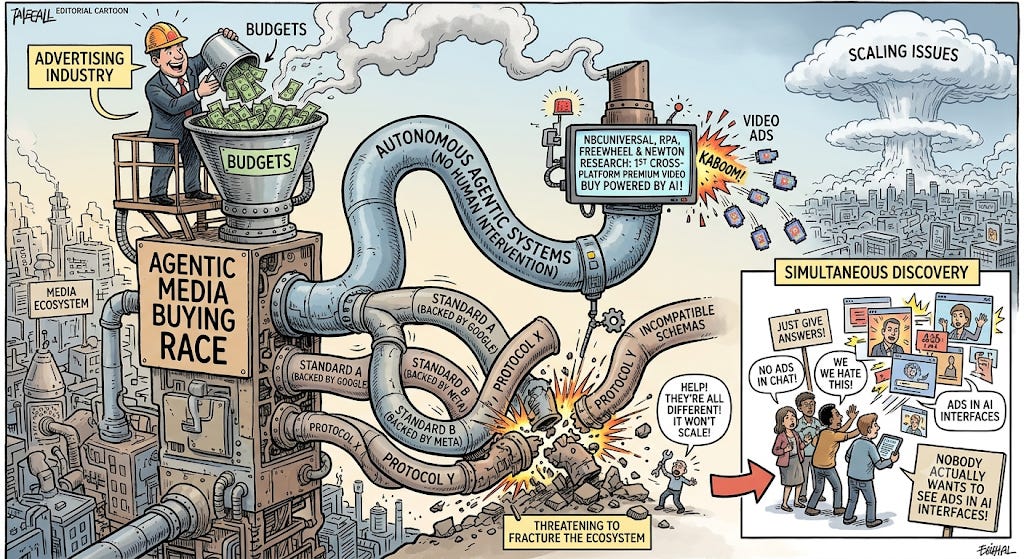
The advertising industry is racing to deploy autonomous agentic systems that execute media buys without human intervention. ”NBCUniversal, RPA, FreeWheel alongside Newton Research just demonstrated the first cross-platform premium video buy powered by AI” while simultaneously discovering that nobody actually wants to see ads in AI interfaces and the competing standards for agentic automation threaten to fracture the ecosystem before it scales.
The Correction That Isn’t Coming
Industry observers describe 2026 as the year AI faces “a dual reality: AI hype will outpace current capabilities, yet the value delivered by some AI solutions will be large and real.” This is corporate doublespeak for “we’re going to keep pretending the emperor has clothes while privately admitting he’s naked.”
The AI marketing industry reached $47.32 billion in 2025 while delivering a 1% ROI recovery rate. The solution? Projecting growth to $107 billion by 2028. Because when your business model doesn’t work at $47 billion, clearly the answer is to scale it to $107 billion.
Dell admitted AI PC marketing failed and got punished. McDonald’s spent seven weeks with ten people generating AI Christmas ads that lasted three days online. 93% of marketers claim they create content faster with AI, yet production complexity hasn’t decreased. It’s just shifted from creative execution to prompt engineering and iteration management.
The party isn’t sobering up. The industry has simply learned to slur its words more convincingly while ordering another round of trillion-dollar shots. The champagne froth isn’t settling, it’s just being rebranded as “strategic infrastructure investment in the practical application phase of the AI transformation journey.”
TechCrunch’s “sobering up” narrative would be more accurate if it read: “If 2025 was the year we promised AI would change everything, 2026 will be the year we quietly extend our timelines, move our goalposts, and continue spending at unprecedented rates while redefining success downward.
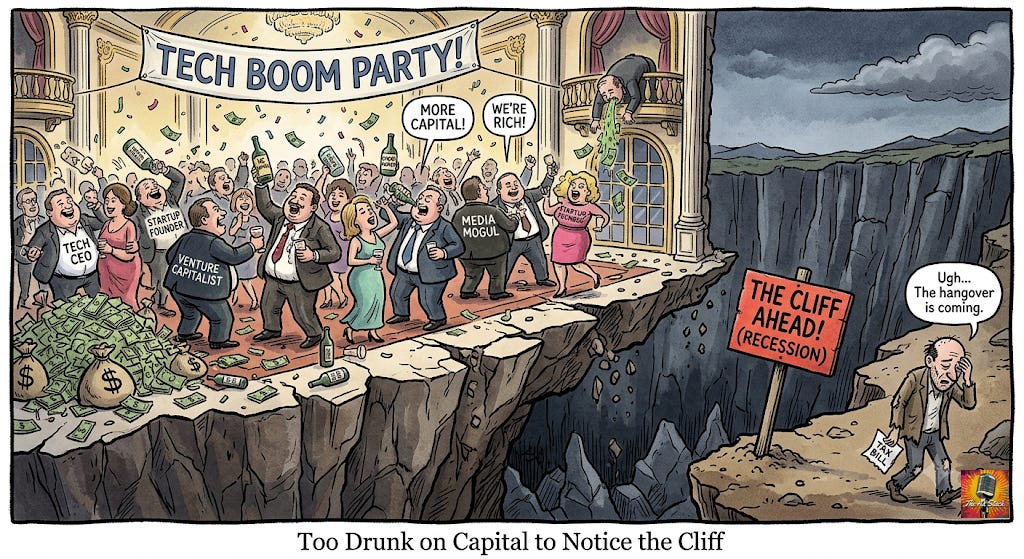
The hangover is coming. But right now, the industry is too drunk on capital to notice the cliff approaching.
Thanks for Stacking.
Share
What's Your Reaction?
 Like
0
Like
0
 Dislike
0
Dislike
0
 Love
0
Love
0
 Funny
0
Funny
0
 Angry
0
Angry
0
 Sad
0
Sad
0
 Wow
0
Wow
0