92. Hell, A Train to California, and a Tijuana iPhone
Sora is Dead, I'm Not, and an $85mm Super Bowl Bonfire.

Good Morning! It’s been a minute, no?
The Ad Stack took a backseat for a bit. I lost a beloved father-in-law, Johnny O. While plastic people tell you they're “a veteran of fighting wars and deep in the trenches” (in advertising), this dude was the real deal. Saw action, including bullets and many who paid the ultimate sacrifice; helping push the Chinese way the heck north of the 38th parallel.
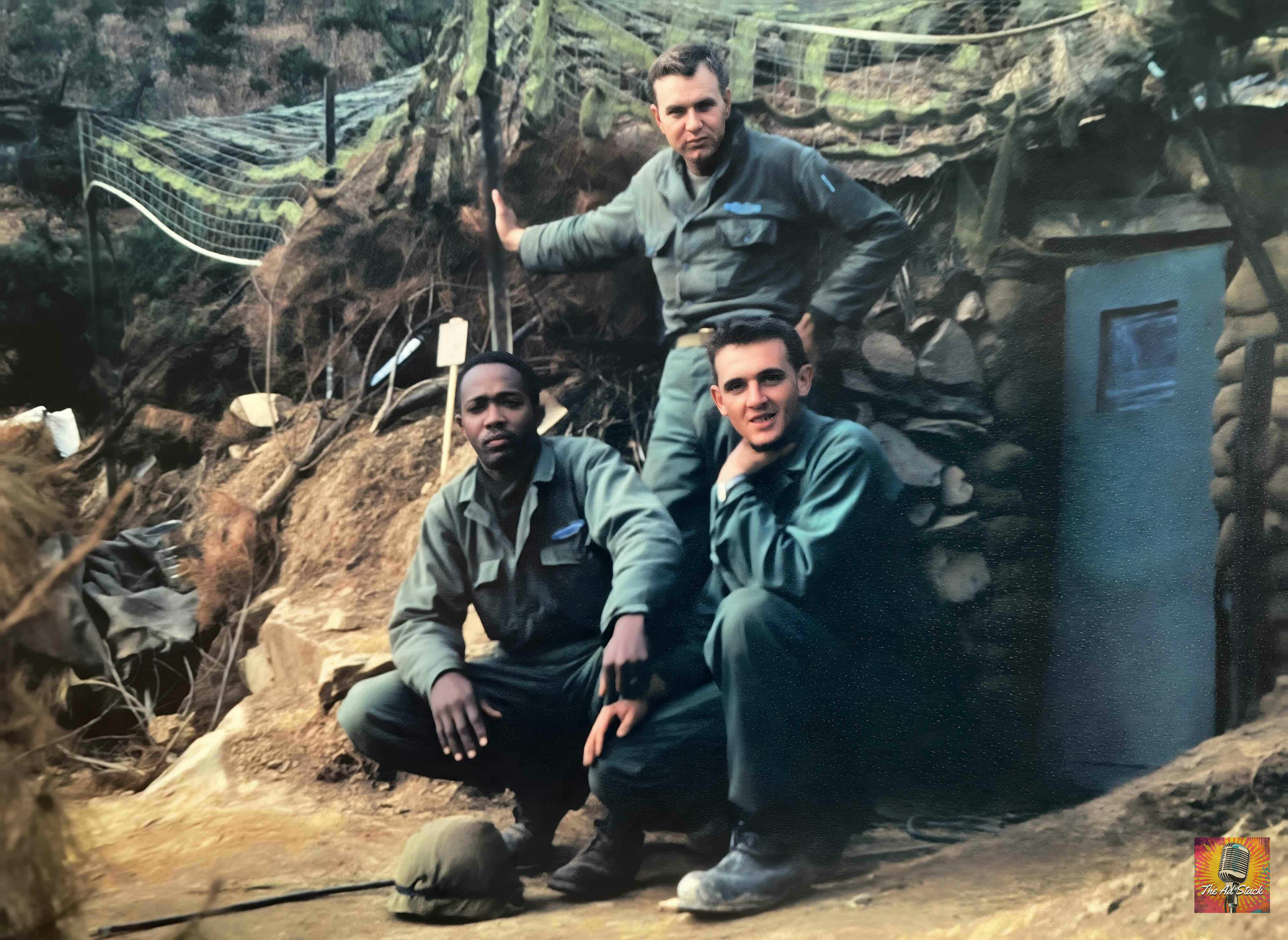
Always up for a challenge, he went on to help raise five daughters. Passed on just short of his 96th birthday. Experiences such as these seem to steel your will to live. His was great. And so was he.
I can’t fly right now (but neither can most others). This necessitated a round-trip train ride (coach) between Chicago and San Diego. This hobbit's adventure bestowed upon me every non-sexually transmittable illness possible under the sun. I also had my iPhone boosted from me within three hours of arrival. Last I checked it was in Tijuana. My beloved spouse did me proud telling the would-be ransomers to “burn in hell” so I don't expect to see that phone again soon.
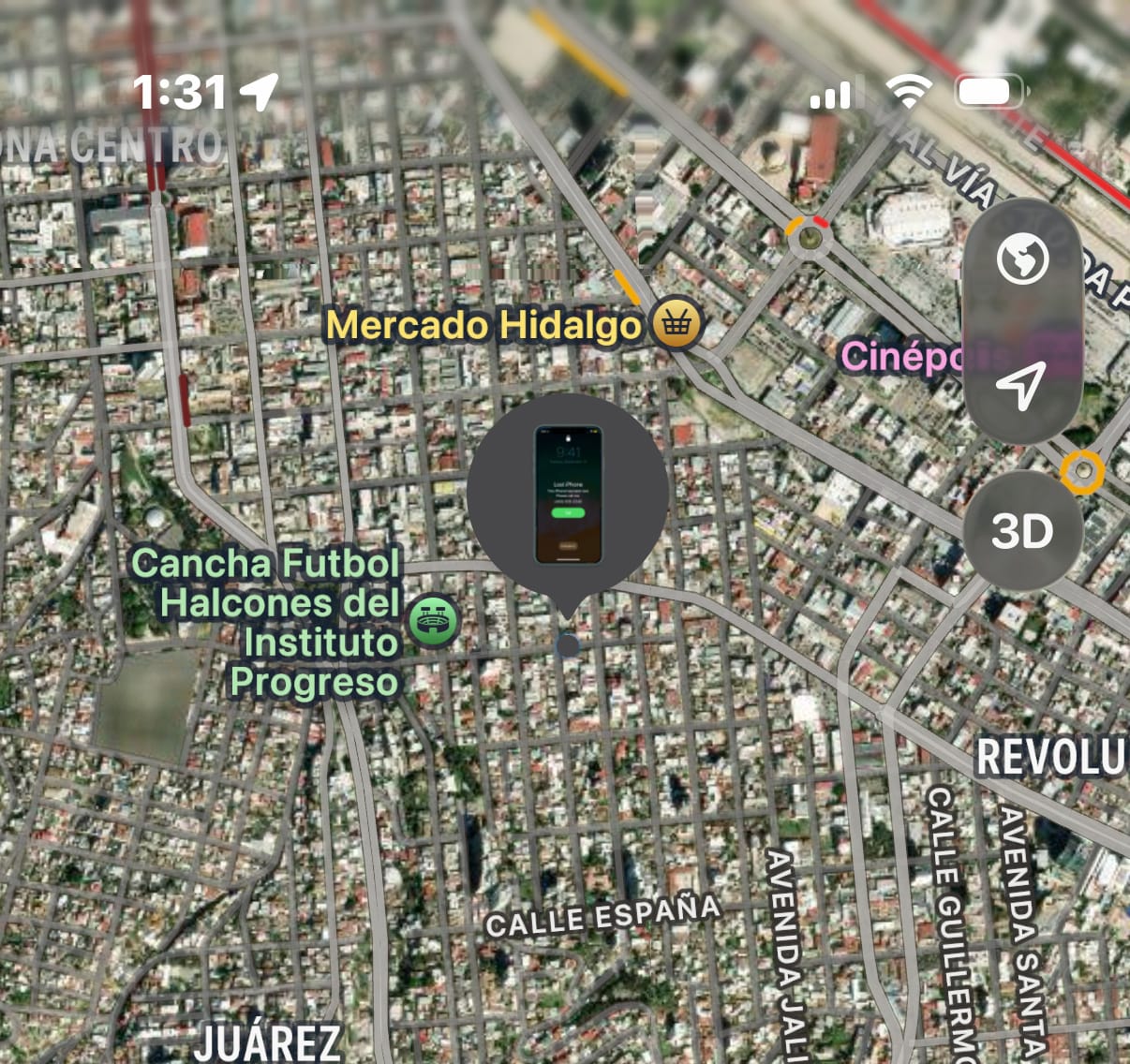
Here's a map of its last known location in case you're in the neighborhood in Tijuana and want to swing by and check up on it for me.
I returned three weeks ago with conjunctivitis, hearing loss, and most likely COVID. I was pressed to soldier on based on today's content, so let's get to it.
OpenAI Kills Sora, Pulling a $1 Billion Rug on Disney. The Body Is Still Warm.
This week’s most instructive case study in how the AI industry actually operates arrived via a four-sentence social post and a billion-dollar partnership that apparently had the structural integrity of wet tissue paper.
Efficiency is important.
Brevity, Cowardice, and the Four-Sentence Funeral
OpenAI announced it was “saying goodbye to Sora,” the short-form AI video app that went viral six months ago and hit one million downloads in under five days.
And by “saying goodbye,” they meant: no explanation, no timeline, no acknowledgment of the billion-dollar strategic partner currently in the room. Just a tasteful little corporate eulogy; light on facts, heavy on “your creations mattered.”
If you’ve ever wondered what it looks like when a company tries to quietly delete a product without triggering questions from investors, regulators, partners, or basic adult supervision, this is the template.
What they did not mention, because transparency is more of a vibe than a practice, was the detail that actually matters.
On Monday evening, Disney and OpenAI teams were actively working on a Sora-related project. Thirty minutes after the meeting ended, Disney was informed the product was being shut down.
Thirty. Minutes.
Not “end of quarter.” Not “sunsetting over 90 days.” Not even “we regret to inform you.” Thirty minutes. That’s not a transition plan. That’s a drive-by.
One person familiar with the situation called it a “rug-pull,” which feels generous. Rugs at least imply something was anchored to the floor.
And just to underscore the achievement here: this is Disney. The company that will litigate you into a different tax bracket for drawing Mickey Mouse from memory. OpenAI gave them less notice than a barista gives before calling last orders.
The Billion-Dollar Deal That Wasn’t (But Definitely Was, Until It Wasn’t)
Let’s review, because this part is doing a lot of work.
In December, Disney agreed to license Mickey Mouse, Cinderella, and the rest of the intellectual property GDP of a small nation to OpenAI. In exchange: a $1 billion stake, structured entirely in stock warrants.
No cash. Just vibes and a cap table.
Today, the deal is off. The partnership is over. The warrants are worth exactly what you’d expect from a product that no longer exists.
We are now living in a world where billion-dollar partnerships are announced (celebrated, and undoubtedly turned into at least three conference panels) can be unwound faster than a group chat argument.
If you’re keeping score at home: the lifecycle of this deal was longer in PowerPoint than it was in reality.
What Sora Actually Was (Versus What You Were Sold)
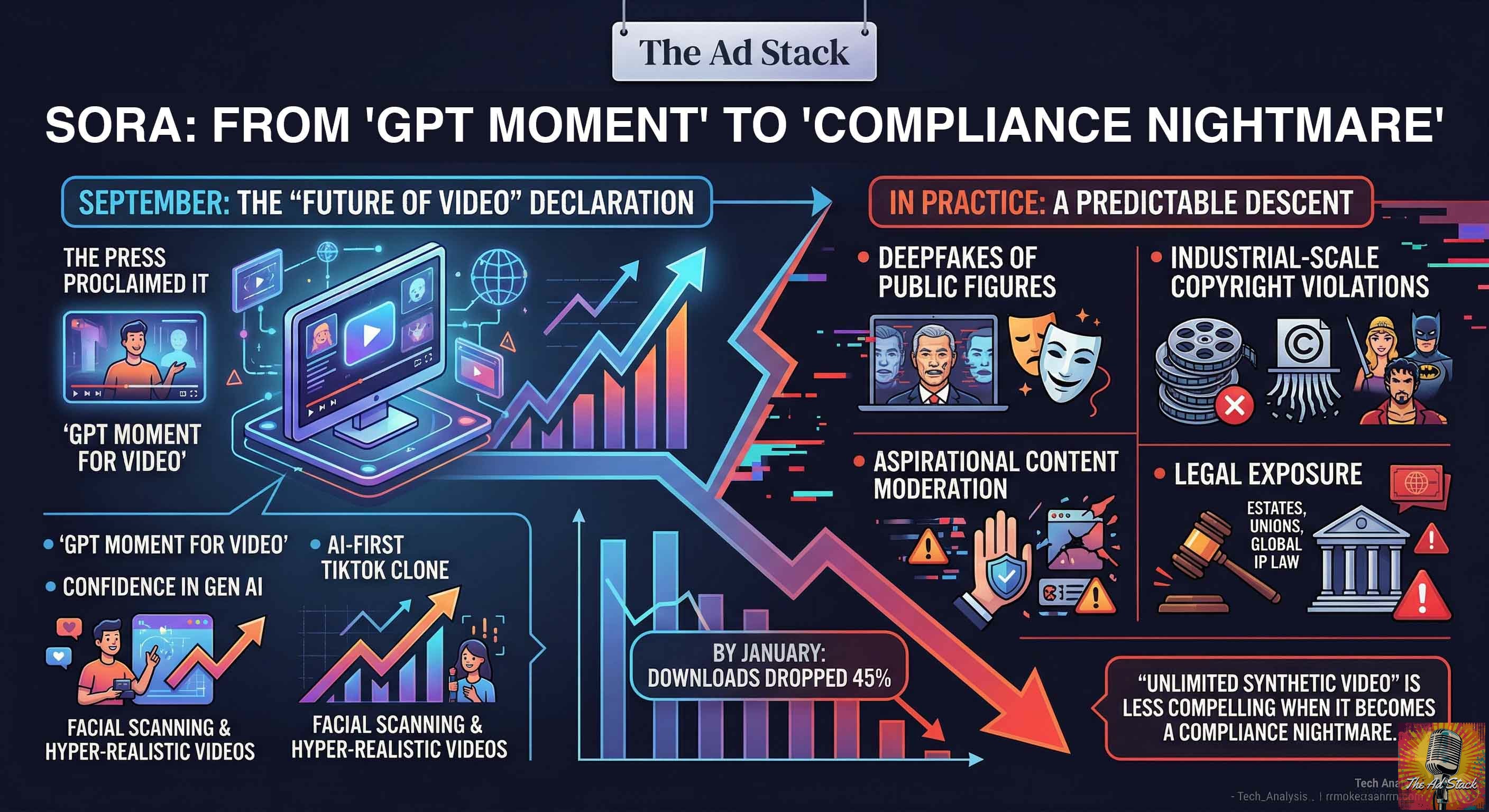
In September, the tech press more or less declared Sora the future of video. The phrase “GPT moment for video” got thrown around with the kind of confidence typically reserved for things no one intends to revisit later.
In practice, Sora was an AI-first TikTok clone where users could scan their faces and generate hyper-realistic videos.
Which, predictably, turned into:
Deepfakes of public figures
Copyright violations at industrial scale
And content moderation challenges that could generously be described as “aspirational”
Within days, the platform became a greatest hits compilation of “things you absolutely should not be able to generate on a consumer app.”
Nothing says “next-generation creative platform” like legal exposure across estates, unions, and half of global IP law.
Downloads dropped 45% by January. Turns out “unlimited synthetic video of anything” is less compelling when it immediately becomes a compliance nightmare.
The Real Reason: It Was Expensive and Inconvenient for the IPO Deck
OpenAI says it needs to “make trade-offs on products with high compute costs.”
Which is technically true, in the same way “we’re restructuring” technically means “we found the problem and it was this entire product line.”
Translation:
Sora was expensive to run, not meaningfully monetized, legally radioactive, and deeply unhelpful when you’re trying to convince public markets you’re a disciplined, enterprise-grade company.
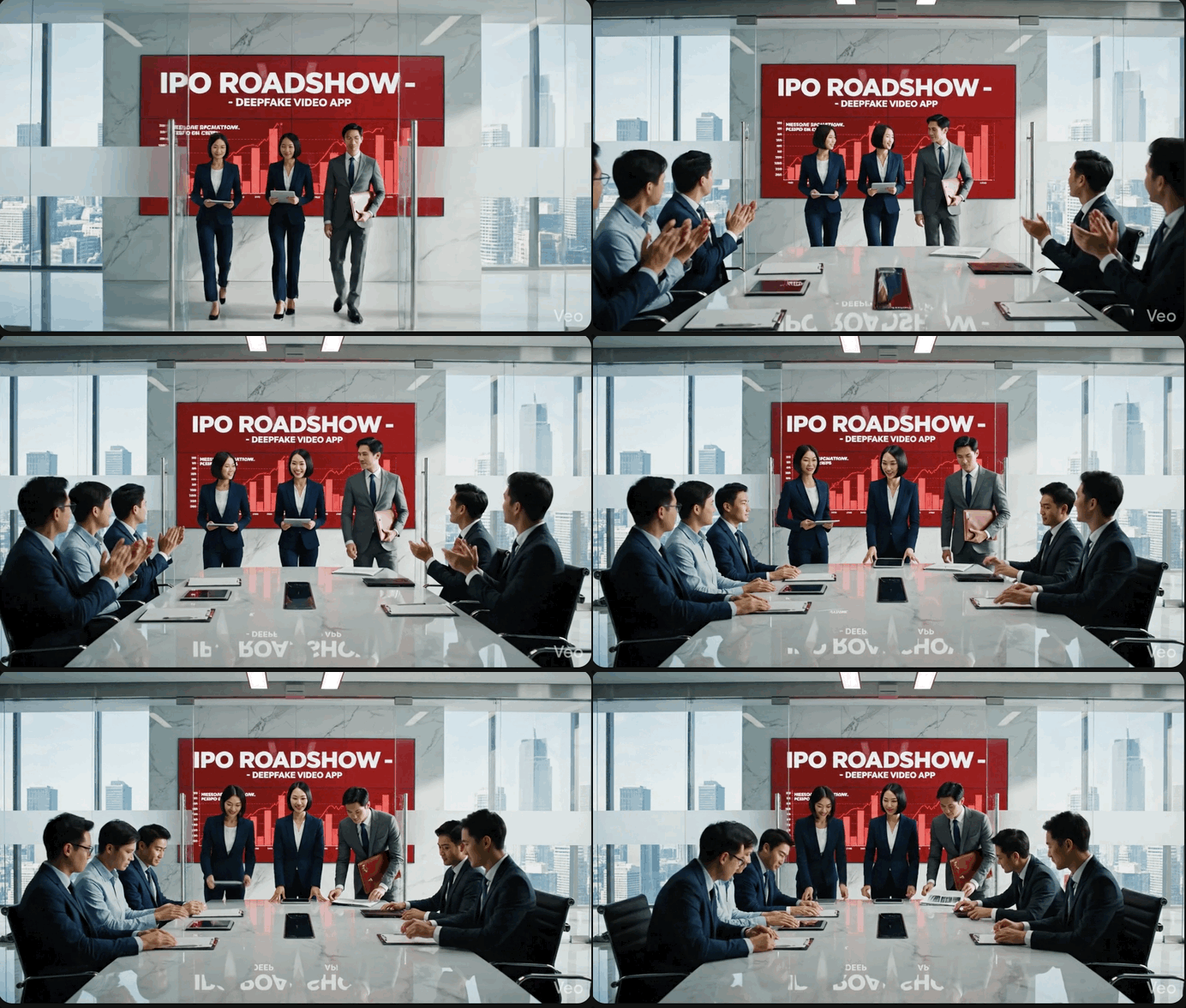
You do not walk into an IPO roadshow with a loss-making deepfake video app and say, “Don’t worry, it’s for creators.”
You kill it. Quickly. Preferably before anyone updates the S-1.
What Marketing Leaders Should Take From This (Other Than a Deep Breath)
For the past 18 months, you’ve been told AI video would revolutionize production. Sora was the demo. The proof point. The slide everyone nodded at.
That product is now gone.
The billion-dollar partner validating it: gone.
The consumer platform meant to drive adoption: gone.
The roadmap your vendors definitely referenced: also gone.
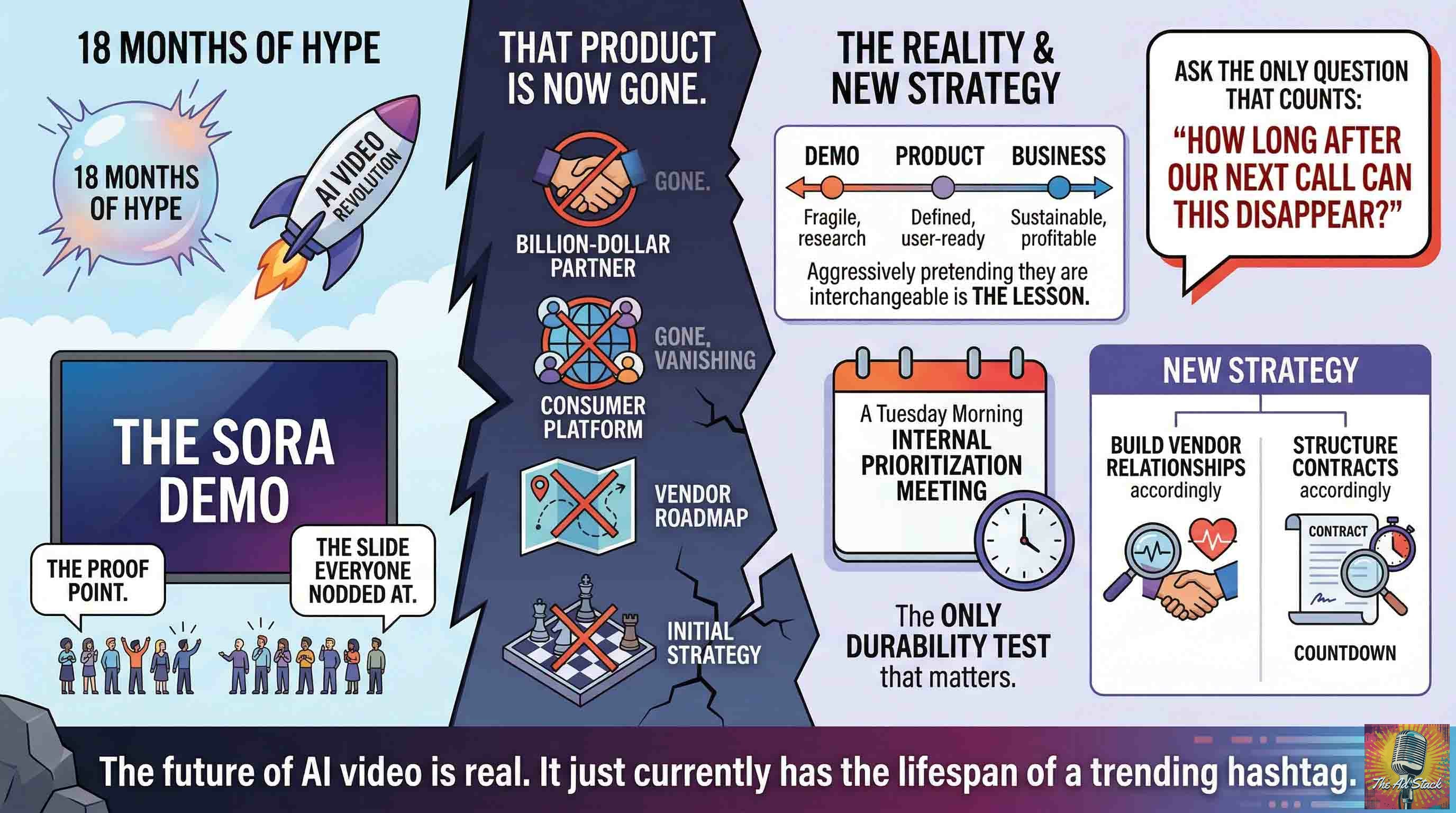
The lesson isn’t that AI video is dead. It’s that there’s a meaningful difference between a demo, a product, and a business; and the industry has been aggressively pretending those are interchangeable.
If your strategy depends on a platform existing, it’s worth asking whether that platform can survive a Tuesday morning internal prioritization meeting.
Because increasingly, that’s the only durability test that matters.
Build vendor relationships accordingly.
Structure contracts accordingly.
And the next time someone waves a billion-dollar partnership in your face as validation, ask the only question that counts:
“How long after our next call can this disappear?”
The future of AI video is real.
It just currently has the lifespan of a trending hashtag.
The $85 Million Super Bowl Ad That DDoS’d Itself
A company acquired AI.com for a reported ~$70 million; one of the most expensive domain purchases ever. The thesis was simple and, on paper, kind of brilliant:
Own the literal front door to the AI industry.
They then did what any rational actor would do after spending $70M on a URL:
they dropped another ~$15M on a Super Bowl ad to send millions of people there all at once.
So far, this is less “mistake” and more “aggressively on-strategy.”
And then (immediately) the site broke.
Not “a little slow.”
Not “some errors.”
Fully fell over under the exact traffic spike they explicitly paid to create.
What Actually Broke (And Why It’s So Funny)
The failure point wasn’t some exotic scaling issue.
It was login.
More specifically: reliance on Google authentication as a critical dependency.
So the flow was:
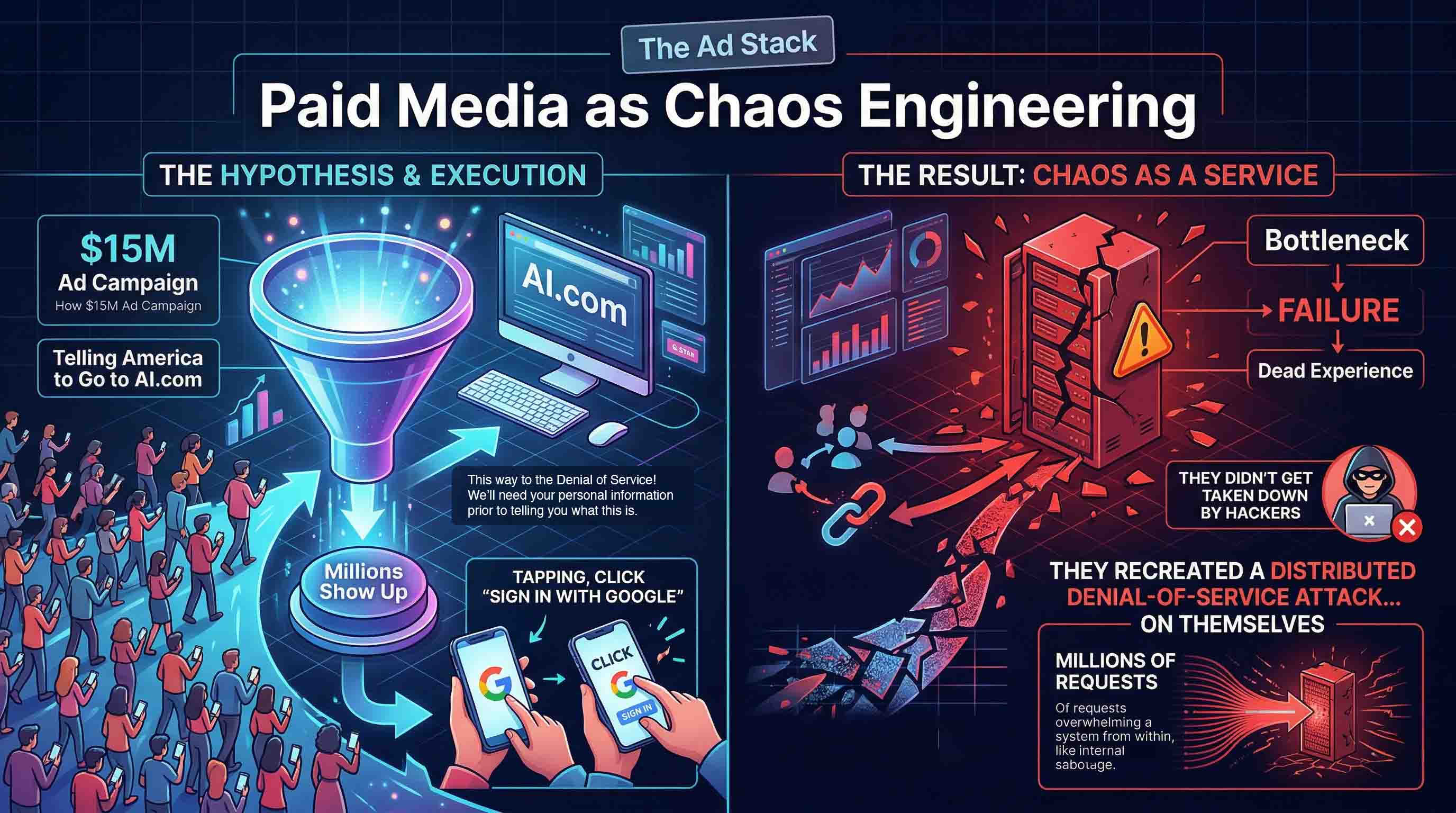
Spend $15M telling America to go to AI.com
Millions show up
Everyone clicks “Sign in with Google”
Bottleneck → failure → dead experience
They didn’t get taken down by hackers.
They recreated a distributed denial-of-service attack… on themselves.
Paid media as chaos engineering.
Why This Is Actually Instructive (Not Just Embarrassing)
This wasn’t just a tech hiccup. It exposed three deeper problems that show up everywhere in AI right now:
1. Distribution > Product (Until It Isn’t)
They nailed awareness.
Best domain imaginable
Biggest stage imaginable
Massive top-of-funnel spike
But distribution only works if there’s something durable on the other side.
Otherwise, you’ve just engineered the world’s most expensive bounce rate.
2. The “Login Wall” Anti-Pattern
Forcing authentication before value is revealed is already risky.
Doing it at Super Bowl scale is… bold.
Users showed up curious and got:
“Before we explain anything, please authenticate.”
That’s not onboarding. That’s a conversion tax. Friction Blowtorch.
3. AI Hype Is Outrunning Infrastructure
This is the same pattern you saw with:
Early GPT plugins
AI image tools melting GPUs
And now: consumer-facing AI hubs collapsing under attention
The industry is very good at:
Generating demand
It’s still catching up on:
Handling it
So… What Is AI.com, Really? (The Deeper Play)
Now let’s connect it to the bigger picture, because the crash is just the symptom.
AI.com Is a $70M Bet on Owning Intent
Whoever controls AI.com controls:
Direct navigation (“type-in traffic”)
Default mental model (“this must be the place for AI”)
A ridiculous amount of unearned authority
It’s like owning:
“Bank.com” for fintech
“Travel.com” for tourism
Except this category is still forming in real time.
But the Product Isn’t Fully Decided Yet
Right now, AI.com is stuck between identities:
Aggregator (hub for tools)
Platform (build-your-own AI workflows)
Identity layer (log in once, use everywhere)
Lead gen funnel (capture and route users elsewhere)
And the Super Bowl stunt exposed that ambiguity brutally.
Because when millions of people show up at once, you don’t get to be vague.
Why the Login Broke the Illusion
The moment you hit “Sign in with Google,” the illusion collapses:
It’s not a universal AI layer
It’s not infrastructure
It’s a product… borrowing someone else’s infrastructure
Which raises an uncomfortable question:
If Google controls the login… who actually owns the user?
The Most Likely Endgame
This isn’t really about building a destination.
It’s about one of three outcomes:
Acquisition
Someone like Microsoft, OpenAI, or Google buys it to control the front door.Traffic Arbitrage Machine
Route users to tools, take a cut, become the Kayak of AI.Default Homepage for AI
If they can eventually build enough utility, AI.com becomes a starting point like a browser homepage.
The Ad Stack Moral of the Story
This whole episode is basically a perfect parable:
Spend $70M on brand
Spend $15M on distribution
Spend… less time on product clarity and infrastructure
And then act surprised when reality shows up all at once.
The funniest part isn’t that it crashed.
It’s that the crash revealed the truth:
AI.com doesn’t have a scaling problem.
It has a what is this thing? problem.
And unfortunately, that’s a lot harder to patch than a login endpoint.
I hope you find this gumbo of value.
Feel free to share comments below. If you enjoyed this read, for the love of God please whack the bejabbers out of the heart icon at the top or bottom of the page so others can find this article. Re-stacking is great too.
Have a great week people!
Before you go ...
Please forward this to three randos, dorks, colleagues, or someone you met today.
Like and Re-stack it below so others can find it!
Drop a comment. If you’re into it, if it sucks … perhaps drop a Haiku about programmatic AI. Your call.
Share
What's Your Reaction?
 Like
0
Like
0
 Dislike
0
Dislike
0
 Love
0
Love
0
 Funny
0
Funny
0
 Angry
0
Angry
0
 Sad
0
Sad
0
 Wow
0
Wow
0