91. The New Agency of Today!
Or at least for a short while.

Welcome to Edition 91!!!
The Ad Stack is now ranked #7 in the Satire category and # 7 in Advertising per Inbox Reads.
This week: The New Agency of Today
1. Who’s winning inside agencies
2. Who’s quietly screwed
3. What clients will demand next
AI did not flatten agencies.
It sorted them.
What looks like a general acceleration is actually a quiet redistribution of power. Some people are becoming indispensable. Others are discovering that their relevance was attached to a process that no longer exists. Clients, watching all of this unfold in real time, are already recalibrating what they expect and who they are willing to pay.
This is not a future state. It is already happening inside the building.
1. Who’s Winning Inside Agencies
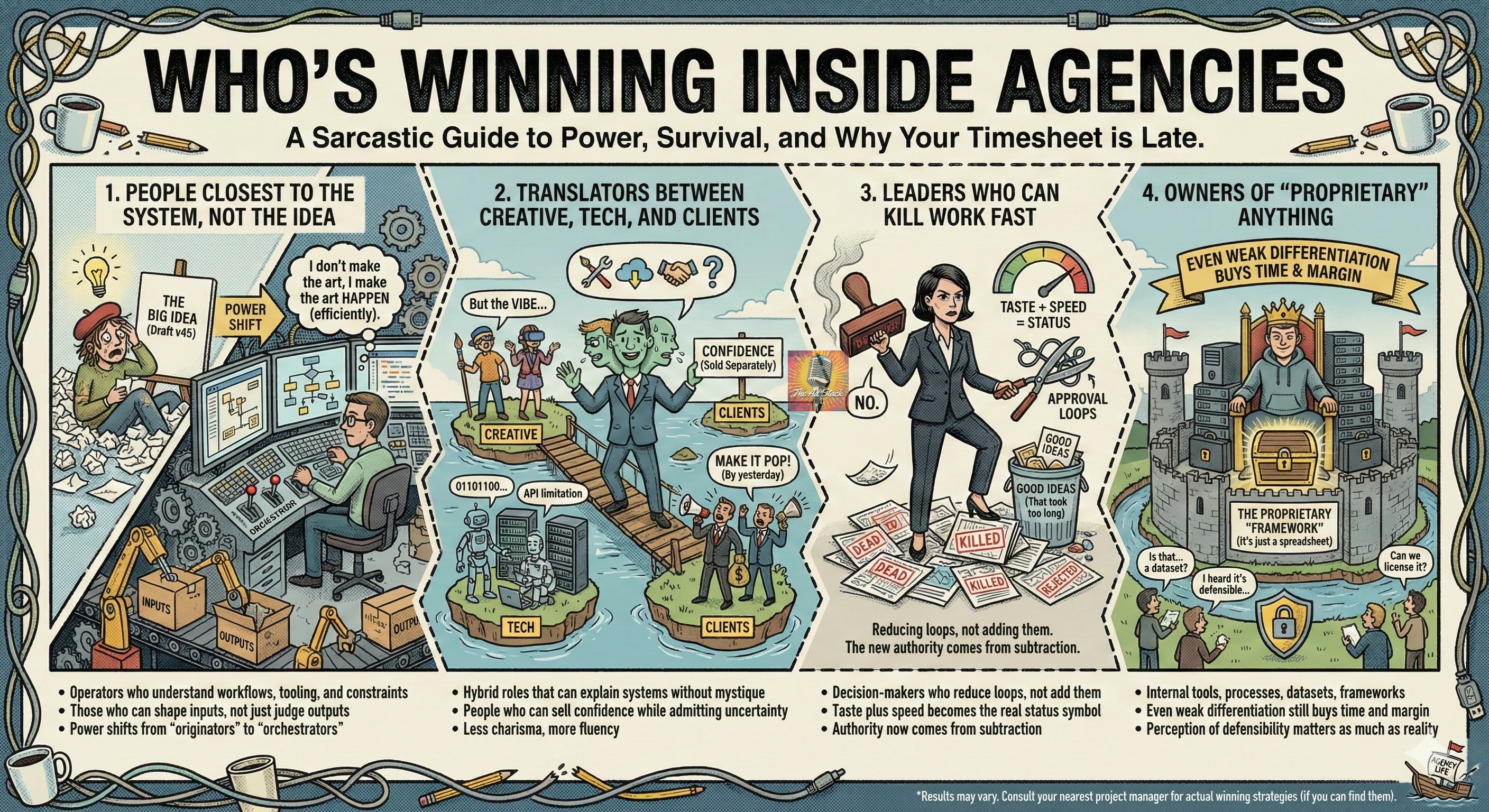
Anyone who understands how work actually moves now has leverage. Not in theory. In practice. These are operators who know how tools connect, where decisions get made, and how inputs shape outputs. They do not romanticize ideas. They shape conditions. They decide what the machine sees and what it never touches.
The winners are not the loudest creatives or the most visionary leaders. They are the people closest to the system.
Power has shifted away from originators toward orchestrators.
The person who can frame the problem cleanly now matters more than the person who can generate the most interesting response to it.
Closely related are the translators.
People who can move between creative, technical, and commercial language without mystifying any of it. They can explain what the system does, what it cannot do, and why the output looks the way it does. They do not oversell certainty, but they do sell confidence. That combination is suddenly rare and highly valued.
Then there are leaders who can kill work quickly.
Speed alone is no longer impressive. Everyone has speed. What stands out now is subtraction. The ability to look at ten viable options and remove nine without ceremony. Taste plus decisiveness has become a form of authority. Not because it feels good, but because it keeps things moving without hiding behind process.
Finally, anyone who owns something that looks proprietary is winning, even if it barely is.
Internal tools. Custom workflows. Datasets. Frameworks with names. The actual defensibility matters less than the perception of it. In a world where output is cheap, anything that appears hard to replicate buys time, margin, and credibility. Agencies understand this, which is why so many of them are suddenly describing themselves like software companies while insisting they are not one.
2. Who’s Quietly Screwed
The people in trouble are not being laid off first. They are being ignored.
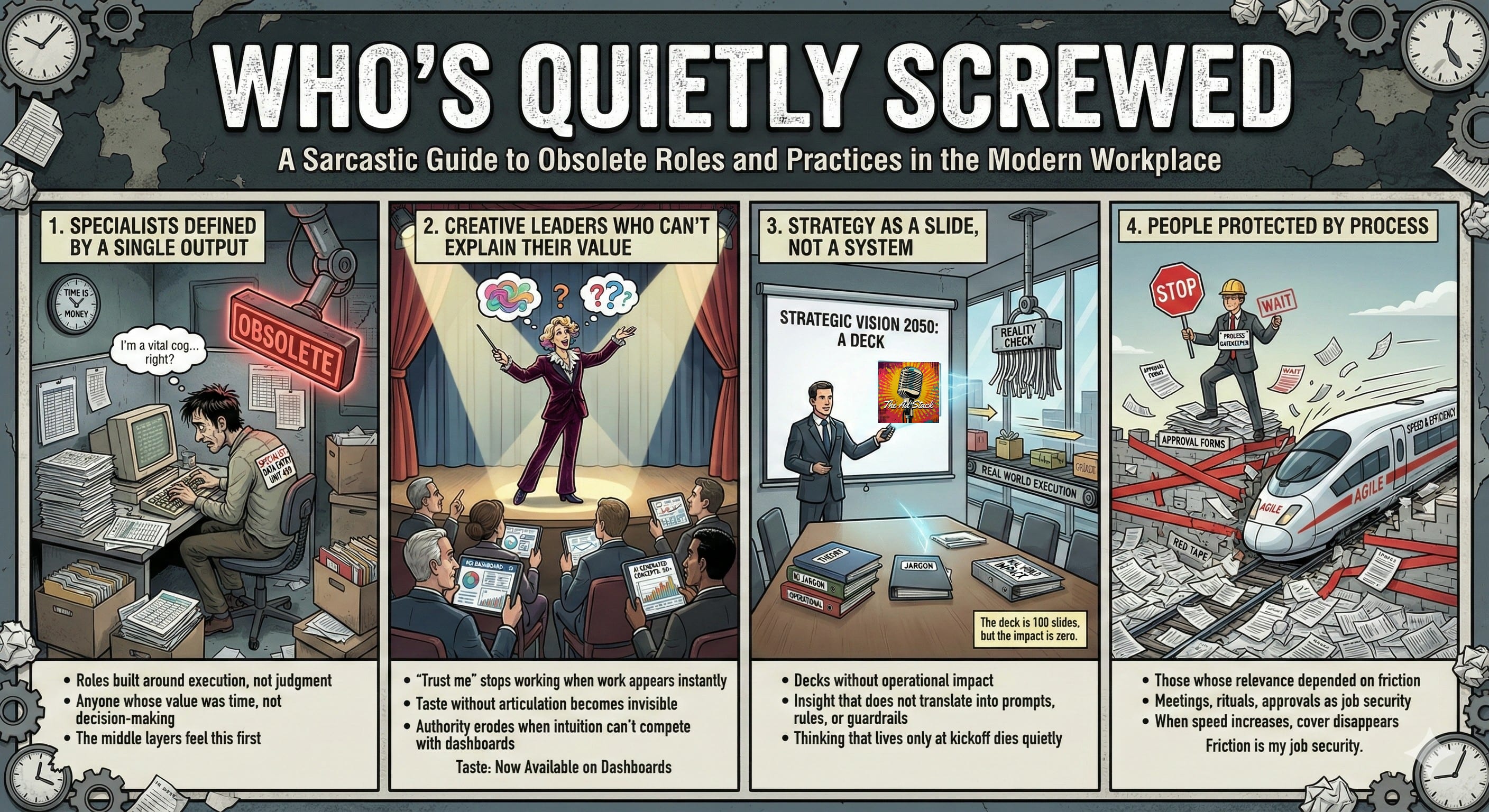
Specialists whose value was defined by a single output are feeling it already.
Roles built around execution rather than judgment lose gravity when execution becomes abundant. This does not hit the top or the bottom first. It hits the middle. The layer that once translated time into value now has less to translate.
Creative leaders who cannot explain their value are also exposed.
Intuition alone does not survive contact with instant output. When work appears in hours, “trust me” stops working as a leadership strategy. Taste still matters, but only if it can be articulated and defended in the same language clients now use to evaluate everything else.
Strategy is another quiet casualty, especially when it exists only as slides.
Insight that does not turn into rules, constraints, prompts, or decisions dissolves quickly. Thinking that lives at kickoff but never touches the system becomes ceremonial. Strategy that cannot operate inside the machine is treated as decoration, even if it is smart.
Then there are the people who were protected by process.
Meetings. Rituals. Review cycles. Layers of approval. Four account people because that’s how we’ve always done it. For a long time, friction created safety. It absorbed accountability and justified headcount. When speed increases, that cover disappears. The work shows up faster, and so does the question of who actually decided anything.
No announcement is made. The org chart just starts to feel thinner.
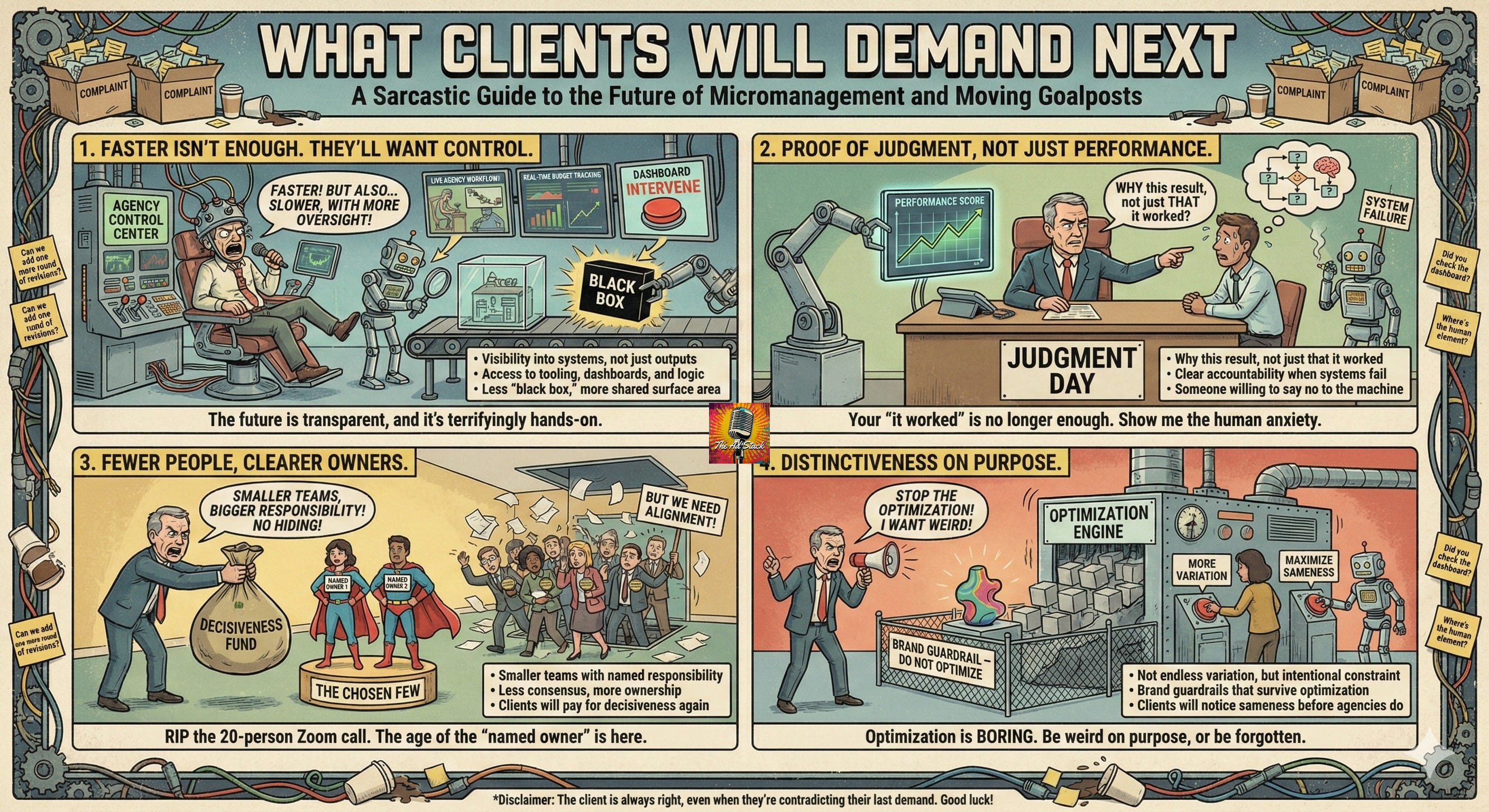
3. What Clients Will Demand Next
Clients have already seen what speed looks like. That novelty is gone. Faster is no longer enough.
What they want next is control.
Not control over every decision, but visibility into how decisions happen. They want access to the systems producing the work. Dashboards. Logic. Guardrails. Less black box. More shared surface area. If the agency cannot explain how the machine works, the client will eventually decide they should own it themselves.
They will also demand proof of judgment, not just performance.
“It worked” is no longer a satisfying answer. Clients will ask why it worked, why this output was chosen over others, and who is accountable when optimization produces something technically effective but strategically wrong. Someone will need to say no to the machine, and mean it.
Clients will also push for fewer people with clearer ownership.
Large teams made sense when time was the constraint. When output is instant, coordination becomes the bottleneck. Clients will prefer smaller groups with named responsibility over sprawling teams with shared accountability. They will pay for decisiveness again, because indecision is now the most expensive thing in the room.
Finally, they will demand distinctiveness on purpose.
Endless variation stops feeling impressive when everything starts to blur together. Clients will notice sameness before agencies do. They will want constraint, not abundance. Clear brand boundaries that survive optimization instead of dissolving inside it. The agency that can design those boundaries and enforce them will stand out quickly.
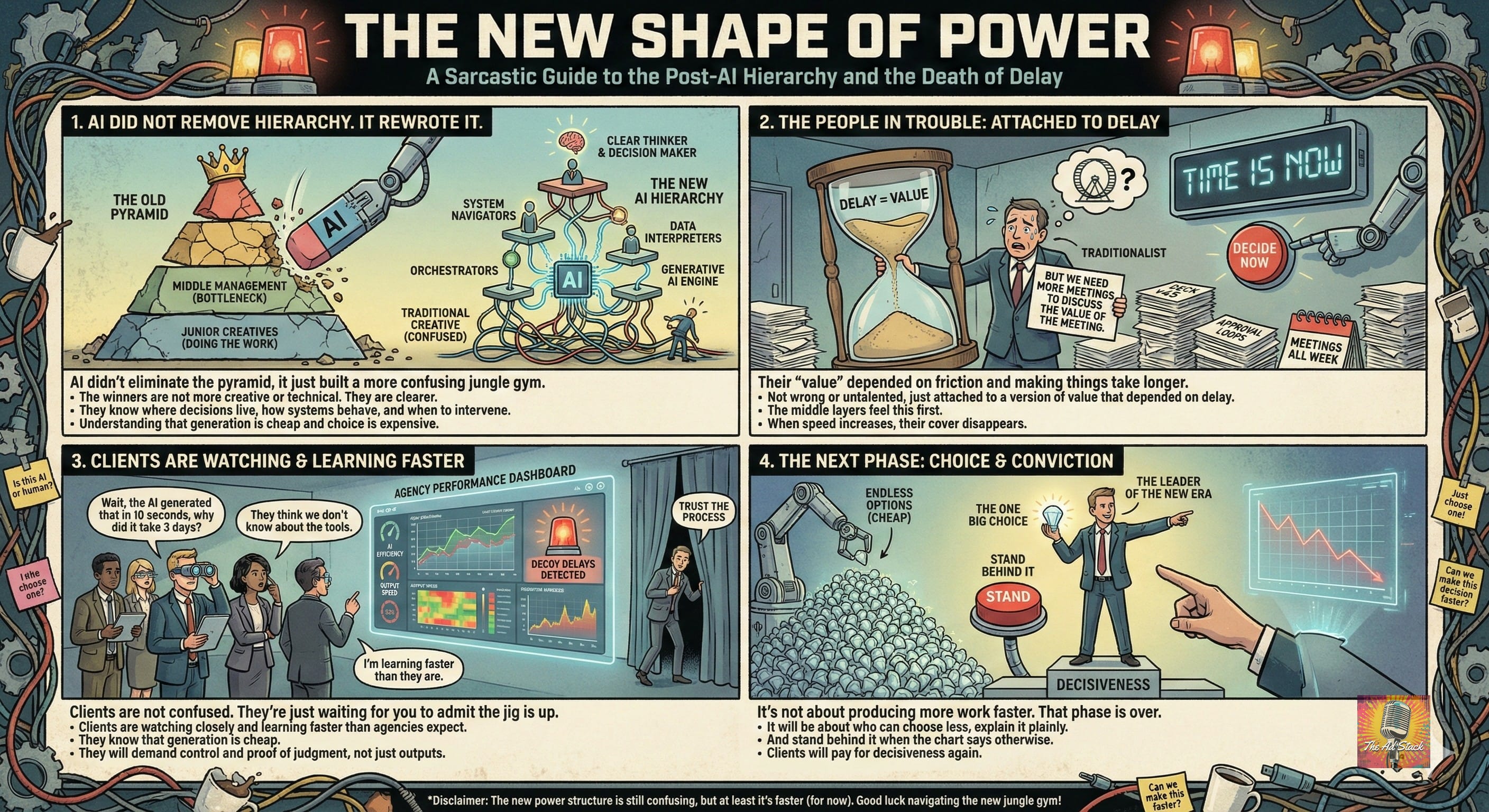
The New Shape of Power
AI did not remove hierarchy inside agencies. It rewrote it.
The winners are not necessarily more creative, more technical, or more visionary. They are clearer. They know where decisions live, how systems behave, and when to intervene.
They understand that generation is cheap and choice is expensive.
The people in trouble are not wrong or untalented. They are simply attached to a version of value that depended on delay.
Clients are not confused about this. They are watching closely. They are learning faster than agencies expect.
The next phase will not be about who can produce more work, faster. That phase is already over.
It will be about who can choose less, explain it plainly, and stand behind it when the chart says otherwise.
I hope you find this mumbo jumbo of value.
Feel free to share comments below. If you enjoyed this read, for the love of God please whack the bejabbers out of the heart icon at the top or bottom of the page so others can find this article. Re-stacking is great too.
Have a great week people!
Before you go ...
Please forward this to three randos, dorks, colleagues, or someone you met today.
Like and Re-stack it below so others can find it!
Drop a comment. If you’re into it, if it sucks … perhaps drop a Haiku about programmatic AI. Your call.
Share
What's Your Reaction?
 Like
0
Like
0
 Dislike
0
Dislike
0
 Love
0
Love
0
 Funny
0
Funny
0
 Angry
0
Angry
0
 Sad
0
Sad
0
 Wow
0
Wow
0